

Getting a government job in Assam is a dream that lakhs of young aspirants chase every single year. And if you are one of them, you already know that the Assam Direct Recruitment Exam is one of the biggest opportunities the state government offers. The real question, though, is this, can you actually crack ADRE in 3 months if you start right now?
The honest answer is yes, absolutely. Cracking ADRE in 3 months is more than enough time to cover the syllabus, practice thoroughly, and walk into the exam hall with real confidence. But only if you follow a structured plan and stay consistent. So, let us get into exactly how you do that. Before you begin, make sure you go through the latest ADRE 3.0 Notification 2026 to understand the exam pattern, syllabus, and important updates.
Why 3 Months Is Enough for ADRE Preparation

Before jumping into the plan, it helps to understand why three months actually works for this exam. The ADRE syllabus, while broad, is not impossible to cover. The subjects, General Knowledge, English, Mathematics, Reasoning, and Social Studies, are topics most candidates have already studied at the school level. The Grade IV syllabus stays within the Class 8 and Class 10 levels, while Grade III covers up to the bachelor’s degree level, depending on the post.
This means you are not learning entirely new concepts from scratch. Instead, you are revisiting familiar ground with sharper focus and exam-specific practice. Additionally, the exam is MCQ-based and conducted on OMR sheets, which means the format itself is straightforward. Planning for ADRE in 3 months, when approached smartly, gives you more than enough time to build a strong foundation, sharpen your accuracy, and revise everything at least twice before the exam day. For structured preparation, you can explore ADRE Online Coaching to get expert guidance and a clear study roadmap.
Understanding the ADRE Exam Pattern Before You Start
One of the biggest mistakes candidates make is jumping into preparation without understanding the exam structure. Knowing the pattern saves you time and keeps your preparation targeted. So before you open a single book, take a good look at what the exam actually looks like.
For Grade III posts at the bachelor’s degree level, the exam has 6 sections. The total paper includes 125 questions worth 1 mark each, and 25 questions from Reading Comprehension and English language that carry 2 marks each. The exam runs for 3 hours and takes place in offline mode on OMR sheets.
For Grade III at the HSSLC level, the exam has 5 sections, and for Grade IV posts, the pattern aligns with the HSLC or Class 8 level, depending on the candidate’s educational background.
One crucial detail that every aspirant must remember is that there is a negative marking system in place. For every wrong answer to a 1-mark question, you lose 0.25 marks. For every wrong answer to a 2-mark question, you lose 0.50 marks. This makes accuracy just as important as speed, and it completely changes how you should approach the paper. Blind guessing can hurt your score, so your three-month plan must include deliberate accuracy training alongside speed practice.
Month 1 — Building the Foundation
The first month of your 3 months study plan is all about getting the basics solid. Think of this phase as laying bricks. If the base is weak, nothing you build on top of it will stand.
Weeks 1 and 2—General Knowledge and Assam GK
Start your preparation with general knowledge because it is the subject that carries the most weight and also takes the longest to build. Begin with current affairs, read a newspaper daily, even if it is just 30 minutes in the morning. The Assam Tribune is a great choice since it covers both national news and Assam-specific developments, which matters a great deal for this exam.
After current affairs, move into static GK. Cover Indian history, geography, polity, and economy using NCERT books from Class 6 to Class 10. These books cover the syllabus thoroughly without overloading you with unnecessary detail. Spend dedicated time on Assam-specific GK, the state’s history, culture, important rivers, political developments, geography, and famous personalities. Assam GK often decides the final cutoff, so treat this section with extra seriousness. For structured preparation, you can also consider ADRE Coaching at Majestic Academy.
Week 3 — Mathematics and Quantitative Aptitude
In the third week, shift your primary focus to mathematics. Work through the basics first, percentages, ratios, profit and loss, simple and compound interest, time and work, pipes and cisterns, and number systems. For Grade III candidates, also add permutation and combination, and probability to the mix.
The key to Maths is practice. Reading theory without solving problems does not help. Set aside at least 1 to 1.5 hours every day exclusively for Maths during this week. Use NCERT Class 8 to 10 books as your base, and then move to a standard competitive exam guide for extra practice sets.
Week 4 — Reasoning and English
The fourth week of your first month should go towards Reasoning and English. For Reasoning, focus on the topics that appear most frequently in ADRE: logical deduction, number series, statement and conclusion, embedded figures, verbal reasoning, and statement and assumption. These topics are straightforward once you practice them enough.
For English, cover the grammar fundamentals, spotting errors, sentence correction, phrase replacement, idioms and phrases, fill in the blanks, and reading comprehension. Since the Reading Comprehension section in Grade III carries 2 marks per question, give it extra attention. Practice comprehension passages daily, even short ones, to build speed and accuracy.
Month 2 — Deep Practice and Subject Mastery
By the time the second month of your 3 month plan begins, you have a basic understanding of all subjects. Now the goal shifts from learning to doing. This phase is entirely about practice, mock tests, and identifying weak areas.
Weeks 5 and 6 — Previous Year Papers and Topic-Wise Practice
Start solving the ADRE previous year question papers from week 5. Go through each paper carefully—not just to get the right answers, but to understand the pattern of questions, the difficulty level, and the type of language the exam uses. Pay attention to which topics repeat across years, because those are the ones the exam setters clearly love.
After each paper, note down the areas where you made mistakes or felt uncertain. Then go back to those specific topics and practice them harder. This targeted approach saves time and makes your preparation much more efficient than simply reading through the syllabus again from start to finish.
Week 7 — Full Mock Tests Under Timed Conditions
From week 7 onwards, start taking full-length mock tests under real exam conditions. Sit down for the full duration, put your phone away, and time yourself strictly. This is important because the ADRE exam gives you 3 hours for 150 to 200 questions, depending on your grade level. Managing that time well, knowing when to move on, when to attempt, when to skip, is a skill you build only through repeated practice.
After each mock test, spend equal time reviewing it. Look at what you got wrong, why you got it wrong, and what the correct reasoning or formula was. Treat review sessions as seriously as the tests themselves, because that is where the real learning happens.
Week 8 — Assam GK Revision and Current Affairs Update
Dedicate the eighth week to refreshing your Assam GK and updating your current affairs. A lot changes over a few weeks in terms of news, appointments, government schemes, and state developments. Make sure your current affairs notes are up to date. Also, review your Assam history and culture notes from month one, because this is a section where many candidates either score very well or very poorly, there is rarely a middle ground.
Month 3 — Revision, Speed, and Final Polish
The third and final month of your ADRE in 3 months journey is not the time to start new topics. Instead, use it to tighten everything you have already built.
Week 9 and 10 — Subject-Wise Revision
Go back through each subject systematically. Revise your formula sheets for Maths, your grammar rules for English, your important dates and facts for GK, and your reasoning shortcuts. Keep your revision notes short and punchy, the kind of notes you can go through in 30 minutes right before the exam.
At the same time, continue taking mock tests every two to three days. By now, your speed should be improving noticeably. If it is not, identify whether the slowdown is coming from a specific subject and work on that area more aggressively.
Week 11 — Negative Marking Strategy
Spend at least a few days in the eleventh week developing a clear strategy for handling negative marking. Since wrong answers cost you 0.25 marks for 1-mark questions and 0.50 marks for 2-mark questions, you cannot afford to attempt every question blindly. The general rule is this, only attempt a question if you are at least 60 to 70 percent sure of the answer. If you are completely unsure, skip it.
Practice this strategy in your mock tests. Learn to distinguish between questions you know, questions you partially know, and questions you are completely guessing on. This mental discipline can easily add 10 to 15 marks to your final score, and in a competitive exam, that margin often makes the difference between getting selected and missing out.
Week 12 — Final Revision and Exam Readiness
The last week is for final revision and mental preparation. Go through all your short notes one more time, especially for GK, Assam-specific topics, and English grammar. Attempt one full mock test every two days to keep your timing sharp. Avoid starting any new topic during this week, it creates unnecessary confusion and stress.
Also, during this final week, make sure your exam logistics are sorted. Know your exam centre, plan your travel, keep your admit card ready, and get at least 7 to 8 hours of sleep every night. A well-rested brain performs significantly better than a sleep-deprived one, and that is a preparation tip many candidates unfortunately ignore.
Subject-Wise Tips to Score Better in ADRE
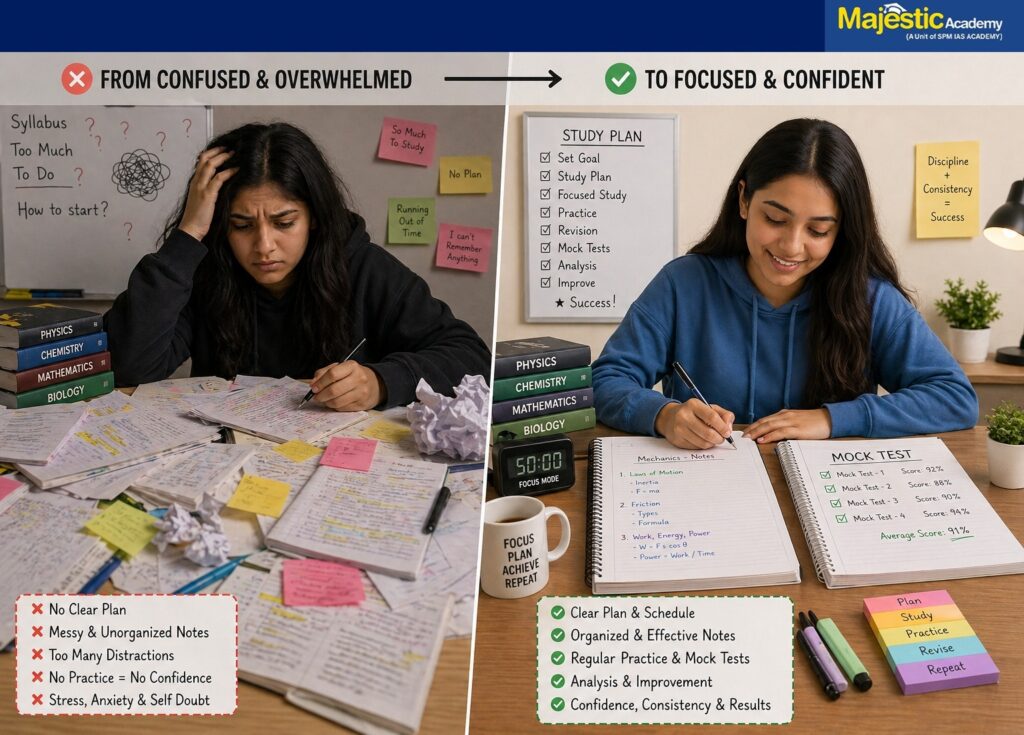
Beyond the monthly plan, here are some focused tips to help you score higher in each subject when you prepare for ADRE in 3 months. These pointers work best when you combine them with consistent daily study rather than treating them as last-minute hacks; Consistency beats cramming. Spending 45 minutes daily on current affairs over three months gives you far more retention than reading 10 hours the night before the exam. For Assam GK, make a dedicated notebook with facts, dates, and key events, and revisit it every week.
For English, reading comprehension is your highest-value section in Grade III. Practice at least one passage every day from day one. For grammar, focus on error spotting and sentence correction, as these topics appear the most frequently in ADRE papers.
For mathematics, never skip the basics. Even if you are a graduate-level candidate, the exam tests core concepts, and a shaky foundation in basics will cost you marks. Practice time-bound sets to build calculation speed.
For reasoning, shortcuts and pattern recognition matter more than deep theory. Once you practice enough previous-year questions, you start spotting patterns, and the section becomes very manageable within the allotted time.
Conclusion
Preparing for ADRE in 3 months is completely achievable when you approach it with a clear plan, honest self-assessment, and consistent daily effort. The exam rewards candidates who cover the syllabus methodically, practice with real papers, build accuracy alongside speed, and understand the negative marking system well enough to use it to their advantage.
Month one builds your foundation across all subjects. Month two deepens your practice through previous papers and timed mock tests. Month three tightens everything through targeted revision, strategy refinement, and final readiness. Each phase has a clear purpose, and each week has a specific focus so that you never waste time wondering what to study next when following a 3 months approach.
So, start today, stay consistent, and trust the process. Three months from now, after following this 3 months plan faithfully, you could be walking out of that exam hall knowing you gave it everything you had and that is exactly the kind of preparation that turns aspirants into government employees.
Frequently Asked Questions
What is the ADRE Syllabus 2025?
The ADRE 2025 syllabus covers five core subjects, General Knowledge and Current Affairs, General English, Quantitative Aptitude or Mathematics, Reasoning Ability, and Social Studies. The depth of each subject varies depending on the grade level of the post. Grade IV posts follow an elementary and HSLC-level syllabus, while Grade III posts at the HSSLC and bachelor’s degree levels go deeper into each subject, with additional sections like computer knowledge for certain posts. Within general knowledge, the exam covers Indian history, geography, polity, economy, current national and international affairs, culture, and a strong focus on Assam-specific topics, including the state’s geography, history, and political developments. The English section covers grammar rules, reading comprehension, idioms and phrases, error spotting, and sentence formation. For candidates aiming at Grade III posts, the reading comprehension questions carry 2 marks each, making this one of the highest-value sections in the paper.
What is the selection process for ADRE Recruitment 2025?
The selection process for Assam Direct Recruitment 2025 runs in two main stages. First, candidates appear for the written examination, which is an MCQ-based, OMR-answer-sheet test conducted offline. Once the written exam results come out, shortlisted candidates then go through a skill test or interview, depending on the nature of the post they applied for. For technical posts, the skill test evaluates specific competencies like typing, computer operations, or driving, while for other posts, an interview assesses the candidate’s personality, communication, and overall suitability for the role. The final merit list combines scores from both stages, and the Assam government’s reservation policies for SC, ST, OBC, and PwD candidates apply throughout the process.
Is there any negative marking for ADRE 2025?
Yes, the ADRE 2025 exam does carry negative marking, and every candidate must factor this into their exam strategy right from the preparation stage. For every wrong answer to a question carrying 1 mark, 0.25 marks get deducted from your total score. For every wrong answer to a question carrying 2 marks, the deduction is 0.50 marks. This means careless or random guessing can significantly damage your final score. The safest approach is to attempt a question only when you are reasonably sure of the answer and to skip questions where you have no idea rather than taking an uninformed guess. Building this habit during mock tests over your three-month preparation period will help you develop the discipline needed to handle negative marking effectively on exam day.