
When people think about SSC CGL, the first thing that comes to mind is the exam itself, the competition, the preparation, the result. But what happens after you clear the exam is just as important, and honestly, not enough people talk about it. The SSC CGL promotion hierarchy is one of the strongest reasons why this exam attracts millions of aspirants every single year. The career growth it offers, from an entry-level government post all the way up to senior administrative positions, is structured, transparent, and genuinely rewarding if you stay focused throughout your service.
This article gives you the full picture of the SSC CGL promotion hierarchy, department by department, post by post, with real salary figures, timelines, and strategies so you can make smart decisions about your career right from Day 1. If you’re serious about cracking the exam and want structured guidance, then choosing the right preparation platform becomes very important. To make your preparation smoother and more focused, you can explore this SSC CGL Course and understand how it can support your journey.
SSC CGL 2026 — Key Career Information at a Glance
Before getting into the promotion structure, here is a quick overview of the 2026 cycle so you have all the basics in one place.
| Career Growth Details | Information |
| Notification Date | March 31, 2026 |
| Application Period | March 31 to April 30, 2026 |
| Starting Pay Level | Pay Level 4 to Pay Level 8 |
| Promotion Prospects | Up to Group A Officer Level |
| Career Span Growth | Pay Level 4 to Pay Level 12+ |
| Official Website | ssc.gov.in |
SSC CGL 2026 gives selected candidates the opportunity to grow from entry-level posts all the way to Group A gazetted officer positions through departmental promotion exams and time-bound promotions. The career progression typically leads to pay level 10 to 12 positions within 10 to 15 years of service, which is a very strong trajectory for a government career.
Understanding the SSC CGL Promotion Hierarchy: How It Works
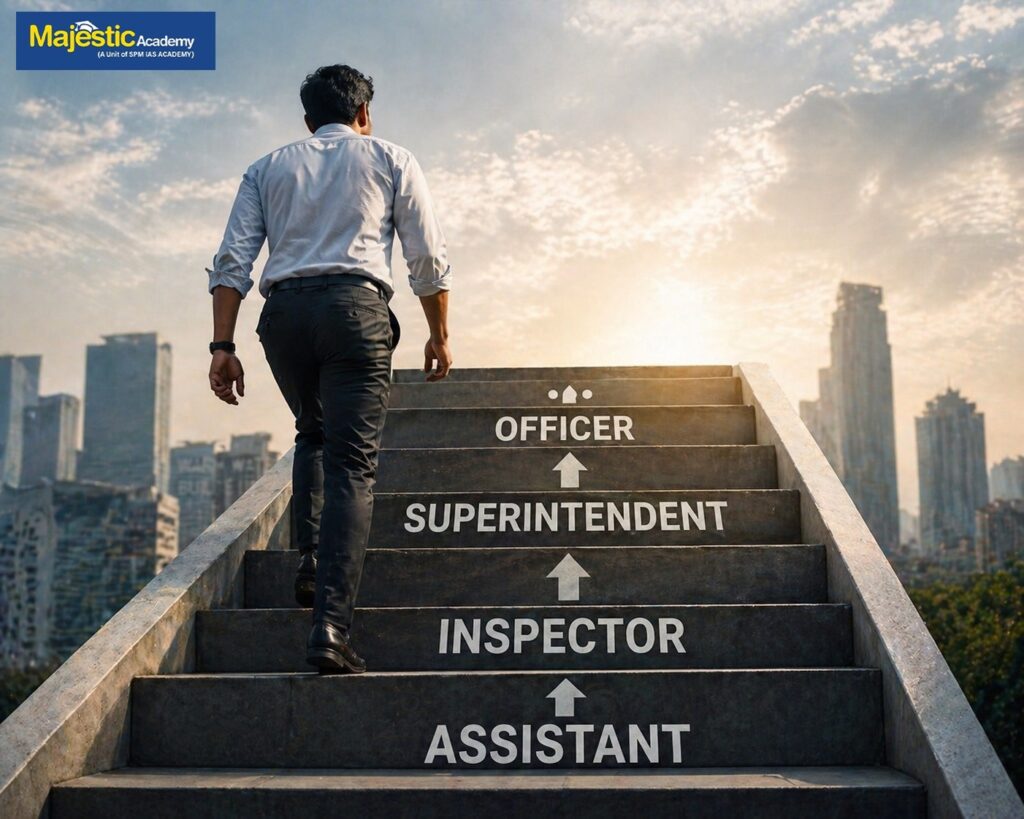
The SSC CGL promotion hierarchy does not work the same way across all departments. Each post comes with its own promotion routes, timelines, and eligibility conditions. However, the overall framework follows a well-defined progression path.
Group B posts like Assistant Section Officer and Income Tax Inspector come with direct promotion routes to Group A gazetted positions. Group C positions, such as Tax Assistant and Upper Division Clerk, also offer structured advancement, though the timelines are a bit longer. Most promotions across departments happen through three main channels, departmental promotion exams, merit-based selections, and time-bound career advancement schemes implemented by the respective ministries.
So, the SSC CGL promotion hierarchy is not a one-size-fits-all structure. It depends on which post you join and which department you serve in. Let us look at each major department separately. If you are preparing seriously and want structured guidance, you can also explore professional support options. For complete preparation guidance, check out SSC CGL Coaching to boost your chances of success.
Department-Wise Career Growth Under SSC CGL Promotion Hierarchy
Income Tax Department Career Progression
The Income Tax Department is one of the most sought-after departments for SSC CGL candidates, and for good reason. The promotion path here is clear and well-defined.
An income tax inspector joins at pay level 7 and can reach the position of assistant commissioner at pay level 11 through departmental exams. The typical timeline for the first major promotion is around 8 to 10 years of service.
A tax assistant, on the other hand, starts at pay level 4. Through consistent performance and departmental exams, a tax assistant can advance to income tax officer at pay level 10 within 12 to 15 years. After that, further growth leads to Assistant Commissioner and even Deputy Commissioner positions with more years of experience.
Central Excise and Customs Career Growth
The Inspector of Central Excise post starts at Pay Level 7 and offers excellent growth prospects. Through departmental exams and merit-based selections, an inspector can move up to superintendent at pay level 11 and then to the assistant commissioner level. This department also offers field posting opportunities across India, along with specialized training programs and foreign deputation opportunities at senior positions.
Ministry Departments Career Ladder
The Assistant Section Officer role in various ministries starts at Pay Level 6. From there, the growth route moves to a section officer at pay level 10 and then onward to undersecretary positions. Promotions here are merit-based and happen through regular departmental exams. The Upper Division Clerk, meanwhile, advances to Assistant Section Officer through internal promotions and can reach senior administrative positions with experience and strong performance records.
SSC CGL Post-Wise Promotion Data
Here is the post wise promotion data to make your understanding better. Have a look
| Post Name | Starting Pay Level | Promotion To | Timeline |
| Assistant Section Officer | Pay Level 6 | Section Officer (PL-10) | 8–10 years |
| Income Tax Inspector | Pay Level 7 | Asst. Commissioner (PL-11) | 10–12 years |
| Tax Assistant | Pay Level 4 | Income Tax Officer (PL-10) | 12–15 years |
| Inspector (Central Excise) | Pay Level 7 | Superintendent (PL-11) | 8–10 years |
| Upper Division Clerk | Pay Level 4 | Assistant (PL-6) | 10–12 years |
This table gives you a quick snapshot of where each post begins and where it can take you. The SSC CGL promotion hierarchy is fairly consistent within each department, but the speed of growth depends heavily on how actively you prepare for departmental exams and how your performance appraisals look over the years. If you are exploring other SSC career options and want to compare roles, responsibilities, and growth opportunities, it’s also helpful to look at similar recruitment updates. For example, you can check the detailed guide on SSC Stenographer Recruitment to understand eligibility, exam pattern, and career scope. This will give you a broader perspective before making your final preparation strategy.
How Promotions Actually Happen — Three Main Methods
Departmental Promotion Exams
Most SSC CGL posts offer promotions through departmental competitive exams, commonly known as DCEs. These exams are conducted annually or once every two years by the respective departments. They test subject knowledge, administrative skills, and understanding relevant to the higher position being applied for.
To appear for these exams, candidates need a minimum service experience of 5 to 8 years. The selection is purely merit-based, with written tests and sometimes a personal interview. Officers who take these exams seriously and prepare consistently tend to climb the SSC CGL promotion hierarchy much faster than those who do not.
Time-Bound Promotions
Several posts under SSC CGL also offer automatic grade advancements after a candidate completes specific service periods. These promotions bring pay scale increases without necessarily changing your designation, but they do provide steady financial growth even if you are not actively competing through exams.
Time-bound promotions typically happen after 4 years, 9 years, and 13 years of service. This ensures that even officers who do not clear departmental exams still see some upward movement in their pay and career over time.
Merit-Based Selection
Some departments also conduct merit-based promotions where your Annual Performance Appraisal Report, commonly called APAR or ACR, plays the deciding role. Training certifications, special assignments completed, and notable achievements during service also factor into this. Officers who maintain excellent performance records consistently get fast-track promotions and access to specialized assignments and advanced training programs, which further fuel their career growth.
Post-Wise Detailed Career Progression

Assistant Section Officer Career Path
An assistant section officer enters at pay level 6 and, through departmental exams and merit, advances through the following stages:
- Assistant Section Officer — Pay Level 6, entry-level position
- Section Officer — Pay Level 10, typically after 8 to 10 years of service
- Under Secretary — Pay Level 11, usually after 15 to 18 years
- Deputy Secretary — Pay Level 12, after 20 to 25 years of service
- Director or Joint Secretary — Senior positions at the top tier
Income Tax Inspector Growth Timeline
An income tax inspector starts strong and moves through a well-defined ladder:
- Income Tax Inspector — Pay Level 7, starting position
- Assistant Commissioner — Pay Level 11, after clearing the departmental exam
- Deputy Commissioner—Pay Level 12, through merit-based promotion
- Joint Commissioner — Pay Level 13, senior management role
- Commissioner level — Top-tier positions after sustained performance
Tax Assistant Career Advancement
The Tax Assistant begins lower on the pay scale but still has a solid progression path:
- Tax Assistant — Pay Level 4, initial appointment
- Senior Tax Assistant — Pay Level 5, through time-bound promotion
- Income Tax Officer — Pay Level 10, through departmental exam
- Assistant Commissioner — Pay Level 11, further advancement
- Senior positions — Continued growth within the Income Tax Department
Salary Progression and Financial Growth
The promotion hierarchy directly translates to significant salary growth over a career. Here is what the numbers typically look like at different stages:
| Career Stage | Pay Level | Approximate In-hand Salary | Service Period |
| Entry Level | PL-4 to PL-8 | Rs 35,000 – Rs 55,000 | 0–5 years |
| Mid Career | PL-8 to PL-10 | Rs 60,000 – Rs 85,000 | 5–12 years |
| Senior Level | PL-11 to PL-12 | Rs 90,000 – Rs 130,000 | 12–20 years |
| Top Positions | PL-13 to PL-14 | Rs 140,000 – Rs 200,000 | 20+ years |
Starting salaries range from around Rs 35,000 to Rs 50,000 per month, and they grow to Rs 80,000 to Rs 150,000 at senior levels. Each promotion also brings better allowances, improved perquisites, and, in some departments, official accommodation and vehicle facilities. So, the financial rewards grow alongside the designation. If you want a clearer idea about the detailed pay structure and benefits, you can also explore the complete SSC CGL Salary 2026 breakdown for better understanding.
Training and Skill Development Opportunities
Government departments give SSC CGL officers access to extensive training programs throughout their careers. Right from induction training at the start, these programmes extend to specialized skill development courses and leadership development workshops at senior levels.
Training opportunities span both domestic institutes, like ISTM (Institute of Secretariat Training and Management) and NIFM (National Institute of Financial Management) and international courses and foreign deputation assignments. Completing advanced training programs often opens the door to accelerated promotions, making it worth taking these seriously rather than treating them as routine obligations.
Beyond these, digital literacy programs, e-governance training, and policy implementation workshops run regularly across departments to keep officers up-to-date with modern administrative practices.
Lateral Movement and Deputation Opportunities
One thing that the SSC CGL Promotion Hierarchy often does not get enough credit for is the flexibility it offers through lateral transfers and deputations.
SSC CGL officers can apply for lateral transfers to different departments based on available vacancies and departmental requirements. This gives you exposure to different work environments without losing your pay scale or promotion eligibility. Deputation opportunities to international organizations, state governments, and public sector undertakings are also available to experienced officers and these assignments can significantly strengthen your overall career profile.
Inter-ministry transfers further allow officers to gain specialized experience in different sectors while maintaining their existing pay levels and future promotion prospects intact.
Your Career Strategy: Inspector Track vs Assistant Track
Understanding the Promotion Hierarchy also means understanding which track suits your long-term goals better.
Go for Inspector posts if: You want to reach Commissioner-level positions at Pay Level 13 or 14 before retirement. Career growth speed matters more to you than posting stability. You are willing to invest time in preparing for departmental exams over the years. You want faster salary progression and higher terminal benefits at retirement.
Go for Assistant posts if: Work-life balance throughout your career is a priority. You prefer stable Delhi postings, especially through the Central Secretariat Service, over frequent transfers. A steadier, seniority-based progression suits your personality better. You accept that the terminal position is typically around pay level 10 as a reasonable trade-off for that stability.
The financial reality: Inspector-track officers earn approximately Rs 60 to 80 lakh more over a 35-year career compared to assistant-track officers when you account for pay scale differences, allowances, and terminal benefits. However, inspector posts also come with higher job stress, frequent transfers, and the need for continuous skill upgradation. Neither track is wrong, it depends on what you value more.
Your SSC CGL rank determines your initial post allocation, but your departmental exam performance determines your career ceiling. Officers who stop preparing after clearing the exam and treat government jobs as fully settled tend to plateau at middle management. Those who actively appear for DCEs, maintain excellent ACRs, and seek challenging postings consistently reach senior positions with significantly better retirement benefits.
Retirement Benefits and Long-Term Security
The SSC CGL posts do not stop rewarding you when you retire. SSC CGL posts come with comprehensive retirement benefits, including pension through the New Pension Scheme, gratuity, and lifetime medical facilities.
The Group Insurance Scheme and medical reimbursement facilities extend to family members, giving complete healthcare coverage both during service and after retirement. Leave encashment, pension computed on the highest pay drawn during service, and annual pension increments together ensure a comfortable post-retirement life for officers across all levels.
Conclusion
The SSC CGL promotion hierarchy is not just a chart of designations, it is a real roadmap for building a meaningful and financially rewarding career in government service. From Pay Level 4 all the way up to Pay Level 14, the growth is structured, transparent, and achievable for anyone willing to put in the work at every stage. So, understand the promotion hierarchy for your specific department and post, build a long-term strategy from Day 1, and treat your government career the same way you treated your exam preparation with focus and genuine effort. The ladder is already there. You just need to keep climbing.
Frequently Asked Questions
Q1. What is the maximum salary I can reach through the SSC CGL Promotion Hierarchy?
Inspector-track officers who stay consistent throughout their careers can reach the Commissioner level, which falls at Pay Level 14 with a base salary of Rs 144,200. With a dearness allowance and other allowances added, the monthly take-home works out to Rs 1.8 lakh and above. Assistant-track officers, on the other hand, typically max out around the undersecretary or deputy secretary level, which falls between Pay Level 10 and Pay Level 11, with base salaries ranging from Rs 56,100 to Rs 78,800. These figures do not include retirement benefits, commissioners receive significantly higher gratuity and pension compared to deputy secretary-level officers. So the terminal position you reach directly affects not just your working salary but also what you take home in retirement.
Q2. Are promotions in SSC CGL guaranteed or entirely performance-based?
The answer sits somewhere in the middle, and the stage of your career you are at determines which side matters more. Initial promotions, like Inspector Grade II to Grade I or Assistant to Senior Assistant are nearly guaranteed through seniority after clean service of 5 to 8 years. However, once you aim for Superintendent and above, things change. Reaching those levels requires either clearing departmental competitive exams or maintaining outstanding annual confidential reports year after year. Beyond the assistant commissioner level, promotions become quite selective, only about 20 to 30 percent of officers reach deputy commissioner, and fewer than 5 percent make it to the commissioner rank before retirement. So, lower promotions are fairly secure, but climbing the upper rungs of the SSC CGL Promotion Hierarchy demands active effort.
Q3. Can an Assistant-level SSC CGL candidate eventually reach the same positions as an Inspector-level candidate?
Technically, yes, but in practice, it is difficult. An assistant-track officer can clear the Limited Departmental Competitive Exam, which is known as the LDCE, to jump to inspector-equivalent positions. However, success rates through the LDCE are below 10 percent, and the number of opportunities each year is limited. Even after clearing the LDCE, these officers are typically 8 to 10 years behind direct inspector-entry officers in the career timeline. Most assistant-track officers realistically plateau around the section officer or under secretary level, which falls between Pay Level 7 and Pay Level 10. Inspector-track officers, by contrast, routinely reach Pay Level 12 and Pay Level 13. Both tracks have genuine value, but if reaching top-level positions matters deeply to you, the Inspector route is the more practical path within the promotion hierarchy.
Majestic Academy is a trusted coaching institute offering result-oriented SSC Coaching, Banking Coaching, and ADRE Coaching for competitive exam aspirants. Serving students across Guwahati and Assam, we provide structured preparation with expert faculty, updated study materials, and regular mock tests. Our specialized RRB Coaching in Guwahati helps railway exam candidates build strong fundamentals and gain exam confidence. We also offer focused TET Coaching in Guwahati for aspiring teachers with concept-based learning and exam-oriented guidance. At Majestic Academy, we are committed to quality education, clear mentoring, and consistent student success.
