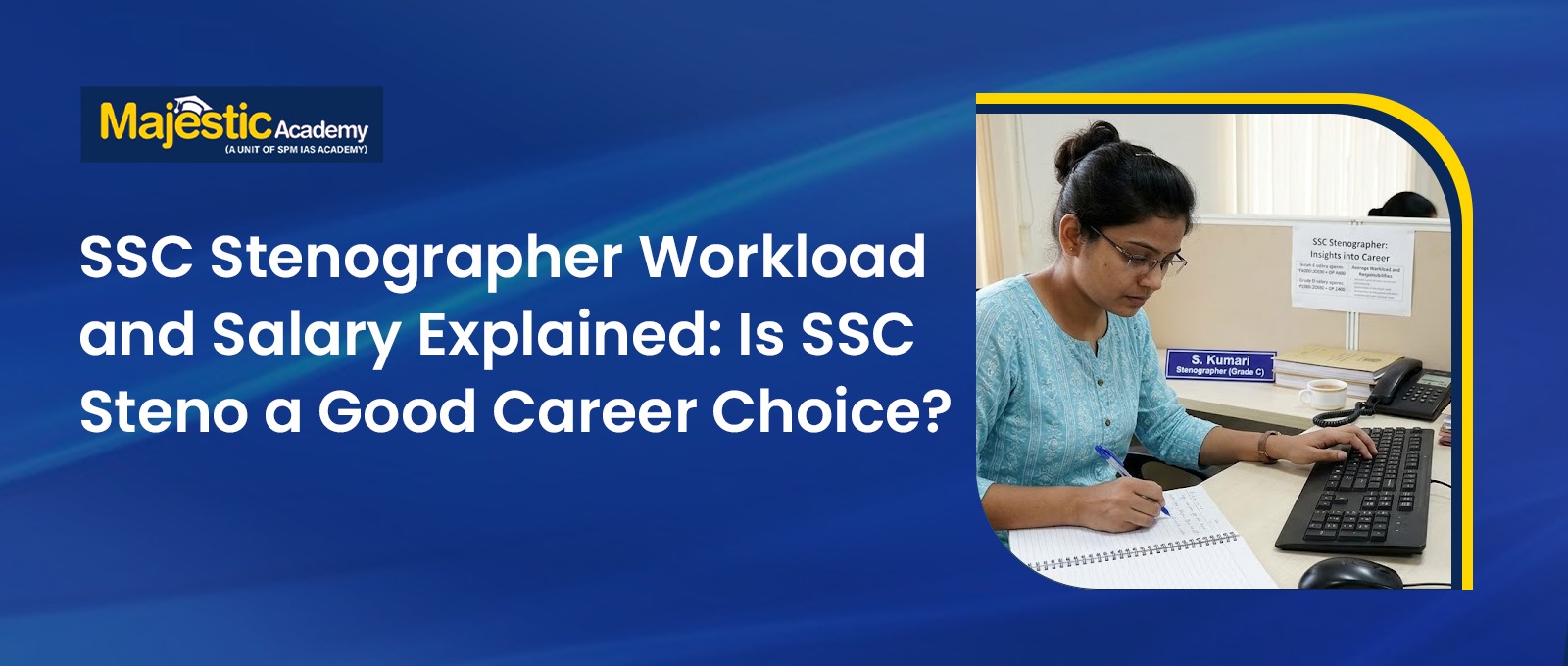
If you cleared Class 12 and want a stable central government job without a graduation degree, SSC Stenographer is one of the best options on the table. The SSC Stenographer workload and salary combination is genuinely attractive, the pay is solid for a 12th-pass position, the work environment is a regular government office, and the daily responsibilities are manageable without being overwhelming. But is it the right career for you? That depends on what you are looking for, and this blog gives you everything you need to decide.
This guide covers the SSC Stenographer workload and salary in full detail, Grade C vs Grade D pay, complete duty breakdown, work environment, stress levels, promotion path, and a clear verdict on whether SSC Steno is a good career choice in 2026. Proper guidance and exam-focused preparation can help SSC aspirants improve their chances of success. Students looking for expert support can join SSC CGL Coaching In Guwahati for structured learning and better preparation.
What Is the SSC Stenographer Salary in 2026?
The 7th Pay Commission governs the SSC Stenographer salary structure and includes Basic Pay, dearness allowance (DA), house rent allowance (HRA), and travel allowance (TA). The final in-hand salary depends on your grade and the city of your posting.
Grade D Stenographer:
- Basic Pay: Rs. 25,500 per month (Pay Level 4)
- Monthly In-Hand Salary: Approximately Rs. 36,000 to Rs. 43,000 after all allowances are added
Grade C Stenographer:
- Basic Pay: Rs. 44,900 to Rs. 47,600 per month (Pay Level 6 or Pay Level 7)
- Monthly In-Hand Salary: Approximately Rs. 50,000 to Rs. 65,000 after all allowances are added
Here is a quick salary comparison:
| Grade | Pay Level | Basic Pay | Approximate In-Hand Monthly |
| Grade D | Level 4 | Rs. 25,500 | Rs. 36,000 – Rs. 43,000 |
| Grade C | Level 6 / 7 | Rs. 44,900 – Rs. 47,600 | Rs. 50,000 – Rs. 65,000 |
Beyond the monthly salary, SSC Stenographers also receive central government benefits, including medical coverage under CGHS, pension through NPS, paid annual leave, and gratuity on retirement. When you add these up, the total package is stronger than the basic salary figure alone suggests. Preparing for SSC exams with the right guidance can make a significant difference in understanding the syllabus, improving skills, and building confidence. Candidates looking for expert support and structured preparation can join Best SSC Coaching In Guwahati to get proper guidance from experienced mentors and follow an effective learning approach.
What Is the Difference Between Grade C and Grade D Stenographer?
Understanding the SSC Stenographer workload and salary difference between Grade C and Grade D is important before you target either post. Here is a clear comparison:
| Factor | Grade C | Grade D |
| Level | Higher | Entry Level |
| Work Assigned By | Senior Officers and Department Heads | Department Officers |
| Responsibility Level | Higher | Moderate |
| Confidential Work Exposure | More frequent | Limited |
| Administrative Exposure | Greater | Basic |
| Promotion Scope | Faster | Gradual |
Grade C stenographers work directly with senior administrative officers and carry greater responsibility, including handling sensitive and confidential communications. Grade D is the entry-level position and serves as the starting point for most SSC Stenographer recruits, from where they eventually grow to Grade C through promotions. For candidates planning a career in government services, understanding salary structure, allowances, and career growth opportunities is an important part of exam preparation. You can also check the detailed information about AJS Salary 2026 to understand the pay scale and benefits associated with higher administrative positions.
What Does an SSC Stenographer Actually Do Every Day?
The SSC Stenographer workload and salary discussion is incomplete without a real picture of the daily work. Here is a detailed breakdown of all the core duties:
1. Taking Dictation
This is the most central responsibility of an SSC Stenographer. Officers dictate during meetings, briefings, and official discussions, and the stenographer records everything in shorthand with complete accuracy. This includes recording speeches, capturing meeting notes, writing down instructions from senior officers, and preparing official transcripts.
2. Transcribing Official Documents
After taking shorthand dictation, stenographers type out the content into formal documents. This includes typing official letters, preparing reports, drafting notes for government files, preparing circulars for distribution, and creating other official records. Accuracy is non-negotiable here because every transcribed document becomes part of the official government record.
3. Assisting Senior Officers
Stenographers work closely alongside the officers they are assigned to and provide daily operational support. This includes managing appointment schedules, preparing meeting agendas, handling correspondence on the officer’s behalf, and drafting notes. Grade C stenographers especially work directly with senior administrative personnel who hold more authority.
4. Managing Office Documentation
File management and record maintenance are regular parts of the job. Stenographers help maintain documentation systems, organize physical and digital files, manage document storage, and ensure that records are filed correctly so the office runs smoothly.
5. Handling Official Communication
SSC stenographers also act as communication coordinators within their offices. They handle official emails, manage incoming and outgoing letters, coordinate between departments, and distribute communications to the right recipients on time.
6. Meeting and Conference Support
When senior officers attend meetings or conferences, stenographers accompany them to record discussions. This involves preparing meeting notes, recording agenda items, writing minutes of the meeting, and documenting action points for follow-up.
7. Administrative Support Duties
Beyond documentation and communication, stenographers also perform broader administrative tasks. These include office coordination, event scheduling, arranging travel logistics for senior officers, and providing general logistics support to the department.
8. Handling Confidential Information
This responsibility is more prominent in Grade C. Stenographers regularly access confidential government documents and sensitive official communications. Maintaining strict confidentiality, handling classified documents with care, and managing secure document storage are all part of the role, especially at the Grade C level.
Where Do SSC Stenographers Work?
The work environment plays a big role in the overall SSC Stenographer workload experience. SSC Stenographers work in:
- Central government ministries
- Government departments and attached offices
- Secretariat offices at various levels
- Offices under various central government bodies
These are standard government office environments with fixed working hours, typically 9:30 AM to 6:00 PM on weekdays with Saturday and Sunday off. The atmosphere is formal but structured, and most stenographers describe the day-to-day environment as professional and predictable rather than fast-paced or pressured. You can also check the detailed information about SSC CGL Salary 2026 to understand the expected in-hand salary, pay level, and other benefits available after selection.
What Skills Do You Need to Succeed as an SSC Stenographer?
The SSC Stenographer workload and salary package comes with specific skill expectations. The core skills required are:
- Shorthand: The exam requires shorthand speed at 80 words per minute for Grade D and 100 words per minute for Grade C. This is the most unique and non-negotiable skill for this post.
- Typing: Accurate and fast typing is equally essential since transcription forms a large part of daily work.
- Communication: Clear written and verbal communication helps in drafting notes, managing correspondence, and coordinating across departments.
- Accuracy: Every document a stenographer produces becomes an official record. Errors can have real administrative consequences, so a high accuracy standard is expected at all times.
What Is the Career Growth Path for SSC Stenographers?
Beyond the immediate SSC Stenographer workload and salary benefits, the promotion ladder offers meaningful long-term growth. Grade D stenographers who perform consistently and clear departmental requirements move up to Grade C. From Grade C, the path continues upward through Personal Assistant (PA), Private Secretary (PS), and eventually Senior Private Secretary (SPS) roles in some departments.
The promotions are time-bound in the early years and performance-linked in the later stages. Grade C stenographers with strong performance records and favorable Annual Confidential Reports move faster through the promotion ladder than those who coast through their service years without active engagement.
Is SSC Stenographer a Good Career Choice?
When you put the full SSC Stenographer workload and salary picture together, the answer for the right candidate is clearly yes.
For a 12th-pass candidate who wants central government job security, a salary ranging from Rs. 36,000 to Rs. 65,000 per month depending on grade and experience, fixed working hours, no public dealing pressure, and a structured career path, SSC Stenographer checks every important box.
It is especially well-suited for candidates who:
- Have strong shorthand and typing skills and genuinely enjoy administrative work
- Want a stable government career without spending 3 to 4 more years on a graduation degree
- Prefer a desk-based job with predictable hours over field-based enforcement roles
- Want a career that leaves space for personal life without constant overtime pressure
It may not be the right fit for candidates who want rapid financial growth, very high starting salaries, or roles that involve a lot of field interaction and variety in daily work.
Conclusion
The SSC Stenographer workload and salary combination is one of the most balanced packages available to 12th-grade pass candidates in the central government recruitment system. Grade D starts you at Rs. 36,000 to Rs. 43,000 per month; Grade C moves you up to Rs. 50,000 to Rs. 65,000; and the work itself, dictation, transcription, documentation, office coordination, and officer support, is structured, predictable, and manageable without excessive pressure. If shorthand and typing are skills you enjoy or are willing to develop, and if a stable desk-based government career with fixed hours sounds right for your goals, SSC Stenographer workload and salary is a combination that genuinely delivers. Go after it with confidence, it is a solid career choice for the right candidate. Proper guidance and regular practice play an important role in cracking the SSC Stenographer exam. Students can get expert support and structured preparation through SSC Stenographer Coaching in Guwahati to improve their skills and exam readiness.
Frequently Asked Questions
Is the SSC stenographer job stressful?
The SSC Stenographer role carries a moderate and generally manageable workload. The work is desk-based with fixed office hours and does not involve the kind of field pressure or public enforcement that higher-grade SSC Inspector posts carry. The actual stress level depends on which officer you are assigned to and how busy their schedule is, but for most postings, the work stays comfortably within office hours.
Does an SSC stenographer deal with confidential documents?
Yes, handling confidential documents is part of the SSC stenographer role, especially at the Grade C level. Stenographers regularly transcribe sensitive official communications, handle classified files, and are expected to maintain strict confidentiality at all times. Grade D roles have limited exposure to classified material, while Grade C stenographers deal with it more frequently as they work directly with senior officers.
What skills are required for an SSC stenographer?
The core skills needed are shorthand at 80 words per minute for Grade D and 100 words per minute for Grade C, accurate typing, clear written and verbal communication, and a high level of accuracy in document preparation. Every document produced by a stenographer becomes an official government record, so precision is not optional, it is a fundamental part of the job.

Majestic Academy is a trusted coaching institute offering result-oriented SSC Coaching, Banking Coaching, and ADRE Coaching for competitive exam aspirants. Serving students across Guwahati and Assam, we provide structured preparation with expert faculty, updated study materials, and regular mock tests. Our specialized RRB Coaching in Guwahati helps railway exam candidates build strong fundamentals and gain exam confidence. We also offer focused TET Coaching in Guwahati for aspiring teachers with concept-based learning and exam-oriented guidance. At Majestic Academy, we are committed to quality education, clear mentoring, and consistent student success.