Teaching is one of the most respected and socially impactful professions in India. If you aspire to become a teacher in a central government school, the CTET 2026 is your most important milestone. Conducted by the Central Board of Secondary Education (CBSE), the Central Teacher Eligibility Test (CTET) is a mandatory qualification for candidates aiming to teach in Kendriya Vidyalayas, Navodaya Vidyalayas, and other central government-aided schools across the country.
The CTET 2026 exam for the February session was officially conducted on 8 February 2026, making it one of the key national-level teaching eligibility exams.
For complete details, updates, and preparation guidance, check CTET exam date 2026.
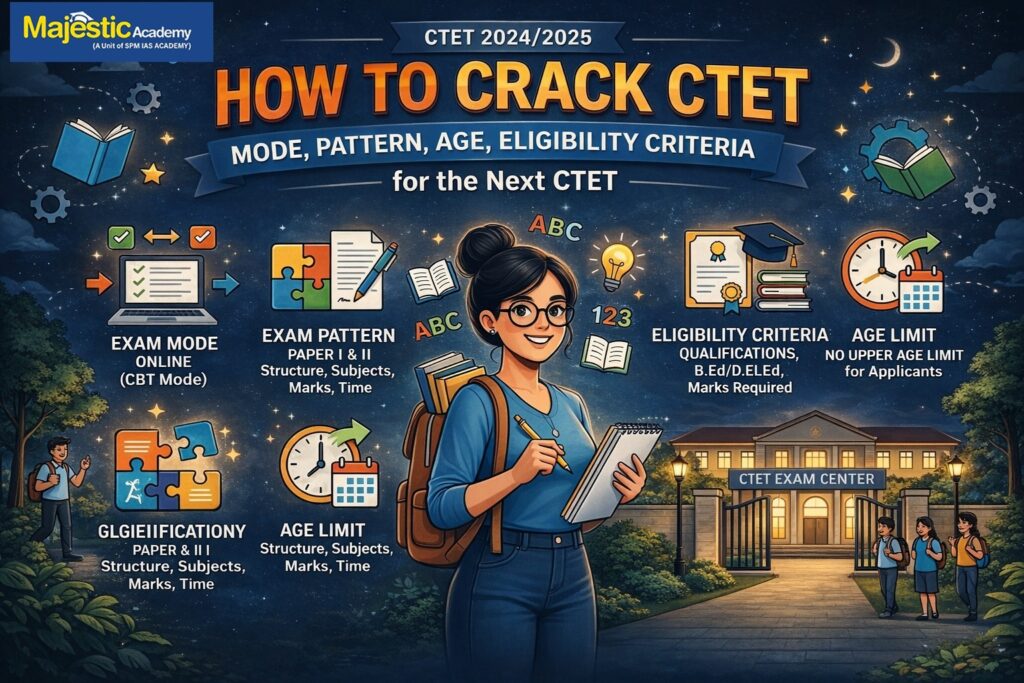
In this article, we will look into the CTET eligibility criteria for 2026, the CTET age limit, and the exam pattern of CTET. We will also discuss proven strategies on how to crack the CTET exam.
Key Highlights
| Detail | Info |
| Exam Name | Central Teacher Eligibility Test (CTET) 2026 |
| Conducting Body | Central Board of Secondary Education (CBSE) |
| Mode of Exam | Offline – Pen & Paper (OMR-based) |
| Total Marks | 150 per paper |
| Duration | 150 minutes (2.5 hours) per paper |
| Negative Marking | None |
| Upper Age Limit | No upper age limit |
| Certificate Validity | Lifetime |
| Qualifying Marks | 60% (General) |
CTET Eligibility Criteria 2026
One of the first things every aspirant must confirm is whether they meet the CTET eligibility criteria 2026. The requirements differ based on which paper you are appearing for. For the latest updates and exam-related details, check CTET city intimation slip 2026.
Paper 1: For Teachers of Classes I to V (Primary Level)
To be eligible for CTET Paper 1, candidates must have completed or be in the final year of one of the following qualifications. For proper guidance and preparation, you can also explore CTET coaching Assam.
- Senior Secondary (Class 12 or equivalent) with at least 50% marks AND a 2-year Diploma in Elementary Education (D.El.Ed), OR
- Senior Secondary with at least 45% marks AND a 2-year Diploma in Elementary Education in accordance with the NCTE (Recognition Norms and Procedure) Regulations 2002, OR
- Senior Secondary with at least 50% marks AND a 4-year Bachelor of Elementary Education (B.El.Ed), OR
- Senior Secondary with at least 50% marks AND a 2-year Diploma in Education (Special Education), OR
- Graduation with at least 50% marks AND a 1-year Bachelor of Education (B.Ed).
Note for Reserved Category Candidates: SC/ST/OBC/PwD candidates receive a 5% relaxation in the minimum marks requirement, reducing the threshold from 50% to 45% wherever applicable.
Paper 2: For Teachers of Classes VI to VIII (Upper Primary Level)
For CTET Paper 2, candidates must have completed or be in the final year of one of the following qualifications. For official updates and preparation guidance, you can also visit Majestic Academy.
- Graduation with at least 50% marks AND a 2-year Diploma in Elementary Education (D.El.Ed), OR
- Graduation with at least 45% marks AND a 2-year Diploma in Elementary Education (as per NCTE Regulations 2002), OR
- Graduation with at least 50% marks AND a 1-year Bachelor of Education (B.Ed), OR
- Graduation with at least 45% marks AND a 1-year B.Ed from a recognized institution (as per NCTE Regulations), OR
- Senior Secondary with at least 50% marks AND a 4-year B.El.Ed, OR
- Senior Secondary with at least 50% marks AND a 4-year B.A.Ed/B.Sc.Ed.
5% Relaxation: As with Paper 1, a 5% concession in qualifying marks is extended to candidates belonging to SC, ST, OBC, and PwD categories.
Candidates may choose to appear for both Paper 1 and Paper 2 if they wish to be eligible to teach at both primary and upper primary levels.
CTET Age Limit & Nationality Requirements
1. Age Limit
One of the most candidate-friendly aspects of CTET 2026 is its liberal age policy:
- Minimum Age: 17 years (as per the requirement to have passed Senior Secondary)
- Maximum Age (Upper Age Limit): None. There is no upper age limit for appearing in CTET 2026. This makes the exam accessible to candidates of all age groups.
2. Nationality Requirements
Candidates must belong to one of the following categories:
- Indian Nationals
- Subjects of Nepal or Bhutan
- Tibetan refugees who came to India before January 1, 1962
- Persons of Indian origin who have migrated from Pakistan, Burma, Sri Lanka, East African countries of Kenya, Uganda, the United Republic of Tanzania, Zambia, Malawi, Zaire, Ethiopia, and Vietnam with the intention of permanently settling in India
All non-Indian nationals must produce an eligibility certificate issued by the Government of India.
CTET Exam Pattern 2026
Understanding the CTET exam pattern is fundamental to building an effective preparation strategy. Both papers are conducted in an offline, OMR-based format with no negative marking, making it crucial to attempt all questions confidently.
Paper 1 vs. Paper 2: Comparison Table
| Section | Paper 1 (Classes I–V) | Paper 2 (Classes VI–VIII) |
| Child Development & Pedagogy | 30 Questions – 30 Marks | 30 Questions – 30 Marks |
| Language I (Compulsory) | 30 Questions – 30 Marks | 30 Questions – 30 Marks |
| Language II (Compulsory) | 30 Questions – 30 Marks | 30 Questions – 30 Marks |
| Mathematics | 30 Questions – 30 Marks | 30 Questions – 30 Marks* |
| Environmental Studies (EVS) | 30 Questions – 30 Marks | — |
| Social Science/Social Studies | — | 30 Questions – 30 Marks** |
| Total | 150 Questions – 150 Marks | 150 Questions – 150 Marks |
| Duration | 150 Minutes | 150 Minutes |
For Paper 2, candidates opting for Mathematics & Science will answer the combined Mathematics + Science section (60 Questions – 60 Marks) instead of Social Science. For Paper 2, candidates opting for Social Studies/Social Science will answer the Social Science section (60 Questions – 60 Marks).
Key Exam Highlights
- Total Marks: 150 per paper
- Total Duration: 150 minutes (2.5 hours) per paper
- No Negative Marking, every attempt counts
- All questions are MCQ (Multiple Choice) with four options
- Medium of Exam: Available in 20+ languages, including Hindi and English
How to Crack CTET 2026: 5 Proven Strategies
So you know the eligibility and the exam structure now, the real question is: how to crack CTET? Here are five battle-tested strategies from toppers and educators:
1. Master NCERT Textbooks from Classes I to VIII
CTET 2026 is heavily NCERT-aligned. A large portion of the content in Environmental Studies, Mathematics, Social Science, and Language sections is directly drawn from NCERT textbooks of Classes I–VIII. Read them thoroughly, not just for facts, but for the pedagogical approach they use. Understanding how these books teach is as important as what they teach.
2. Prioritize Child Development & Pedagogy (CDP)
CDP carries 30 marks in both papers and is the differentiator between average and excellent scores. Concepts like Piaget’s theory of cognitive development, Vygotsky’s sociocultural theory, inclusive education, and learning disabilities are frequently tested. Allocate a minimum of 30–35% of your study time to CDP, as it is your most reliable scoring section.
3. Solve Previous Year Question Papers (PYQs) Religiously
At least 5–7 years of previous CTET question papers must be in your preparation arsenal. PYQs reveal recurring question types, frequently tested concepts, and the difficulty level. More importantly, they train your mind to identify the “CTET-style” of questioning. Aim to solve at least one full-length mock paper every week in the final two months.
4. Strengthen Both Language Sections
Many candidates overlook Language I and Language II, assuming they’re easy. However, these sections test grammar, reading comprehension, and language pedagogy — the last of which trips up many aspirants. Focus on language acquisition theories, error analysis, and principles of bilingual education alongside standard grammar rules.
5. Build a Consistent, Time-Bound Study Plan
Consistency beats intensity. Dedicate 4–5 hours daily for a minimum of 4–5 months. Break your schedule into subject-wise weekly goals: CDP in the first week, Language I and II in the second, Mathematics/EVS in the third, followed by revision and mock tests. Use apps, flashcards, and short notes for quick revision in the final weeks.
Final Thoughts: Your CTET 2026 Journey Starts Now
CTET 2026 is more than just a qualifying exam; it is the foundation of a fulfilling career dedicated to shaping the next generation of India. With no upper age limit, generous relaxation norms, and a lifetime-valid certificate, CBSE has designed CTET to be as inclusive and aspirant-friendly as possible.
The road to clearing CTET 2026 requires patience, consistency, and a deep understanding of both content and pedagogy. Whether you are just starting your preparation or are already midway through your studies, remember: every teacher who inspires a student today was once a student who refused to give up.
Begin your preparation today. Study smart, practice harder, and walk into the exam hall with confidence. Your classroom is waiting.
Frequently Asked Questions
Q1. What is the minimum qualifying mark for CTET 2026?
Candidates from the General category must score at least 60% (90 out of 150 marks) to qualify. Candidates belonging to reserved categories, SC, ST, and OBC, need a minimum of 55% (approximately 82 out of 150 marks) to qualify. Candidates with disabilities (PwD) also receive this relaxation.
Q2. Is there any change in the CTET 2026 exam mode?
As per the latest official updates, the CTET 2026 will continue to be conducted in Offline (Pen and Paper) OMR-based mode. Candidates will be required to mark their answers using a blue/black ballpoint pen on OMR sheets. No shift to online mode has been officially announced for 2026.
Q3. Can final-year B.Ed/D.El.Ed students apply for CTET 2026?
Yes, absolutely. Candidates who are appearing in or pursuing the final year of a recognized teacher training program (such as B.Ed, D.El. Ed, B.El. Ed, etc.) are eligible to apply for CTET 2026. However, they must submit proof of completing the program if selected for teaching positions subsequently.
Q4. What is the validity period of the CTET certificate?
In a landmark decision that benefited millions of teachers across India, the Ministry of Education declared that the CTET qualifying certificate now holds lifetime validity. You no longer need to reappear in CTET once you have qualified. Your certificate will remain valid permanently for eligibility purposes.
Majestic Academy is a trusted coaching institute offering result-oriented SSC Coaching, Banking Coaching, and ADRE Coaching for competitive exam aspirants. Serving students across Guwahati and Assam, we provide structured preparation with expert faculty, updated study materials, and regular mock tests. Our specialized RRB Coaching in Guwahati helps railway exam candidates build strong fundamentals and gain exam confidence. We also offer focused TET Coaching in Guwahati for aspiring teachers with concept-based learning and exam-oriented guidance. At Majestic Academy, we are committed to quality education, clear mentoring, and consistent student success.