
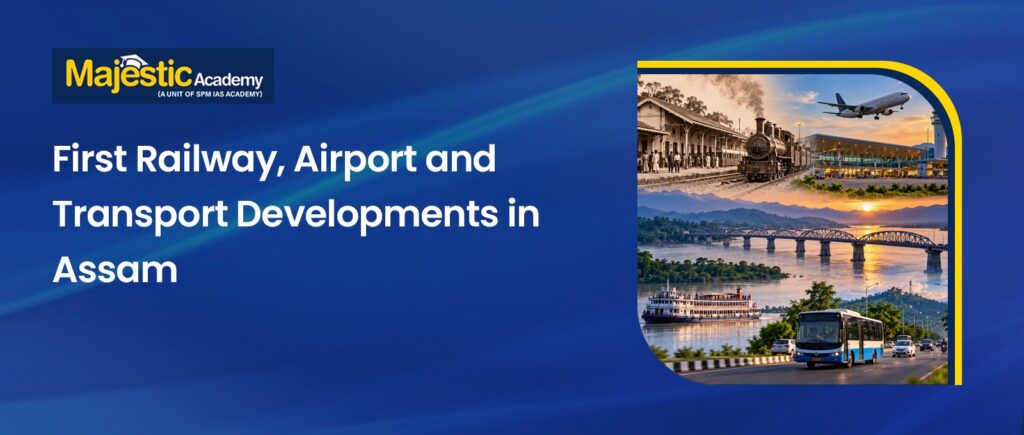
Assam has played an important role in connecting Northeast India with the rest of the country. Over the years, the state has witnessed major changes in railways, airports, roads and waterways. The transport developments in Assam began during the colonial period and gradually expanded with new railway lines, airports, highways, and inland water routes. These developments improved trade, tourism, movement of people and access to remote areas. Therefore, understanding the history of transport developments in Assam helps explain how the state’s present-day connectivity took shape.
How did transport develop in Assam for the first time?
The early transport developments in Assam were closely linked with the tea industry and the need to move tea, coal and other goods. During British rule, the authorities introduced railway connections to support commercial activities and improve access to the region. The railway network later became an important part of Assam’s transport system. At the same time, rivers such as the Brahmaputra supported boat and steamer services, while roads gradually connected important towns and administrative centres.
Major early transport developments
- Introduction of railway services in the 19th century
- Expansion of river-based transport through the Brahmaputra
- Development of roads connecting important towns
- Establishment of airports for regional connectivity
- Expansion of railway and road networks after Independence
What was the first railway development in Assam?
The first major transport developments in Assam included the introduction of railway services in the Dibrugarh region. The first railway line in Assam began operating in 1881, and the railway network expanded further in the following years.
Dibrugarh became an important railway centre because of its connection with the tea-producing areas of Upper Assam. Railway connectivity made it easier to transport tea and other goods while also improving passenger movement.
| Feature | Early railway development |
| Region | Upper Assam |
| Important centre | Dibrugarh |
| First railway service | 1881 |
| First railway station | Dibrugarh Town Railway Station |
| Main importance | Trade, tea transport and passenger movement |
Which railway stations became important in Assam?
As the network expanded, several railway stations and junctions gained importance. These transport developments in Assam helped connect major cities, industrial areas and remote parts of the state.
| Railway station | Importance |
| Dibrugarh Town | Historically associated with the first railway service in Assam |
| Guwahati Junction | Major railway gateway to Northeast India |
| Lumding Junction | Important railway junction connecting several routes |
| New Bongaigaon | Major railway and connectivity centre |
| Tinsukia | Important railway centre in Upper Assam |
Guwahati Junction later became one of the most important railway stations in the Northeast. Lumding also developed into a significant junction because several railway routes pass through the area.
How did airports change Assam’s connectivity?
The development of airports added another important chapter to the transport developments in Assam. Air connectivity allowed people to travel faster between Assam and other parts of India, particularly when long-distance road or rail journeys required more time. Lokpriya Gopinath Bordoloi International Airport in Guwahati became the state’s principal aviation hub. Other airports, including Dibrugarh, Jorhat, Silchar and Lilabari, strengthened regional air connectivity.
Important airports in Assam
- Lokpriya Gopinath Bordoloi International Airport, Guwahati
- Dibrugarh Airport
- Jorhat Airport
- Silchar Airport
- Lilabari Airport
- Tezpur Airport
- Rupsi Airport
Lilabari Airport, also known as North Lakhimpur Airport, is generally considered the smallest operational commercial airport in Assam. It has a compact terminal and serves regional air travel.
What role did roads play in Assam’s transport growth?
Road connectivity became another major part of transport developments in Assam. Roads connected railway stations, markets, villages, towns, and border areas. They also helped people reach places that did not have direct railway or air services. Today, national highways and state roads provide important connections across Assam. The road network also supports trade between Assam and neighboring states of Northeast India.
Key benefits of road development
- Better rural and urban connectivity
- Faster movement of agricultural products
- Improved access to education and healthcare
- Easier movement between Assam and other northeastern states
- Support for tourism and local businesses
How have modern transport developments improved Assam?
Modern transport developments in Assam have focused on improving speed, safety and connectivity. Railway electrification, upgraded highways, new bridges, improved airports and inland water transport have gradually strengthened the state’s transport infrastructure.
The development of bridges across the Brahmaputra has also improved connectivity between northern and southern parts of the state. These projects reduce travel time and make transportation more reliable.
Major areas of modern development
- Railway electrification and track upgrades
- Highway expansion
- New and improved bridges
- Airport infrastructure upgrades
- Inland water transport facilities
- Better connectivity with other northeastern states
Why are transport developments important for Assam?
The history of transport developments in Assam shows how infrastructure has influenced the state’s economic and social growth. Better connectivity supports industries, tourism, agriculture, education, and employment. Assam also acts as an important gateway to Northeast India. Therefore, efficient transport infrastructure benefits not only Assam but also neighboring northeastern states.
What is the future of transport in Assam?
The future of transport developments in Assam will depend on better integration between railways, roads, airports, and waterways. Multimodal connectivity can make the movement of passengers and goods more efficient. With continued infrastructure investment, Assam can strengthen its role as a transport and logistics hub for Northeast India. Improved connectivity can also support tourism, trade and regional development.
Conclusion
The story of transport developments in Assam began with early railway and river services and gradually expanded into a large network of roads, railways, airports, and waterways. Dibrugarh’s early railway connection, the growth of Guwahati as a major transport hub, and the expansion of airports and highways all contributed to this transformation. Today, Assam’s transport infrastructure continues to evolve. Better multimodal connectivity can further strengthen the state’s economy and its position as the gateway to Northeast India.
Frequently Asked Questions
Which was the first railway station in Assam?
Dibrugarh Town Railway Station is generally identified as the first railway station in Assam and Northeast India. The first railway service in the region began in the Dibrugarh area during the early 1880s, with the first train associated with the station’s early railway history.
Which is the smallest airport in Assam?
Lilabari Airport, also known as North Lakhimpur Airport, is generally considered the smallest operational commercial airport in Assam. It has a compact terminal and primarily supports regional air connectivity.
What is the second biggest railway station in Assam?
Lumding Junction is often regarded as the second major railway station and junction in Assam after Guwahati Junction. However, the definition of “biggest” can vary depending on passenger traffic, railway routes, land area and junction importance.
Sources…