
The Indian Railways is among the largest employers in India and offers a wide range of job opportunities through exams conducted by the Railway Recruitment Board (RRB). Two of the most sought-after exams are RRB NTPC vs RRB Group D, as both lead to secure government jobs. Still, they differ significantly in eligibility, job roles, selection process, salary, and career growth. For admit card updates and exam information, explore RRB NTPC admit card.
If you are trying to decide between these two exams, the first step is to understand the full picture of RRB NTPC vs RRB Group D. RRB NTPC positions mainly involve clerical, administrative, and supervisory work and require higher educational qualifications. RRB Group D roles, on the other hand, focus on manual, technical, and maintenance tasks. In this blog, we cover a complete comparison of RRB NTPC vs RRB Group D across every important parameter, so you can make the right choice based on your qualifications and career goals.For effective railway preparation, consider enrolling in coaching programs that provide expert guidance and structured learning to help you succeed in either exam.
RRB NTPC vs RRB Group D – Quick Comparison
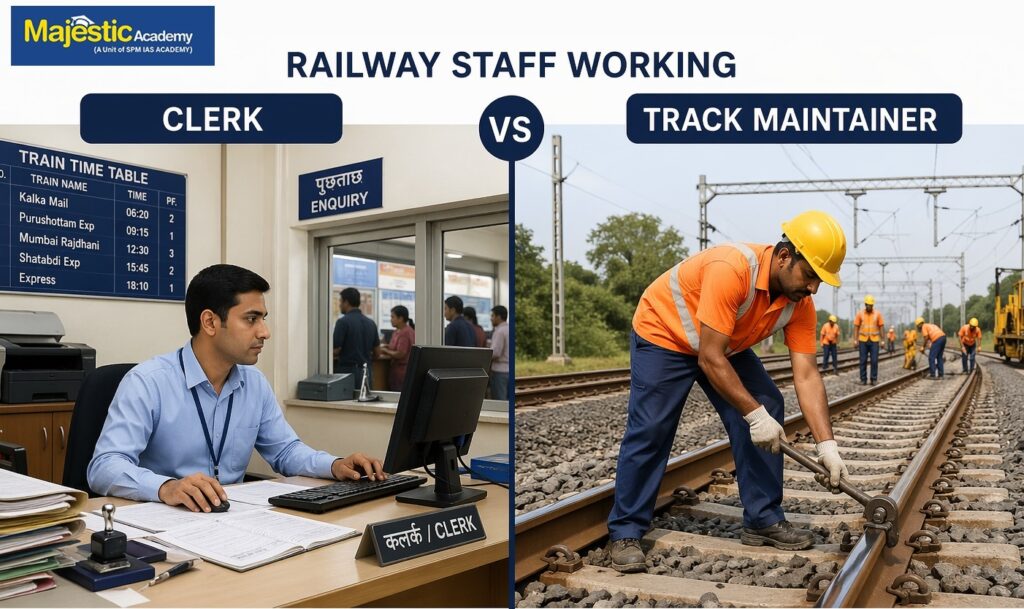
Here is the quick comparison between both the posts
| Parameter | RRB NTPC | RRB Group D |
| Full Form | Non-Technical Popular Categories | Railway Group D |
| Job Level | Clerical, Supervisor, and Manager positions | Entry-level positions |
| Exam Conducting Body | Railway Recruitment Board | Railway Recruitment Board |
| Number of Posts | Clerk, Station Master, Train Manager, Ticket Supervisor, and more | Track Maintainer, Electrician, Fitter, Helper, Pointsman, and more |
| Educational Qualification | Minimum 12th pass; some posts require graduation | Minimum 10th pass |
| Nature of Work | Administrative, clerical, and supervisory tasks | Manual, technical, and maintenance work |
| Salary | ₹35,000 – ₹118,000 per month (varies by post and grade) | ₹21,000 – ₹35,000 per month (Level 1 pay matrix) |
| Age Limit | 18–33 years (varies by post) | 18–33 years (relaxation as per rules) |
| Selection Process | CBT 1, CBT 2, Typing/Skill Test, DV and Medical | CBT, Physical Efficiency Test (PET), DV and Medical |
| Job Location | All over India | All over India |
RRB NTPC vs RRB Group D – Eligibility Criteria
The eligibility requirements for RRB NTPC and RRB Group D differ in terms of education, age, and physical standards. Understanding these differences clearly helps you figure out which exam you are eligible for and which one aligns better with your current qualifications. RRB NTPC generally offers separate eligibility for 12th-pass and graduate-level posts, while Group D is commonly open to candidates with Class 10 / ITI qualifications and includes physical efficiency standards in later stages.
For complete updates and official exam information, explore RRB NTPC exam date
Educational Qualification
| Parameter | RRB NTPC | RRB Group D |
| Minimum Qualification | 12th Pass for some posts; Graduation for others | 10th Pass or ITI from NCVT/SCVT-recognized institutions |
| Specific Requirements | Certain posts require typing skills (Clerk, Typist) | No additional qualifications required |
RRB NTPC vs RRB Group D – Examination Pattern
The exam patterns for RRB NTPC and RRB Group D differ significantly. RRB NTPC involves multiple stages including two computer-based tests (CBT 1 and CBT 2) followed by a skill test for certain posts. RRB Group D has a single computer-based test followed by a Physical Efficiency Test (PET). Here is the complete stage-wise comparison. For complete preparation support, explore Railway online coaching.
| Parameter | RRB NTPC | RRB Group D |
| Stage 1 | Computer-Based Test (CBT 1) | Computer-Based Test (CBT) |
| Subjects | General Awareness, Mathematics, General Intelligence and Reasoning | General Science, Mathematics, General Intelligence and Reasoning, General Awareness and Current Affairs |
| Total Questions | 100 | 100 |
| Duration | 90 minutes | 90 minutes |
| Negative Marking | 0.33 marks per wrong answer | 0.33 marks per wrong answer |
| Stage 2 | Computer-Based Test (CBT 2) | Physical Efficiency Test (PET) |
| Subjects | General Awareness, Mathematics, General Intelligence, and Reasoning | Physical tasks based on gender (running, lifting, etc.) |
| Total Questions | 120 | N/A |
| Duration | 90 minutes | Varies depending on the task |
| Negative Marking | 0.33 marks per wrong answer | Not applicable |
| Stage 3 | Skill Test (Typing for Clerks; Aptitude for Station Master) | N/A |
| Stage 4 | Document Verification and Medical Examination | Document Verification and Medical Examination |
One key point to note when comparing RRB NTPC and RRB Group D on the exam front, both exams carry negative marking of 0.33 marks per wrong answer in the CBT stage. So blind guessing is not a good strategy in either exam. Additionally, it’s important to be aware of the RRB Group D Reservation Policy, which ensures reserved category candidates receive the benefits of relaxation in age, educational qualification, and other criteria as per government norms.
RRB NTPC vs RRB Group D – Job Profiles
Understanding the actual day-to-day job responsibilities is one of the most important parts of the RRB NTPC vs RRB Group D comparison, because the nature of work at these two levels is completely different. RRB NTPC roles are generally office-based, clerical, customer-service, or supervisory in nature, while Group D posts are more field-oriented and involve maintenance, track operations, technical assistance, and physical duties.
For complete preparation guidance, explore railway coaching.
RRB NTPC Job Profiles
| Post | Job Description |
| Junior Clerk cum Typist | Performs clerical duties such as record maintenance, file management, and assisting with general office tasks |
| Accounts Clerk cum Typist | Maintains financial records, processes payments, and handles basic accounting functions |
| Commercial cum Ticket Clerk | Manages ticket sales, assists passengers with reservations, and handles customer service |
| Trains Clerk | Checks passenger tickets and addresses queries or issues during train travel |
| Chief Commercial cum Ticket Supervisor | Supervises ticketing operations, oversees staff, and ensures smooth passenger services |
| Station Master | Manages railway station operations, including train schedules and passenger assistance |
| Goods Train Manager | Ensures safe and timely cargo transport, supervises loading and unloading, and manages freight operations |
| Senior Clerk cum Typist | Handles senior-level clerical work including data entry, record management, and administrative tasks |
| Junior Accountant Assistant cum Typist | Assists in accounting tasks, financial data management, and typing work related to finance |
RRB Group D Job Profiles
| Post | Job Role Description |
| Track Maintainer | Maintains and inspects railway tracks to ensure safety |
| Helper / Assistant | Assists technicians in various departments |
| Gateman | Operates level crossing gates safely and efficiently |
| Pointsman | Assists in switching railway tracks for train movements |
| Assistant Loco Shed | Handles electrical maintenance of locomotives |
| Assistant C&W (Carriage and Wagon) | Maintains railway carriages and wagons |
| Assistant Loco Shed (Diesel) | Manages the maintenance of diesel locomotives |
| Assistant Signal and Telecom | Maintains and repairs signal and telecommunication systems |
The job profiles in this RRB NTPC and RRB Group D comparison make it clear that if you prefer office-based administrative and supervisory work, NTPC suits you better. If you prefer hands-on fieldwork and technical roles in railway infrastructure, Group D is the right fit.
RRB NTPC vs RRB Group D – Salary and Benefits
Salary is one of the most checked parameters in any RRB NTPC vs RRB Group D comparison. Group D positions fall under Level 1 of the pay matrix, while RRB NTPC roles range from Level 2 to Level 6, which directly results in higher salaries and better allowances for NTPC posts.
| Parameter | RRB NTPC | RRB Group D |
| Pay Level | Level 2 to Level 6 | Level 1 |
| Basic Pay (Entry Level) | ₹19,900 to ₹35,400 per month | ₹18,000 per month |
| Grade Pay | ₹2,800 to ₹4,200 | ₹1,800 |
| Total Salary (with allowances) | ₹30,000 to ₹45,000 | ₹22,000 to ₹25,000 |
| Allowances | HRA, DA, Travel Allowances | HRA, DA |
| Promotion Opportunities | Frequent — can reach higher administrative levels | Limited — mostly technical promotions |
| Job Stability | High | High |
| Transfer Policies | May be frequent depending on post | Less frequent |
In the RRB NTPC and RRB Group D salary comparison, NTPC clearly offers higher starting pay and significantly better promotion prospects. However, both roles offer the job stability and government benefits that make railway jobs so attractive in the first place.
Which is Better—RRB NTPC or RRB Group D?
When looking at RRB NTPC vs RRB Group D as a whole, the answer depends entirely on your educational background, career aspirations, and the kind of work you want to do every day.
- RRB NTPC is best suited for candidates who have completed 12th grade or graduation and are aiming for clerical, supervisory, or managerial roles in the Railways. These positions offer higher salaries, better promotion opportunities, and a career path that can reach higher administrative levels over time.
- RRB Group D is ideal for candidates with basic educational qualifications, 10th pass or ITI, who are comfortable with hands-on technical and physical work. Group D jobs are more accessible and provide a strong entry-level foot in the door of Indian Railways with complete job security.
Both exams lead to stable and secure government jobs. RRB NTPC provides higher pay and faster growth. RRB Group D is the right choice for candidates who prefer technical, maintenance-oriented fieldwork and want to join the Railways at the earliest opportunity.
Final Thoughts
The RRB NTPC vs RRB Group D comparison shows two very different career paths within the same organization, the Indian Railways. Both are government jobs with strong job security, but they serve different types of candidates with different educational backgrounds and work preferences.
If you hold a 12th pass or graduation degree and want a desk-based administrative or supervisory career with higher pay and promotion prospects, go for RRB NTPC. If you have a 10th pass or ITI qualification and are comfortable with hands-on technical fieldwork, RRB Group D gives you a stable and respectable entry into the railways. To improve your chances in either exam, enrolling in Railway Coaching can provide expert guidance, structured study plans, and practice tests to boost your preparation.
Study the eligibility, salary, job profile, and selection process of both exams carefully; decide which one aligns with where you are right now and where you want to go, and start your preparation accordingly.
Frequently Asked Questions
Q1. Which has a higher salary – RRB NTPC or RRB Group D?
In the RRB NTPC and RRB Group D salary comparison, RRB NTPC roles generally offer higher salaries compared to RRB Group D positions. RRB NTPC posts fall under Pay Levels 2 to 6 of the 7th CPC pay matrix, with entry-level basic pay ranging from ₹19,900 to ₹35,400 per The total monthly salary, including allowances, ranges from approximately ₹30,000 to ₹45,000. RRB Group D, on the other hand, falls under Level 1 of the pay matrix, with a basic pay of ₹18,000 per month and a total salary of approximately ₹22,000 to ₹25,000, including allowances. Beyond the starting pay, NTPC posts also offer better allowances, including HRA, DA, and Travel allowances, as well as more frequent promotion opportunities that allow employees to reach higher administrative pay grades over time. Group D allowances are limited to HRA and DA. So from a purely financial standpoint, RRB NTPC is the stronger option of the two.
Q2. What is the eligibility for RRB NTPC?
The eligibility requirements for RRB NTPC differ based on the level of the post. For undergraduate-level posts, such as Junior Clerk cum Typist, Accounts Clerk cum Typist, Trains Clerk, and Commercial cum Ticket Clerk, candidates need to have passed Class 12 (+2 Stage) or an equivalent examination from a recognized board, with an age limit of 18 to 30 years. For graduate-level posts, such as Station Master, Goods Train Manager, Chief Commercial cum Ticket Supervisor, Senior Clerk cum Typist, and Junior Account Assistant cum Typist, candidates need a graduate degree from a recognized university, with an age limit of 18 to 33 years. Typing skills are also needed for some specific jobs, such as junior clerk cum Typist and accounts clerk cum typist. Age relaxation is applicable for reserved category candidates as per government rules. In the RRB NTPC vs RRB Group D eligibility comparison, NTPC has a higher educational bar, while Group D only requires a Class 10 pass or ITI certificate.
Q3. Which exam has more complex questions – RRB NTPC or RRB Group D?
When it comes to question difficulty in the RRB NTPC and RRB Group D comparison, RRB NTPC typically has more complex and varied questions compared to RRB Group D. RRB NTPC involves two computer-based tests, CBT 1 with 100 questions and CBT 2 with 120 questions, both covering general awareness, mathematics, and general intelligence and reasoning. The questions in NTPC CBT 2 are more problem-specific and demand a higher level of reasoning and awareness. Additionally, NTPC has a third stage for specific posts, a Skill Test or aptitude test, which adds another layer of assessment. RRB Group D, on the other hand, has a single CBT with 100 questions covering general science, mathematics, general intelligence and reasoning, and general awareness, followed by a Physical Efficiency Test (PET) that does not involve any written questions. The Group D CBT questions are generally more straightforward and accessible, which aligns with the lower educational entry requirement of 10th pass or ITI.