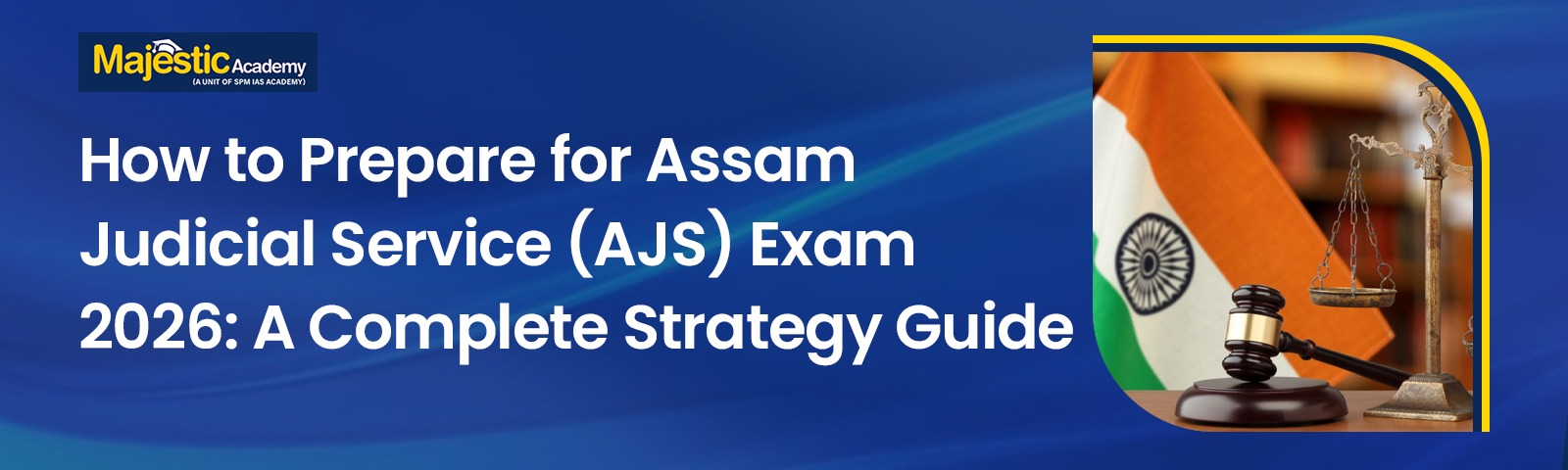
The Assam Judicial Service (AJS) examination is one of the most respected and competitive career paths for law graduates in Assam. It recruits judges across multiple grades for the state judiciary and every selected candidate carries the responsibility of administering, applying, and upholding the law for the people who appear before them. If your goal is a career on the bench, knowing exactly how to prepare for Assam Judicial Service is where everything begins.
To prepare for Assam Judicial Service effectively, you need more than just reading law textbooks. You need a structured plan, a deep understanding of the syllabus across multiple law subjects, regular mock test practice, strong answer writing skills, and a clear strategy for each stage of the examination, Preliminary, Mains, and Viva-Voce.
What Is the Assam Judicial Service Examination?

The Gauhati High Court releases the AJS notification for the recruitment of judges as per vacant posts in different grades. The examination is conducted to fill Grade I, Grade II, and Grade III judicial posts, with Grade III being the most commonly recruited level and the entry point for most aspirants.
The entire selection process runs through three stages:
Stage 1: The Preliminary Examination includes objective questions. This stage serves as a screening test for the Mains examination. The marks scored in the Preliminary examination are not counted in the final merit list, but clearing it is mandatory to proceed. The minimum qualifying marks may vary based on notification requirements.
Stage 2 – Mains Examination: A subjective (descriptive) examination consisting of multiple papers. The marks scored in Mains are the ones that actually count toward the final merit list. This is where the real competition takes place.
Stage 3—Viva-Voce/ Personal Interview: The final stage, which carries 50 marks. Candidates are evaluated on general knowledge, personality, articulation, legal awareness, and overall suitability for judicial service. The minimum qualifying marks for the Viva-Voce is 20 out of 50.
AJS Eligibility Criteria and Age Limit
Before you begin your preparation, confirm that you meet the eligibility conditions. Here are the requirements for appearing for the AJS examination:
- The candidate must be a citizen of India
- The candidate must hold a Degree in Law (LLB) from a recognised university established by law in India, specifically a BCI-recognized college or university and must be eligible to practise as an Advocate in India
- Age Limit (for AJS Grade III) as on the last date of online application:
- General Candidates: 38 years
- SC/ST Candidates: 43 years
- PwBD (Persons with Disabilities): 48 years
Always check the official Gauhati High Court website at http://ghconline.gov.in/NoticeRecruitment.html for the latest notification since exam dates and eligibility details are updated with each recruitment cycle.
Assam Judicial Service Exam Syllabus – Grade III Mains
Before you begin your preparation, confirm that you meet the eligibility conditions. Here are the requirements for appearing for the AJS examination. For better preparation support, you can also explore Judicial Service exam online coaching.
- General Knowledge, Aptitude, and English
- Constitution of India
- Code of Civil Procedure (CPC)
- Code of Criminal Procedure (CrPC)
- Transfer of Property Act
- Indian Contract Act
- Indian Penal Code (IPC)
- Indian Evidence Act
- Law of Torts
- Proficiency in the Official Language(s) of Assam (Assamese)
Each of these subjects demands genuine depth of understanding, not surface-level familiarity. The Mains is a descriptive examination, which means you must be able to write detailed, legally accurate, and well-structured answers. Knowing the law is necessary but not sufficient, so you must also be able to express it clearly and precisely under exam conditions.
How to Prepare for Assam Judicial Service – A Complete Stage-Wise Strategy
Start as Early as Possible
The most consistent advice from candidates who have cleared the AJS examination is to start early. If you are in the 4th or 5th year of a 5-year integrated law course, start building your foundational knowledge now. Judicial service examinations are state-specific, deeply syllabus-intensive, and require months of preparation across multiple law subjects simultaneously. For structured guidance, you can also consider Judicial services exam coaching.
The earlier you begin your preparation to prepare for Assam Judicial Service, the more time you have to go deep into each subject, revise multiple times, practice answer writing, and still have headroom for the language and general knowledge components.
Do not wait to complete your degree before starting. The students who clear on their first or second attempt almost always begin preparing alongside their academics rather than after finishing.
Step 1 – Understand the Exam Pattern Fully Before Touching Any Subject
Before you open a single law textbook, spend a full day going through the official AJS notification carefully. Understand the three-stage structure, Prelims, Mains, and Viva-Voce, the number of papers in Mains, the marks distribution, the qualifying marks for each stage, and the language requirements.
This understanding shapes everything that comes next. When you know that Mains is descriptive and that marks from the preliminary stage do not count toward the final merit, you automatically know that your preparation depth must be Mains-oriented from the very beginning, not just broad enough to clear a screening test.
Step 2 – Build a Subject-Wise Study Plan and Follow It
The AJS syllabus covers ten distinct areas and each one of them needs genuine time and attention. Building a subject-wise study plan means deciding how many weeks to give each subject, in what order to cover them, and how to schedule revision alongside fresh learning.
A practical approach for candidates starting from scratch is to prioritize the subjects that carry both the highest number of questions and the deepest conceptual requirements. The Indian Penal Code, Code of Criminal Procedure, Code of Civil Procedure, Indian Evidence Act, and the Indian Contract Act are the backbone subjects that cover these first and most thoroughly.
The Constitution of India, the Transfer of Property Act, and the Law of Torts come next. General knowledge, English, and Assamese language proficiency should run as parallel ongoing tasks throughout the preparation period rather than being saved for the end.
Once you finish each subject for the first time, schedule a revision date for it. The gap between first reading and first revision should not exceed two to three weeks, and subsequent revisions should happen at regular intervals throughout the preparation.
Step 3 – Read Recent Judgements and Follow Legal Developments
One of the aspects of AJS preparation that many candidates underestimate is the importance of recent judgments and current legal developments. The Viva-Voce in particular includes questions on recent Supreme Court and Gauhati High Court judgements, important constitutional bench decisions, and developments in areas covered by the Mains syllabus.
Make it a habit to read at least one or two significant recent judgements every week. Keep a dedicated notebook for judgments, note the case name, the legal issue involved, the decision, and the principle of law it established or reinforced. Over time, this habit builds a repository of legal knowledge that enriches both your Mains answers and your Viva-Voce performance.
Additionally, reading a newspaper daily keeps your General Knowledge and current affairs updated both of which are tested in the AJS examination alongside core law subjects.
Step 4 – Develop Strong Answer Writing Skills
The most important practical skill for AJS Mains success is answer writing and it is a skill that most law graduates significantly underestimate. Legal knowledge and the ability to write well-structured, authoritative exam answers are two different things, and the gap between them only closes through consistent practice.
Start writing answers from the very first month of your preparation, so do not wait until the syllabus is fully covered. Begin with the subjects you have covered, write out answers to previous year questions, and analyse what your answers are missing in terms of structure, legal accuracy, and completeness.
A strong AJS Mains answer typically follows this structure: a clear opening that identifies the legal issue → relevant statutory provision or constitutional article → applicable case law or judicial principle → application to the specific question → a clear, confident conclusion. Building this structure into your writing habits early is what produces consistent marks in the descriptive papers.
Step 5 – Use Internship Experience Actively in Preparation
Internships in courts, particularly district courts, high courts, and magistrate courts, are one of the most important preparation tools for AJS aspirants. Internship experience gives you direct exposure to the practical application of the subjects you are studying CPC, CrPC, Evidence Act, and IPC come alive in ways that a textbook alone cannot replicate.
Beyond knowledge, court internships build confidence and a realistic understanding of what the judicial role actually involves. You gain a completely different understanding of the procedural law you are studying when you watch proceedings in a courtroom. Internship experience also gives you authentic content for your viva voce answers the panel values candidates who have genuine exposure to legal practice, not just theoretical knowledge of it.
Step 6 – Practice Mock Tests and Previous Year Papers Consistently
To prepare for Assam Judicial Service effectively, mock tests are non-negotiable for both the preliminary and mains stages. Mock tests do four things that no amount of reading alone can replicate:
- They expose the gaps between what you think you know and what you can actually recall under time pressure
- They build the time management skills needed to complete all questions within the exam duration
- They teach you which questions to attempt first and which to leave for the end
- They build the exam temperament that allows you to perform consistently rather than only on good days
For the preliminary stage, take full-length, timed mock tests regularly. Analyse every wrong answer carefully, so do not just check the correct answer, understand why the answer is what it is and which legal principle it tests.
For Mains, practise writing answers to previous year questions from the AJS and other state judicial service examinations. Compare your answers with model answers or have them reviewed by someone with judicial service preparation experience. Previous year papers also tell you which topics appear most frequently and at what depth, which directly guides how you prioritize revision.
Step 7 – Prepare for the Viva-Voce from the Beginning
The Viva-Voce carries 50 marks and requires a minimum of 20 to qualify. Many aspirants treat it as an afterthought that they will prepare for once they clear Mains, but this approach is a mistake. The panel for AJS Viva-Voce includes experienced judges who ask probing questions on recent legal developments, constitutional interpretation, procedural law, and the candidate’s personal and academic background.
The best way to prepare for the Viva-Voce is to build good habits throughout your preparation:
- Keep track of recent Supreme Court and Gauhati High Court judgements in a dedicated notebook
- Read the Preamble to the Constitution regularly and develop a clear personal view on constitutional values and judicial independence
- Practise speaking about legal concepts clearly and concisely, not in the way you write an answer, but in the way you would explain a legal principle to an intelligent person who is asking you directly
- Conduct mock interviews with peers or mentors and work on maintaining composure, confidence, and clarity under questioning
Work on your communication skills, body language, and confidence throughout the preparation period, not just in the weeks before the interview.
Step 8 – Prepare for the Assamese Language Paper
The AJS examination includes marks allotted for proficiency in the Official Language(s) of Assam, specifically Assamese. This is a component that candidates from non-Assamese backgrounds sometimes struggle with if they leave it too late.
Start practicing Assamese reading and writing alongside your law preparation. If your Assamese is weak, allocate 30 to 45 minutes daily to developing it throughout the preparation period, not just in the final month. The language paper has marked on the table that you do not want to give away to a preparation gap.
A Career in Assam Judicial Service – Why It Is Worth Pursuing
A career in the Assam Judicial Service is not just a government job, it is a position of genuine responsibility, independence, and social impact. Judges in the district judiciary deal directly with matters that affect people’s lives every day property disputes, criminal cases, family law matters, and more. The authority to interpret and apply the law, and to deliver justice to those who come before the court, is one of the most meaningful responsibilities any professional can hold.
Beyond the social significance, a judicial career offers job security, a structured career progression through grades, respect within the legal community, and a work environment built around professional integrity and the rule of law. For law graduates who are genuinely committed to justice and legal practice, the AJS is one of the most fulfilling career paths available.
Final Thoughts
To prepare for Assam Judicial Service successfully in 2026, you need more than just reading, so you need a structured plan that covers the full syllabus in depth, regular mock test practice across both Prelims and Mains, consistent answer writing sessions, active engagement with recent judgements, and a genuine readiness for the Viva-Voce stage.
Start early. Go deep into each law subject. Practise writing every week. Read recent judgements regularly. Prepare for Assamese language proficiency alongside your law preparation. And treat the Viva-Voce not as a final hurdle but as the culmination of everything you have learned and experienced throughout your preparation.
The Assam Judicial Service offers a career of genuine impact, professional respect, and lifelong learning in the service of justice. It is a demanding examination but with the right strategy, the right habits, and consistent daily effort, it is absolutely achievable.
Frequently Asked Questions
Q1. When should I start preparing for the Assam Judicial Service exam?
The best time to start preparing for Assam Judicial Service is in the 4th or 5th year of your law course before you even graduate. Starting early gives you the advantage of having enough time to cover the full syllabus in depth, revise multiple times, build strong answer writing skills, and still have time for mock tests and Viva-Voce preparation. The candidates who clear AJS on their first attempt almost universally started preparing well before graduation rather than after finishing their degree. If you have already graduated and are starting now, begin immediately every month of delay is preparation time lost before the next examination cycle.
Q2. What are the most important subjects to focus on for the AJS Mains exam?
When you prepare for Assam Judicial Service Mains, the subjects that require the deepest preparation are the Indian Penal Code, Code of Criminal Procedure, Code of Civil Procedure, Indian Evidence Act, and Indian Contract Act. These five subjects together form the backbone of the AJS Mains examination and appear consistently across papers. The Constitution of India, the Transfer of Property Act, and the Law of Torts are the next priority tier. General knowledge, English, and Assamese Language proficiency should be built as continuous, ongoing habits throughout the preparation period rather than being treated as last-minute additions. The descriptive nature of the Mains means you need to know each subject well enough to write detailed, accurate, and structured answers, surface-level familiarity is not enough.
Q3. How important are mock tests for AJS preparation?
Mock tests are essential to prepare for Assam Judicial Service effectively and this applies to both the preliminary and mains stages. For the Preliminary stage, regular timed mock tests build speed, accuracy, and familiarity with the question pattern. For Mains, practising previous year questions under timed conditions is the most effective way to develop the answer writing quality that converts legal knowledge into exam scores. Mock tests also reveal the gap between what you think you know and what you can actually produce under pressure and closing that gap is the core work of AJS preparation. Candidates who consistently take and analyse mock tests throughout their preparation perform significantly better in the actual exam than those who only practise in the final weeks before the examination.

Majestic Academy is a trusted coaching institute offering result-oriented SSC Coaching, Banking Coaching, and ADRE Coaching for competitive exam aspirants. Serving students across Guwahati and Assam, we provide structured preparation with expert faculty, updated study materials, and regular mock tests. Our specialized RRB Coaching in Guwahati helps railway exam candidates build strong fundamentals and gain exam confidence. We also offer focused TET Coaching in Guwahati for aspiring teachers with concept-based learning and exam-oriented guidance. At Majestic Academy, we are committed to quality education, clear mentoring, and consistent student success.