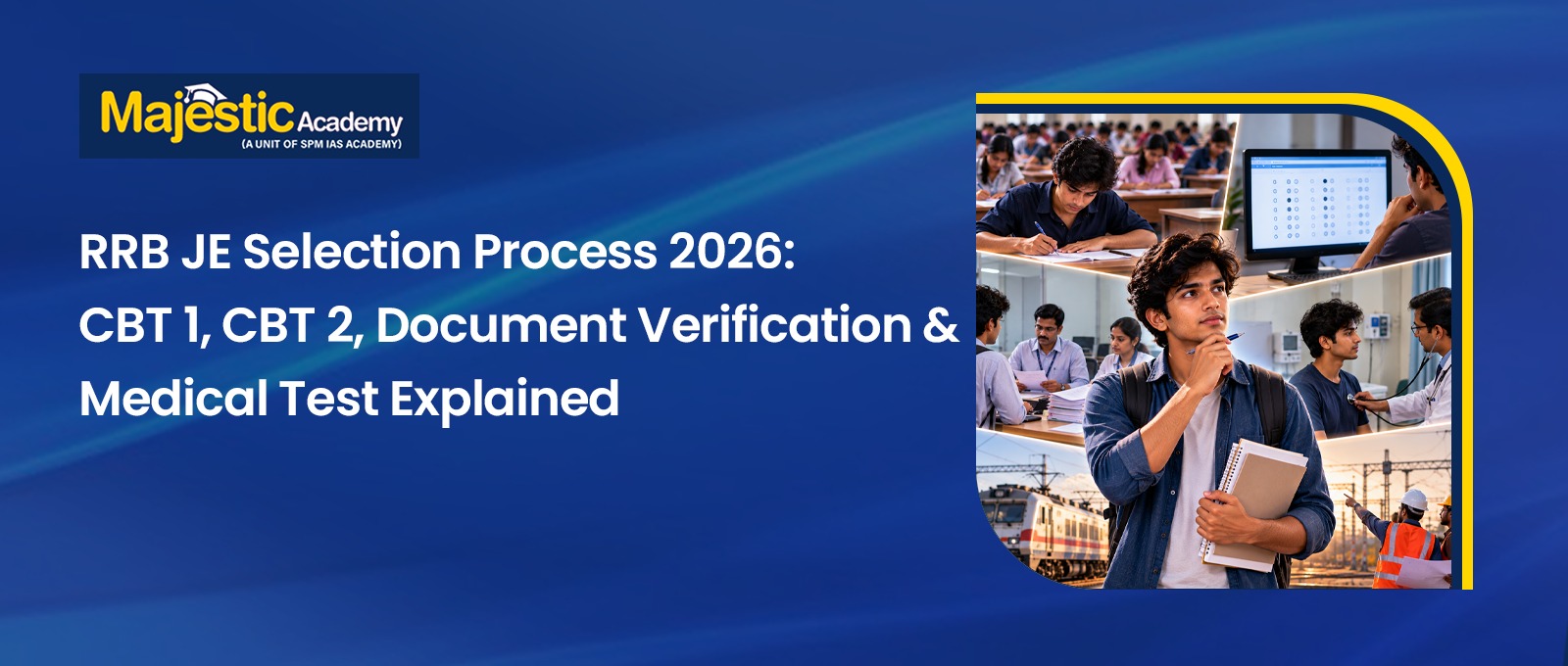
The RRB JE Selection Process is designed to check a candidate’s knowledge, technical ability, documents, and medical fitness before final appointment. For the 2026 recruitment cycle, candidates have to move through CBT 1, CBT 2, Document Verification, and a Medical Examination. There is no interview stage. Therefore, knowing how each stage works can help you prepare in the right order and avoid confusion later.
The RRB JE Selection Process 2026 starts with a screening test and then moves to a more technical second-stage exam. Candidates who clear the computer-based tests are called for document checks and medical fitness assessment. Each stage is important because failing to meet the required conditions at any point can stop further selection.
Candidates preparing for the RRB JE examination should also choose the right guidance and study resources to strengthen their preparation. If you are looking for expert guidance and structured preparation, explore Best Railway Online Coaching In Guwahati to learn more about the available coaching support.
RRB JE Selection Process: Quick Overview
Here is a simple overview of the main stages:
| Stage | Purpose | Key Point |
| CBT 1 | Screening candidates | 100 questions for 100 marks |
| CBT 2 | Tests technical and general knowledge | 150 questions for 150 marks |
| Document Verification | Confirms eligibility and certificates | Original documents are checked |
| Medical Examination | Checks fitness for the allotted post | Required medical standards must be met |
| Final Panel | Appointment process | Depends mainly on CBT 2 merit, DV, medical fitness, vacancies, and applicable rules |
The RRB JE Selection Process does not include an interview. CBT 1 is mainly used to shortlist candidates for the next stage, while CBT 2 carries greater importance in the merit process. Both computer-based tests have negative marking, so careful attempts matter. Candidates preparing for railway recruitment exams can also benefit from structured guidance and regular practice. If you are preparing for these exams, explore our railway coaching centre in Guwahati to learn more about the available coaching options.
Stage 1: RRB JE CBT 1
RRB JE CBT 1 is the first computer-based examination. It works as a screening stage. In other words, candidates need to perform well enough to be shortlisted for CBT 2.
The test has 100 objective questions for 100 marks and is normally completed in 90 minutes. One-third of the marks allotted to a question is deducted for a wrong answer. The subject-wise distribution given for the 2026 pattern is shown below.
| Subject | Questions | Marks |
| Mathematics | 30 | 30 |
| General Intelligence and Reasoning | 25 | 25 |
| General Awareness | 15 | 15 |
| General Science | 30 | 30 |
| Total | 100 | 100 |
The RRB JE Selection Process requires candidates to clear this stage before moving ahead. However, just reaching the minimum qualifying percentage may not be enough for shortlisting. The actual shortlist depends on merit, normalisation, vacancies, and the rules given by the Railway Recruitment Boards.
For the 2026 pattern, the minimum percentage of marks listed is 40% for UR and EWS, 30% for OBC-NCL and SC, and 25% for ST candidates. A relaxation may apply to eligible PwBD candidates in the situation mentioned in the notification.
How to Approach CBT 1
Since CBT 1 is a screening test, speed and accuracy should go together. First, build a strong base in Mathematics and Reasoning. Next, revise General Science regularly. At the same time, keep up with General Awareness. Finally, practise mock tests so that negative marking does not reduce your score. To prepare effectively, candidates should also understand the different stages of the recruitment process and the requirements for each stage. For a better understanding, read our guide on the RRB JE Selection Process 2026. Knowing the selection process helps candidates plan their preparation more effectively, focus on the right subjects, and approach each stage of the RRB JE examination with greater confidence.
Stage 2: RRB JE CBT 2
Candidates shortlisted after the first stage appear for RRB JE CBT 2. This paper is more important for merit because it gives major weight to Technical Abilities. So, candidates should not treat it as just another qualifying test.
CBT 2 has 150 questions for 150 marks and a duration of 120 minutes. It also carries negative marking of one-third of the marks allotted to a question for each wrong answer. The indicative subject distribution is given below.
| Subject | Questions | Marks |
| General Awareness | 15 | 15 |
| Physics and Chemistry | 15 | 15 |
| Basics of Computers and Applications | 10 | 10 |
| Basics of Environment and Pollution Control | 10 | 10 |
| Technical Abilities | 100 | 100 |
| Total | 150 | 150 |
In this stage, CBT 2 needs focused technical preparation because 100 of the indicative 150 questions come from Technical Abilities. Therefore, candidates should revise their engineering discipline in depth instead of depending only on general sections.
Also, the subject-wise number of questions is indicative and may vary in the actual paper. Hence, it is safer to cover the full notified syllabus rather than prepare only according to a fixed question count.
Stage 3: RRB JE Document Verification
After the computer-based stages, shortlisted candidates move to RRB JE Document Verification. At this point, the information given in the application is checked against original certificates and other required records.
The RRB JE Selection Process can move forward only when the required documents are found valid. Therefore, candidates should keep their originals, photocopies, and prescribed certificates ready before the DV date.
Commonly required records may include educational qualification certificates, proof of date of birth, identity proof, category or community certificate where applicable, disability certificate where applicable, and other documents mentioned in the DV notice.
However, candidates should always follow the document list given in their own RRB call letter or official notice because requirements can vary. Previous official RRB JE notices also show that DV schedules, document-upload instructions, and e-call letters are issued for shortlisted candidates.
Important Document-Check Tips
Check that your name, date of birth, category, and qualification details match your application. In addition, make sure certificates are in the required format and are valid on the relevant date. If any certificate needs renewal or correction, deal with it before reporting for verification.
Stage 4: RRB JE Medical Test
The RRB JE Medical Test checks whether a candidate is medically fit for the duties of the allotted railway post. This step is compulsory after the earlier selection stages.
During this stage, Railway medical authorities may assess general health, eyesight, colour vision where required, hearing, and other fitness standards linked to the post. The exact medical category can differ by post. Medical categories listed for RRB JE-related posts include standards such as A3, B1, B2, C1, and C2, depending on the notified post.
The RRB JE Selection Process is not complete just because a candidate has scored well in CBT 2. Medical fitness for the allotted post is also required. Therefore, candidates should check the medical standard for their chosen post early, especially the eyesight requirements.
Candidates preparing for railway recruitment exams can also explore other opportunities available through the Railway Recruitment Board. For example, the RRB NTPC Graduate Level Recruitment 2026 is another recruitment option for eligible graduates who want to build a career in the Indian Railways. Checking the eligibility criteria, selection stages, and important dates can help candidates plan their preparation effectively.
How Is RRB JE Final Selection Done?
RRB JE Final Selection is based mainly on CBT 2 performance, subject to successful document verification, medical fitness, vacancy position, reservation rules, and other conditions given by the Railway Recruitment Boards. CBT 1 mainly serves as the screening stage for shortlisting candidates to CBT 2.
This means the RRB JE Selection Process rewards strong performance in the second-stage exam, but marks alone do not guarantee appointment. A candidate must also clear the remaining checks and satisfy all eligibility conditions.
Once these stages are completed, the concerned Railway Recruitment Board can publish panels or lists of provisionally selected candidates. Previous official JE recruitment pages show main panels as well as later part panels after DV and medical examination rounds.
What Happens After Clearing All Stages?
After completing all selection stages, candidates who meet the required merit, eligibility, document, and medical conditions can be considered for appointment against available vacancies. The final steps may include panel publication, allocation as per applicable rules, and further joining instructions from the concerned railway authority.
Therefore, candidates should continue checking only the official RRB website relevant to their recruitment. This is especially important after CBT 2 because DV schedules, medical instructions, panel notices, and other updates can be released separately.
Key Points to Remember
The RRB JE Selection Process becomes easier to understand when you remember the role of each stage. CBT 1 screens candidates, while CBT 2 plays the major role in merit. After that, documents confirm eligibility and the medical test checks fitness for railway duties.
A few simple habits can also prevent last-minute problems. Keep your certificates organised, read every official notice carefully, practise with negative marking in mind, and check the medical standard for your preferred post before the final stages.
Conclusion
The RRB JE Selection Process follows a clear path from CBT 1 to CBT 2, followed by document verification and a medical examination. While CBT 1 helps shortlist candidates, CBT 2 deserves extra attention because it has a major role in merit. Still, clearing the written exams is only part of the journey.
So, prepare for every stage from the beginning. Build strong basics for CBT 1, give extra time to technical subjects for CBT 2, keep your documents ready, and understand the medical standards for your post. A balanced approach can help you move through the recruitment process with fewer surprises.
Frequently Asked Questions
Q1. What are the stages in the RRB JE recruitment process?
The recruitment process has four main stages: CBT 1, CBT 2, Document Verification, and Medical Examination. CBT 1 is used for shortlisting, while CBT 2 has greater importance in merit. Candidates must also provide valid documents and meet the required medical standards before appointment successfully.
Q2. Are CBT 1 marks counted in the final RRB JE merit list?
CBT 1 mainly works as a screening test for shortlisting candidates to CBT 2. Final merit is based mainly on performance in CBT 2, subject to document verification, medical fitness, vacancies, reservation rules, and other conditions stated by the Railway Recruitment Boards during final selection.
Q3. What happens if a candidate fails the RRB JE medical examination?
A candidate must meet the medical standard prescribed for the allotted post. If the required standard is not met, appointment to that post may not be possible. Since medical categories differ by post, candidates should check the official post-wise fitness and vision requirements well in advance.
READ MORE:

Majestic Academy is a trusted coaching institute offering result-oriented SSC Coaching, Banking Coaching, and ADRE Coaching for competitive exam aspirants. Serving students across Guwahati and Assam, we provide structured preparation with expert faculty, updated study materials, and regular mock tests. Our specialized RRB Coaching in Guwahati helps railway exam candidates build strong fundamentals and gain exam confidence. We also offer focused TET Coaching in Guwahati for aspiring teachers with concept-based learning and exam-oriented guidance. At Majestic Academy, we are committed to quality education, clear mentoring, and consistent student success.