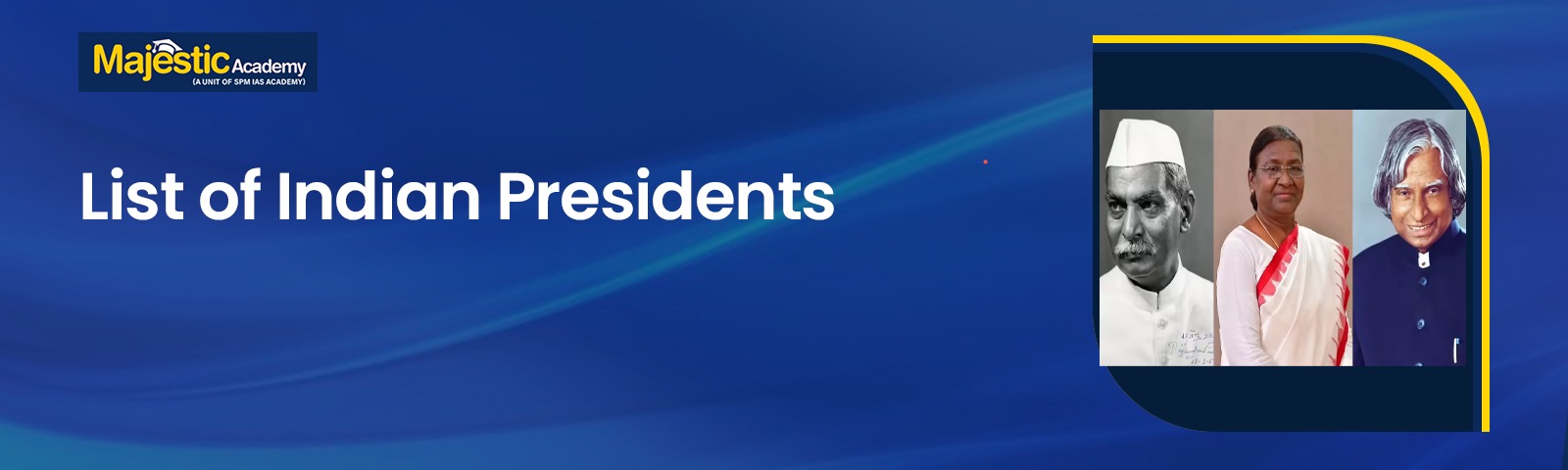
The President is the Head of State in India. Additionally, he or she is referred to as the first citizen of the country. According to Article 52 of the Indian Constitution, there shall be an Indian President. Furthermore, Article 53 states that all the executive powers of the Union shall be executed by him or her, either directly or through officers who are subordinate to him.
On 26 November 1949, the Constitution of India was adopted. Subsequently, it came into force on 26 January 1950. Notably, the first constitutional head of state, the President of India, was Rajendra Prasad.
In this article, we will look at the Presidents of India from 1950 to 2025.
Who is the President of India?
The President of India is referred to as the first citizen of India. Additionally, the Indian President is elected by an electoral college. This electoral college is composed of the elected members of the Parliament, which includes both the Lok Sabha and the Rajya Sabha, as well as the Vidhan Sabha.
Since the adoption of the Indian Constitution in 1950, there have been 15 personalities who served as Indian Presidents. Furthermore, there have been periods when the country was headed by an acting President.
List of Indian Presidents: 1950 – 2025
The Constitution of India was adopted on 26th November 1949. It came into force on 26th January 1950. Additionally, Dr. Rajendra Prasad was elected as the first constitutional head of the state, serving as the Indian President.
Furthermore, Ram Nath Kovind, who was the 14th Indian President, completed his term in July 2022. Although he was eligible, he did not contest for re-election. As a result, Draupadi Murmu became the 15th Indian President in July 2022. She was appointed by the electoral college.
1. Dr. Rajendra Prasad
Dr. Rajendra Prasad was the first Indian President. He served two terms in office. Additionally, he was the President of the Constituent Assembly. Moreover, he played a key role as the Chief Leader of the Indian Independence Movement. In recognition of his contributions, he was awarded the Bharat Ratna in 1962.
2. Dr. Sarvepalli Radhakrishnan
Dr. Sarvepalli Radhakrishnan was born on 5 September 1888. This date is significant because it is celebrated as Teacher’s Day. Furthermore, he was awarded the Bharat Ratna in 1954.
3. Dr. Zakir Husain
Dr. Zakir Husain became the first Muslim Indian President. Unfortunately, he died in office. Consequently, the immediate Vice President, V.V. Giri was made the acting President. Following this, Chief Justice of the Supreme Court, Mohammad Hidayatullah, became acting President. He served from 20 July 1969 to 24 August 1969.
In recognition of his contributions, Mohammad Hidayatullah was awarded the Padma Bhushan in the field of art by the Government of India in 2002. Furthermore, he played a vital role in bringing a revolution in education in India.
4. V.V. Giri
V.V. Giri was the fourth Indian President. His full name was Varahagiri Venkata Giri. Notably, he became the only person to be elected President as an independent candidate. Furthermore, in 1975, he was awarded the Bharat Ratna.
5. Fakhruddin Ali Ahmed
Fakhruddin Ali Ahmed was the fifth Indian President. He holds the distinction of being the second President to die while in office. Consequently, BD Jattha was appointed as the Acting President.
6. Neelam Sanjeeva Reddy
Neelam Sanjeeva Reddy became the sixth Indian President. He was the first Chief Minister of Andhra Pradesh. He was directly elected to the post of Lok Sabha speaker and became the youngest President to occupy Rashtrapati Bhavan, and contested twice for the post of President.
7. Giani Zail Singh
Before becoming the President, he served as the Chief Minister of Punjab. Additionally, he was a Minister at the Centre. Notably, he also used a pocket veto on the Indian Post Office Bill.
During his presidency, several significant incidents occurred. First, there was Operation Blue Star. Then, the assassination of Indira Gandhi took place. Furthermore, the 1984 anti-Sikh riots followed these events.
8. R. Venkataraman
R. Venkataraman was elected as the Indian President from 25 July 1987 to 25 July 1992. Prior to his presidency, he served as the Vice-President of India from 1984 to 1987. Additionally, he has received many honors from different parts of the world. For instance, he is a recipient of the “Tamra Patra” for his contributions to India’s freedom struggle. Moreover, the Russian government conferred upon him the Soviet Land Prize for writing a travelogue about former Tamil Nadu Prime Minister, Kumaraswami Kamaraj.
9. Dr. Shankar Dayal Sharma
He was the eighth Vice-President of India. After serving in that role, he went on to become President. Between 1952 and 1956, he was the Chief Minister of Bhopal. Then, from 1956 to 1967, he served as a Cabinet Minister. Additionally, the International Bar Association recognized him with the ‘Living Legend of Law Award of Recognition.’ This award was given due to his multiple achievements in the legal profession.
10. K R Narayanan
K. R. Narayanan was the first Dalit Indian President. Additionally, he was the first Malayali person to hold the highest office in the country. Moreover, he made history by being the first President to vote in the Lok Sabha elections. Furthermore, he addressed the state assembly, which was another significant milestone.
11. Dr. A.P.J Abdul Kalam
Dr. A. P. J. Abdul Kalam became known as the ‘Missile Man of India.’ He was the first scientist to serve as President. Moreover, he was the first Indian President to win the most votes. During his tenure, he directed the successful launch of the Rohini-1 satellites. Additionally, he oversaw the successful launches of Agni and Prithvi missiles. The Pokhran-II nuclear tests conducted in India in 1998 marked a significant moment. Following the 1974 original nuclear test, he played a pivotal role in the political, organizational, and technical aspects. In recognition of his contributions, he was awarded the Bharat Ratna in 1997.
12. Shrimati Pratibha Singh Patil
She was the Governor of Rajasthan before she became the first woman Indian President. Additionally, from 1962 to 1985, she served as a member of the Maharashtra Legislative Assembly, achieving this five times. Furthermore, she was elected from Amravati to the Lok Sabha in 1991. Notably, she was also the first woman president to fly a Sukhoi.
13. Pranab Mukherjee
Pranab Mukherjee served as the finance minister in the central government before he contested the presidential election. In recognition of his contributions, he was awarded the Best Parliamentary Award in 1997. Additionally, he received the Padma Vibhushan, which is India’s second-highest civilian honour, in 2008. Sadly, he passed away on 31 August 2020, which was a Monday. At the time of his death, he was 84 years old.
14. Ram Nath Kovind
Ram Nath Kovind was born on 1 October 1945 in Uttar Pradesh, India. He is an Indian lawyer and politician. Additionally, he served as the 14th Indian President. He assumed the presidency on 25 July 2017. Furthermore, he is a member of the Bharatiya Janata Party. Before becoming President, he was the Governor of Bihar. His approach towards political problems earned him praise across the political spectrum.
Notably, as Governor, one of his significant achievements was the creation of a judicial commission. This commission was tasked with investigating corruption in universities.
15. Draupadi Murmu
Draupadi Murmu became the 15th Indian President on July 25, 2022. She was born on June 20, 1958, in Uparbeda village, which is located in the Mayurbhanj district of Odisha. Notably, she was born into a Santali tribal family. Her father’s name is Biranchi Narayan Tudu.
Before assuming the presidency, she served as the Governor of Jharkhand. Additionally, in 2007, Draupadi Murmu received the Nilkantha Award. This award was given for being the best MLA (Member of the Legislative Assembly) by the Odisha Legislative Assembly.
Indian Presidents List
| No. | Name | Tenure |
| 1 | Rajendra Prasad | 26 January 1950 – 13 May 1962 |
| 2 | Sarvepalli Radhakrishnan | 13 May 1962 – 13 May 1967 |
| 3 | Zakir Hussain | 13 May 1967 – 3 May 1969 |
| – | VV Giri (Acting President) | 3 May 1969 – 20 July 1969 |
| – | Mohammad Hidayatullah (Acting President) | 20 July 1969 to 24 August 1969 |
| 4 | V.V Giri | 24 August 1969 – 24 August 1974 |
| 5 | Fakhruddin Ali Ahmed | 24 August 1974 – 11 February 1977 |
| – | Basappa Danappa Jatti (Acting President) | 11 February 1977 – 25 July 1977 |
| 6 | Neelam Sanjiva Reddy | 25 July 1977 – 25 July 1982 |
| 7 | Giani Zail Singh | 25 July 1982 – 25 July 1987 |
| 8 | R Venkataraman | 25 July 1987 – 25 July 1992 |
| 9 | Shankar Dayal Sharma | 25 July 1992 – 25 July 1997 |
| 10 | K R Narayanan | 25 July 1997 – 25 July 2002 |
| 11 | APJ Abdul Kalam | 25 July 2002 – 25 July 2007 |
| 12 | Pratibha Patil | 25 July 2007 – 25 July 2012 |
| 13 | Pranab Mukherjee | 25 July – 25 July 2017 |
| 14 | Ram Nath Kovind | 25 July 2017 – 25 July 2022 |
| 15 | Droupadi Murmu | 25 July 2022 – Incumbent |
Conclusion
In conclusion, the Indian Presidents, starting with Rajendra Prasad and continuing to Draupadi Murmu, have significantly shaped our nation’s history. Their legacies are important. Hence, we must respect the contributions of the Indian President. Moreover, as we honor their contributions, we can reflect on the lessons learned. Ultimately, this reflection will guide us as we look to the future of our democracy.
Frequently Asked Questions
1. Who was the first Indian President?
Dr. Rajendra Prasad was the first Indian President, serving from 1950 to 1962. He is also the only President to have served two full terms in office.
2. What is the Indian President?
As per Article 58, any candidate for President of India must be an Indian citizen at least 35 years old, eligible to be a Lok Sabha member, and must not hold any office of profit. (Additionally, upon election, if they are an MP or MLA, they must vacate that seat as per Article 59.)
3. How is the Indian President elected?
The President is indirectly elected by an Electoral College comprising elected MPs of Parliament and elected MLAs of all states (plus Delhi & Puducherry). The election uses proportional representation through a single transferable vote, ensuring votes of MPs and MLAs have appropriate weight based on population. The winning candidate must secure more than half the total vote value to be elected.
4. How many Presidents of India have there been so far?
India has had 15 Presidents from 1950 to the present. The line of Presidents runs from Dr. Rajendra Prasad (the 1st President) up to President Murmu, with each contributing to the constitutional history of the republic.

Majestic Academy is a trusted coaching institute offering result-oriented SSC Coaching, Banking Coaching, and ADRE Coaching for competitive exam aspirants. Serving students across Guwahati and Assam, we provide structured preparation with expert faculty, updated study materials, and regular mock tests. Our specialized RRB Coaching in Guwahati helps railway exam candidates build strong fundamentals and gain exam confidence. We also offer focused TET Coaching in Guwahati for aspiring teachers with concept-based learning and exam-oriented guidance. At Majestic Academy, we are committed to quality education, clear mentoring, and consistent student success.