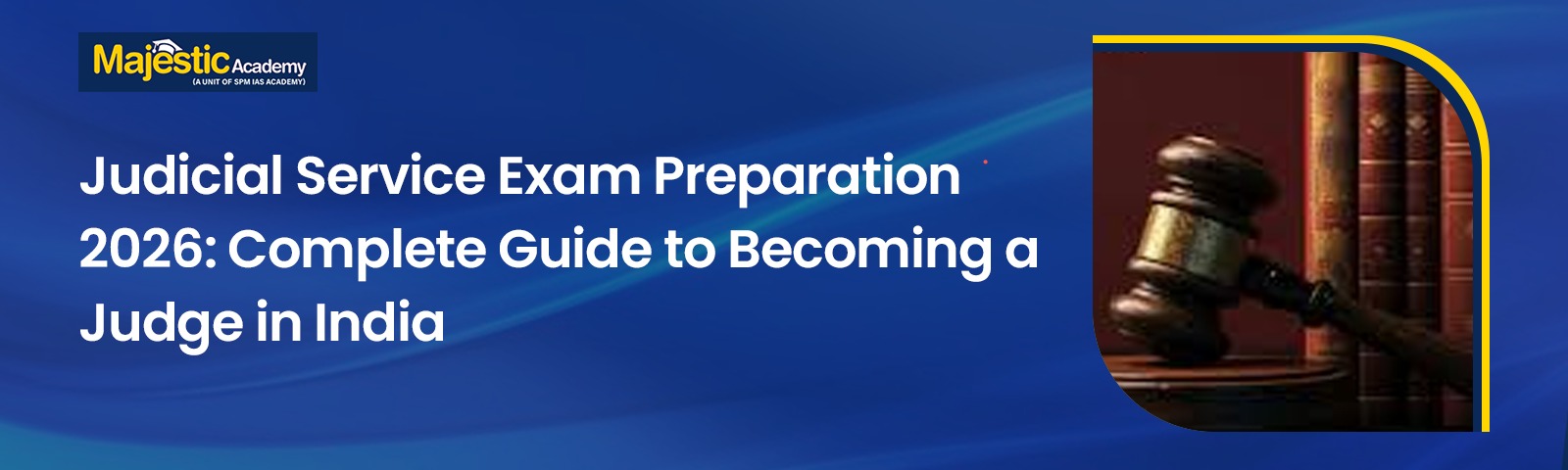
Becoming a judge remains one of the most elite and sought-after career paths for any law student in India. In the legal community, people commonly refer to this journey as the PCS-J, which stands for the Provincial Civil Service Judicial Examination. While many students explore different fields during law school, deciding on judicial service exam preparation during your early years can give you a significant first-mover advantage. If you dream of sitting on the bench and delivering justice, this guide will walk you through every step of the process for 2026.
Understanding the Notification and Seats
Unlike regular competitive exams such as the UPSC, the judicial exam does not follow a fixed annual cycle for a set number of seats. Instead, the State Public Service Commission or the High Court conducts these tests only when the High Court notifies them about vacant seats in the lower judiciary. Therefore, you must stay alert for official announcements from the specific state you wish to serve.
Eligibility Criteria for Aspiring Judges
To begin your judicial service exam preparation, you must first meet the basic educational requirements. The exam primarily recruits for the post of Civil Judge Junior Division, though some states, like Haryana or Madhya Pradesh, use titles like Judicial Magistrate or Civil Judge Class II.
- Educational Degree: You must hold a Bachelor’s Degree in Law (LLB). This can be a 5-year integrated course like B.A.LL.B. or BBA.LL.B., or a 3-year degree completed after graduation.
- Added Advantage: While a master’s degree (LLM) is not mandatory, it often serves as an advantage in terms of future remuneration and academic depth.
Judiciary Exam Syllabus 2026 Overview
The Judiciary exam syllabus 2026 covers a broad range of subjects. These subjects are divided into preliminary and main examinations. You must prepare for both objective (MCQ) and descriptive paper formats to succeed. While the Preliminary stage tests your memory and speed, the Mains stage evaluates your legal reasoning and writing ability.
| Exam Stage | Core Subjects |
| PCS J Syllabus 2026 Prelims | General Knowledge, English Language, Constitutional Law, Criminal Law, Civil Law, Indian Evidence Act, Contract Act |
| Judiciary Exam Syllabus 2026 for Mains | Civil Procedure Code, Criminal Procedure Code, Indian Penal Code, Indian Evidence Act, Specific Relief Act, Transfer of Property Act, Language Papers |
Judiciary Exam Study Plan
Success in the 2026 exams depends on balancing substantive legal knowledge with procedural accuracy. This schedule splits your day into high-focus blocks to ensure no subject is ignored.
| Time Slot | Activity | Focus Area |
| 6:00 AM – 7:30 AM | Current Affairs & Case Laws | Newspaper reading, landmark SC/HC judgments. |
| 8:00 AM – 11:00 AM | Major Law Block (Slot 1) | Core Substantive/Procedural Laws (IPC, CPC, CRPC). |
| 11:30 AM – 1:30 PM | Prelims Practice | Objective MCQ solving and Bare Act indexing. |
| 3:00 PM – 5:00 PM | Minor/Local Law Block (Slot 2) | State-specific acts (Rent Control, Revenue Laws). |
| 6:00 PM – 8:00 PM | Mains Answer Writing | Drafting descriptive answers and translation practice. |
| 9:00 PM – 10:00 PM | Revision & Daily Quiz | Reviewing notes and identifying weak areas. |
When Should You Start Preparing?
Many students feel confused about the right time to start. While preparing after graduation is an option, starting your Judicial Service Exam Preparation while still in law school saves you time and keeps you ahead of the competition. Beginning early allows you to align your academic studies with the competitive syllabus, giving you a head start in the actual race.
12 Essential Preparation Strategy for Judicial Service Exam Preparation
If you want to succeed without losing out on your law school experience, follow these practical strategies:
- Shortlist Your Target States: Every state follows a different pattern and prescribes a unique syllabus. Identify your preferred states early to focus your energy effectively.
- Analyse Previous Year Questions: Study the past papers even before you dive into the subjects. This helps you understand exactly what the examiners expect from you.
- Master the Three-Stage Pattern:
- Preliminary Test: An objective screening test with multiple-choice questions.
- Mains Examination: A subjective, written test that determines your place on the merit list.
- Interview: A personality test assessing your confidence, spontaneity, and presence of mind.
- Make Bare Acts Your Best Friend: Bare Acts are your primary source of law. Prioritize them over any other guide or textbook during your judicial service exam preparation.
- Focus on the Mains’ Perspective: Always prepare with the subjective Mains exam in mind. This strategy naturally covers the preliminary requirements and reduces stress when the actual dates arrive.
- Pay Attention in Law School: The exam syllabus is essentially an extension of what you learn in class. Use your college lectures to build a strong foundation.
- Keep Yourself Updated: General awareness and current affairs carry significant weight. Don’t confine yourself to textbooks; stay informed about the world beyond.
- Command the Language: Most states have a dedicated language paper. Practice translation and read newspapers in both English and your regional language to avoid losing easy marks.
- Create Smart Reference Notes: Summarize thousand-page books into ten-page creative notes. Use diagrams, bullet points, and charts to make your Judicial Service Exam preparation more visual.
- Attempt Regular Mock Tests: You can only improve what you measure. Regularly take mock tests to identify your weak spots and track your growth.
- Perform Multiple Revisions: Revision is the secret to retaining massive amounts of legal data. Revisit your notes frequently to ensure you can recall them under exam pressure.
- Balance Hard Work with Fun: Your personality grows through diverse experiences. Participate in activities and meet new people, as a well-rounded character helps immensely during the interview stage.
Conclusion
Embarking on Judicial Service Exam Preparation is a marathon that requires patience and honest effort. Success and failure often hinge on factors beyond your control, but your diligent efforts consistently yield positive results. By staying true to your schedule, mastering the Bare Acts, and maintaining a healthy balance between studies and personal growth, you can achieve your goal of joining the Indian judiciary. Always remember that persistence is the most important trait for a future judge. Stay focused, keep practicing, and your dedication will eventually lead you to the bench
Frequently Asked Questions
What is the syllabus for judiciary exams?
When you start your judicial service exam preparation, you will find that the syllabus generally centers on core legal subjects like civil law, criminal law, and constitutional law. You must gain expertise in procedural laws such as the Code of Civil Procedure (CPC) and the Code of Criminal Procedure (CrPC), along with the Indian Evidence Act. Furthermore, most state exams require you to study local laws, such as specific tenancy or land revenue acts relevant to that region. Beyond the legal subjects, the paper often includes sections on general knowledge, current legal developments, and proficiency in both English and regional languages to ensure you can handle courtroom proceedings effectively.
How early should I start preparing for judiciary exams?
Most experts suggest that you should ideally begin your judicial service exam preparation about 6 to 12 months before the expected date of the notification. This period provides enough time to break down the massive syllabus into manageable sections while allowing for deep conceptual understanding. If you start during your final years of law school, you gain an even bigger advantage because you can synchronize your semester studies with the exam topics. This early start ensures that you have at least three to four months dedicated solely to multiple revisions and solving mock tests, which are crucial for clearing the subjective mains stage.
How important are state-specific laws?
State-specific laws hold immense importance because they often act as the deciding factor in the final merit list. While everyone studies the core subjects like IPC or CPC, many candidates neglect the local acts, such as the Land Revenue Act or specific rent control acts of the target state. These subjects carry significant marks in the Mains examination and can drastically change your score. Therefore, as part of your judicial service exam preparation, you must dedicate specific time slots to mastering these local statutes. Understanding these laws also demonstrates your genuine interest in serving that particular state during your final interview.

Majestic Academy is a trusted coaching institute offering result-oriented SSC Coaching, Banking Coaching, and ADRE Coaching for competitive exam aspirants. Serving students across Guwahati and Assam, we provide structured preparation with expert faculty, updated study materials, and regular mock tests. Our specialized RRB Coaching in Guwahati helps railway exam candidates build strong fundamentals and gain exam confidence. We also offer focused TET Coaching in Guwahati for aspiring teachers with concept-based learning and exam-oriented guidance. At Majestic Academy, we are committed to quality education, clear mentoring, and consistent student success.