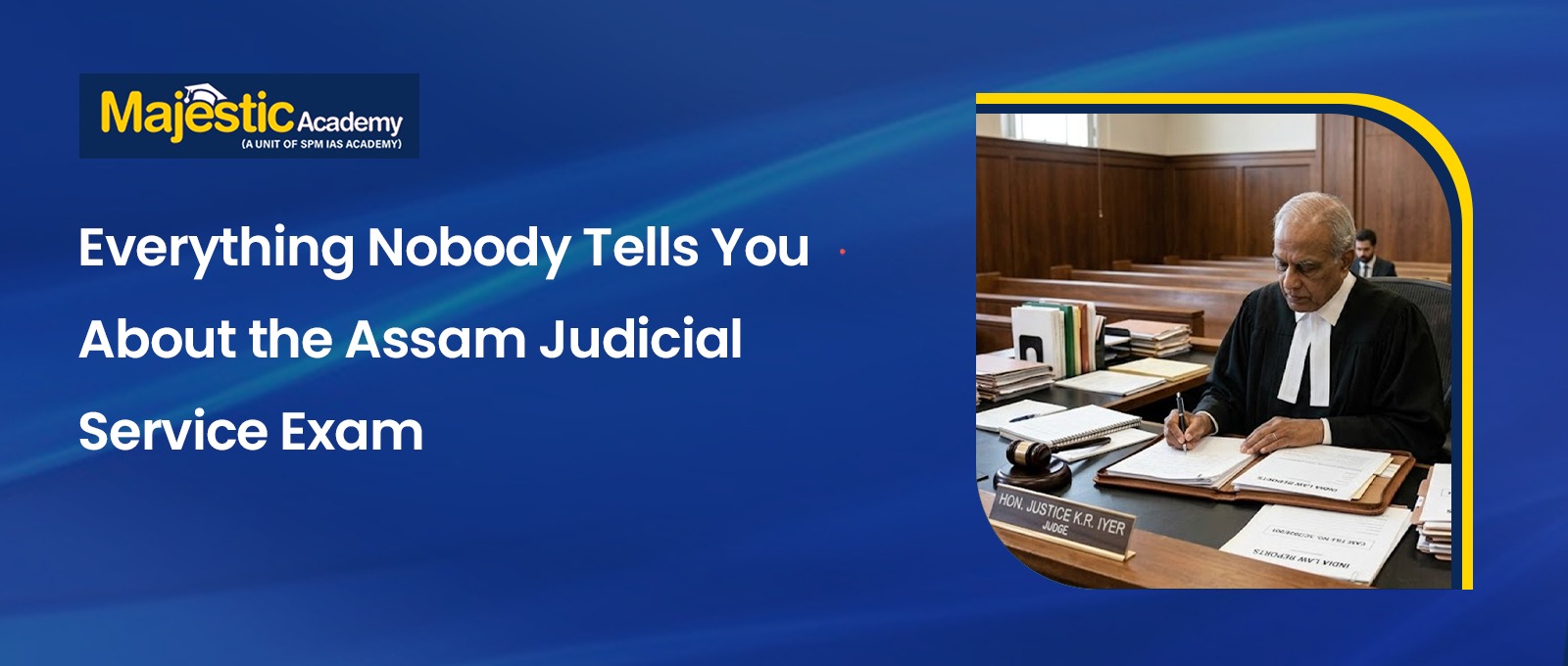
Most law graduates in Assam know the Assam Judicial Service exam exists. Far fewer actually understand how it works, and even fewer know the small but critical details that decide whether a well-prepared candidate clears it or misses by a few marks. This article includes everything from eligibility and exam structure to the syllabus, salary, preparation strategy, and the interview round in a direct, practical way. For focused guidance and structured preparation, explore our Judicial Service Exam Coaching in Guwahati. With the right coaching and preparation strategy, candidates can approach the exam with greater confidence and clarity.
Who Is Eligible to Appear for the Assam Judicial Service Exam?
The eligibility bar for the Assam Judicial Service exam is straightforward but non-negotiable.
A candidate must hold a Degree in Law granted by a recognized university established by law in India. On the age front, general category candidates must not have completed 38 years of age as on the last date of receipt of applications. SC and ST candidates get a five-year relaxation, bringing their upper age limit to 43 years. There is no cap on the number of attempts, candidates can appear as many times as they want until they cross the applicable age threshold. Candidates who meet these eligibility requirements can strengthen their preparation with the right guidance and structured study plan. Enrolling in Judicial Service Exam Coaching can help aspirants prepare systematically for the different stages of the examination.
What Is the Selection Process for the Assam Judicial Service Exam?
The Assam Judicial Service exam is conducted in three stages: the Preliminary Examination, the Mains Examination, and the Viva Voce. Understanding each stage is important because the entire selection process follows a fixed qualification pattern and merit-based system.
- Preliminary Examination (Screening Test):
The first stage of the Assam Judicial Service exam is the Preliminary Examination. Candidates must score 60% or more to qualify for the next stage. The selection ratio is 1:10, which means ten candidates are shortlisted for the Mains for every vacancy. - Mains Written Examination:
Candidates must secure 60% aggregate marks in the Mains, along with at least 45% marks in each of Papers I to IV and 35% in Paper V (Official Language) to qualify for the interview. - Relaxation for SC and ST Candidates:
SC and ST candidates need 50% aggregate marks in the Mains, with at least 40% in each of Papers I to IV and 35% in the Official Language paper. - Official Language Paper:
Paper V is qualifying in nature. Although candidates must obtain the minimum qualifying marks, its score is not included in the final aggregate used for selection. - Viva Voce (Interview):
Candidates who clear the Mains are called for the interview in a 1:3 ratio, meaning three candidates are shortlisted for each post. - Minimum Interview Marks:
To be considered for the final merit list, candidates must secure at least 60% marks in the interview. - Final Selection:
The final merit list for the Assam Judicial Service is prepared on the basis of overall performance and the candidate’s suitability for the post. Candidates who want to improve their preparation strategy should also focus on understanding the complete selection process and preparing consistently for every stage. A detailed guide on Judicial Service Preparation can help candidates plan their studies, choose the right resources, and prepare more effectively.
What Does the Preliminary Examination Look Like?
The Preliminary Examination of the Assam Judicial Service exam is a screening test based on objective-type multiple-choice questions. The total paper carries 100 marks, out of which 90 marks cover the following subjects:
- General Knowledge
- Aptitude and English
- Constitution of India
- Code of Civil Procedure
- Criminal Procedure Code
- Transfer of Property Act
- Indian Contract Act
- Indian Penal Code
- Indian Evidence Act
- Law of Torts
The remaining 10 marks cover Proficiency in the Official Language of Assam. Scoring at least 60% in this stage is the minimum requirement to advance to the Mains. Given the 1:10 call ratio, competition at this stage is intense and accuracy across all subject areas matters enormously. For candidates looking for a structured approach to preparation, following the right study strategy can make a significant difference. You can also explore our detailed guide on Strategies to Crack Judicial Services Exams to understand practical preparation methods, subject-wise planning, and exam-focused techniques.
What Is the Mains Examination Structure?
The Mains is the most demanding stage of the Assam Judicial Service exam. It consists of four papers, each carrying 100 marks with a 2-hour duration, plus a qualifying language paper.
Paper 1 — English (100 Marks, 2 Hours) This paper tests Essay writing, Precise Writing, and Grammar. Strong written expression and command over the English language are essential here.
Paper 2 — General Knowledge (100 Marks, 2 Hours) This paper has an Objective Test and an aptitude test covering general awareness topics.
Paper 3 — Law Paper I (100 Marks, 2 Hours) This paper covers objective questions and law problems from the Transfer of Property Act, Constitution of India, Civil Procedure Code, and Indian Contract Act.
Paper 4 — Law Paper II (100 Marks, 2 Hours) This paper covers Indian Penal Code, Criminal Procedure Code, Law of Torts, and the Indian Evidence Act.
Paper 5 — Official Language Paper (50 Marks) This is a qualifying paper in Assamese. Candidates must secure at least 35% to meet the qualifying threshold. However, the marks from this paper do not count in the final aggregate.
To qualify for the interview, general category candidates need 60% overall with at least 45% in each of Papers 1 to 4. SC and ST candidates need 50% overall with at least 40% in each paper.
What Happens in the Viva Voce Stage?
The Viva Voce or Interview of the Assam Judicial Service exam carries 50 marks and tests far more than legal knowledge. This round assesses legal reasoning, communication skills, ethical judgment, and the candidate’s overall suitability for the role of a judicial officer.
Candidates must score a minimum of 20 marks out of 50 in the interview to qualify and be considered for the final merit list. The final evaluation follows the order of merit based on overall suitability of the candidate.
What Is the Salary of a JMFC in Assam?
The entry-level salary for a Judicial Magistrate First Class, Grade III of the Assam Judicial Service, also referred to as a Civil Judge Junior Division, is among the most attractive starting packages in state government service.
| Component | Details |
| Starting Basic Pay | Rs. 77,840 per month |
| Maximum Basic Pay | Up to Rs. 136,520 per month (after career progression increments) |
| Gross Monthly Salary | Approximately Rs. 113,000 per month (varies based on current DA rate) |
Beyond basic pay, selected candidates also receive:
- Dearness Allowance (DA) — revised periodically based on government rates
- House Rent Allowance (HRA)—as per state rules, or official residential accommodation
- Medical Allowance, Travel Allowance, and Sumptuary Allowance — as applicable
The combination of basic pay, DA, and other allowances makes the Assam Judicial Service exam one of the most financially rewarding state-level government career paths for law graduates in the Northeast.
How Should You Actually Prepare for the Assam Judicial Service Exam?
Success in the Assam Judicial Service exam requires an integrated approach. Since the Prelims and Mains are closely connected, candidates should prepare for both stages together from the very beginning.
- Analyse the Syllabus Thoroughly: Start by understanding the complete syllabus, including general knowledge, aptitude, English, professional legal knowledge, and Assam-specific laws. This will help you divide your study time effectively.
- Focus on Bare Acts: Bare Acts are the foundation of the Assam Judicial Service exam. Give special attention to the IPC, CrPC, CPC, Indian Evidence Act, Constitution, Contract Act, Transfer of Property Act, and the Law of Torts.
- Study Assam-Specific Laws Carefully: Laws such as the Assam Land Revenue Regulation, 1886, and other state laws are important parts of the syllabus. A strong command of these subjects can give candidates a significant advantage.
- Use Digital Resources Wisely: Educational videos, legal current affairs, and judgment analyses can help you understand difficult concepts. However, use them to support your reading, not replace it.
- Practise Mock Tests and Previous-Year Papers: Regular mock tests and previous-year questions help you understand the exam pattern, improve time management, and strengthen your knowledge of procedural laws.
- Do Not Ignore the Language Paper: The Assamese language paper is qualifying in nature, but candidates must score at least 35% to reach the interview stage. Start preparing early, especially if Assamese is not your first language.
- Prepare for the Interview from the Beginning: The interview tests legal knowledge, communication skills, and ethical reasoning. Stay updated with recent judgments and practise expressing your views clearly.
- Maintain a Healthy Study Routine: Preparing for the Assam Judicial Service exam is a long journey. Follow a balanced schedule, take regular breaks, and protect your mental well-being to avoid burnout.
Is the Assam Judicial Service Exam Tougher Than UPSC?
This comparison comes up frequently among law graduates, and the honest answer is that it depends on individual strengths. UPSC has a broader, more unpredictable general studies syllabus covering history, geography, polity, economy, science, and current affairs at a level of depth that spans multiple optional subjects. Its overall success rate is under 1%, making it statistically one of the hardest exams in India.
The Assam Judicial Service exam, on the other hand, demands deep specialized knowledge of law, the ability to apply statutory provisions to practical problems, and strong judgment-writing skills in the Mains. Both exams are genuinely tough, but in different ways. UPSC tests breadth and balance across a vast range of subjects. The judiciary exam tests depth within a defined legal domain. Which one is harder genuinely depends on whether your natural strength lies in broad generalized learning or deep specialized legal understanding.
Conclusion
The Assam Judicial Service exam is one of the most demanding and most rewarding career paths a law graduate from Assam can pursue. The three-stage process, Preliminary Examination, Mains Written Examination, and Viva Voce, tests legal knowledge at depth, written expression in English, general awareness, Assamese language proficiency, and the kind of personality and ethical clarity that judicial work demands. Approaching the exam with a structured plan means studying bare acts thoroughly, giving serious time to Assam-specific laws, practicing with previous year papers consistently, preparing the language paper from the start, and building interview readiness alongside written preparation. None of these can be done in the final few weeks, this exam rewards candidates who start early, stay consistent, and treat every stage of the process with the respect it deserves.
Start preparing today, stay committed to the plan, and give yourself the realistic shot this exam demands.
Frequently Asked Questions
What is the upper age limit for the Assam Judicial Service exam?
General category candidates must not have completed 38 years of age as on the last date fixed for receipt of applications. SC and ST candidates receive a relaxation of five years, placing their upper age limit at 43 years. There is no restriction on the number of attempts as long as the candidate remains within the applicable age threshold.
Is there a restriction on the number of attempts?
No, there is no cap on attempts. Candidates can appear in the exam as many times as they wish until they exceed the official age limit applicable to their category. This means consistent, year-on-year preparation and reattempting after reviewing weak areas is a completely valid and common strategy.
What is the passing criteria for the Viva Voce round?
Candidates must score at least 20 marks out of 50, which is 40% of the total, in the personal interview stage to qualify and be included in the final merit list. The interview also carries a minimum of 60% as the qualifying threshold according to the selection procedure, so both the absolute minimum score and the merit-based evaluation matter here.
Also read …

Majestic Academy is a trusted coaching institute offering result-oriented SSC Coaching, Banking Coaching, and ADRE Coaching for competitive exam aspirants. Serving students across Guwahati and Assam, we provide structured preparation with expert faculty, updated study materials, and regular mock tests. Our specialized RRB Coaching in Guwahati helps railway exam candidates build strong fundamentals and gain exam confidence. We also offer focused TET Coaching in Guwahati for aspiring teachers with concept-based learning and exam-oriented guidance. At Majestic Academy, we are committed to quality education, clear mentoring, and consistent student success.