
Scoring 180+ in SSC CGL Tier 1 sounds like a distant goal when you first start preparing, but the data tells a different story. Only 2.8% of SSC CGL candidates actually cross the 180-mark threshold in Tier 1, yet this score virtually guarantees Tier 2 qualification across all categories. The gap between a 160 and a 185 is not about studying more hours, it is about studying smarter, targeting the right topics, cutting out time-wasting mistakes, and building real exam temperament through consistent practice.
This blog lays out the exact framework that 180+ SSC CGL Tier 1 actually use, which topics to prioritize in each section, how to split your 60 minutes for maximum accuracy, and a proven 90-day schedule that builds both speed and precision together. If you are looking for a structured learning path with proper guidance and strategy-based preparation, you can explore this program for better clarity and practice. This SSC CGL Online Coaching is designed to help aspirants understand exam patterns, improve accuracy, and follow a disciplined study plan for better results.
The Research Behind This Strategy
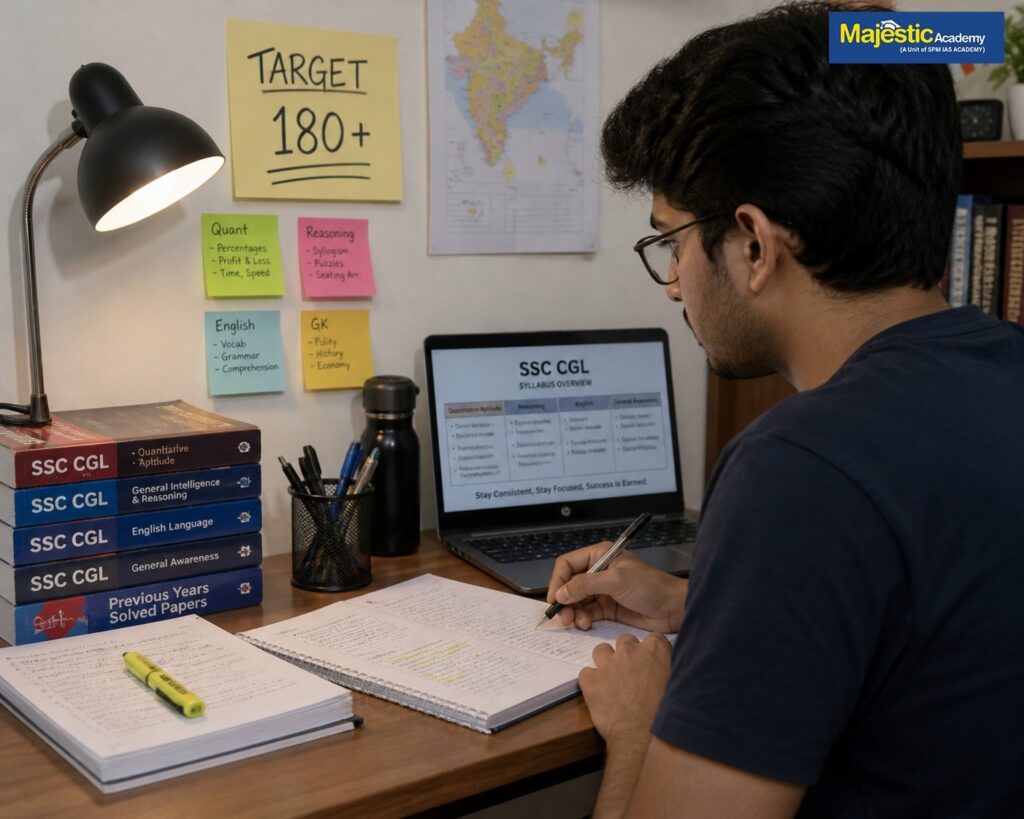
The preparation approach in this article draws from analyzing score patterns of 600-plus students who scored 175 or above in SSC CGL Tier 1 between 2022 and 2024. The goal was to separate what actually works from generic advice that sounds good on paper but does not translate into real marks on exam day.
What this analysis consistently showed is that 180+ in SSC CGL Tier 1 share a very specific set of habits, around topic prioritization, time distribution, mock test usage, and mistake management. The sections below break all of that down clearly. If you are looking for structured preparation guidance, enrolling in a focused coaching program can help you improve consistency and accuracy. This SSC CGL Coaching in Assam program is designed to help aspirants strengthen their concepts and improve overall exam performance.
Section-Wise Target Setting — Your 180+ Blueprint
Before you start preparing, you need a realistic mark-wise target for each section. According to the official SSC marking scheme, each correct answer earns +2 marks and each wrong answer costs 0.50 marks. This means accuracy carries far more weight than raw attempts, and your section targets need to reflect that.
Here is the target breakdown that consistently produces 180+ in SSC CGL Tier 1:
| Section | Target Marks | Correct Questions | Allowed Wrong |
| Quantitative Aptitude | 48 – 50 | 24 – 25 | 0 – 1 |
| General Intelligence and Reasoning | 48 – 50 | 24 – 25marks, | 0 – 1 |
| English Comprehension | 42 – 45 | 22 – 23 | 2 – 3 |
| General Awareness | 42 – 45 | 22 – 23 | 2 – 3 |
| Total | 180 – 190 |
To understand why this distribution works, consider Karthik from Chennai, who scored 184.50 in SSC CGL 2026 Tier 1 using almost exactly this split, 50 in Quant, 48 in Reasoning, 43 in English, and 43.50 in GK. His strategy centered on getting near-perfect scores in Quant and Reasoning while accepting 3 to 4 mistakes in English and GK, where unpredictability runs higher.
The logic is straightforward. Quant and Reasoning are skill-based sections where consistent practice eliminates errors. English and GK always carry some unpredictable elements, idioms you have never seen, current affairs questions you happened to miss. Targeting 100% accuracy in those two sections is unrealistic even for top scorers. The 48-48-43-43 split builds in a buffer for unexpected difficulty while still hitting 180 comfortably. For a more detailed breakdown of the SSC CGL syllabus, exam pattern, and section-wise analysis, you can refer to the complete guide below for better clarity and preparation strategy. SSC CGL Syllabus and Exam Analysis This detailed guide will help you understand how each section is structured and how you can plan your preparation more effectively around the actual exam pattern.
The 90-Day Preparation Timeline for 180+ in SSC CGL Tier 1
A structured 90-day plan divides your preparation into three phases, foundation building, speed development, and exam simulation. Each phase has a specific purpose, and skipping or rushing through any one of them weakens the whole structure.
Phase 1 — Foundation Building (Days 1 to 45)
The first 45 days focus entirely on covering the complete syllabus with genuine conceptual clarity. Move through Arithmetic over 15 days, Algebra and Geometry over 12 days, all Reasoning types over 10 days, and English grammar rules over 8 days. This phase is not about speed, it is about understanding.
Your daily study schedule in this phase should run 4 to 5 hours, divided as follows: 90 minutes on Quantitative Aptitude, 75 minutes on Reasoning, 60 minutes on English, 45 minutes on GK, and 30 minutes on revision of the day’s material.
The most important activity in this phase is solving 50 to 60 questions daily from previous year SSC CGL papers. This gives you a clear feel for SSC’s actual question patterns early in your preparation. Do not attempt full-length mocks yet, build accuracy first, and speed comes in the next phase.
Phase 2 — Speed Building (Days 46 to 75)
Once your foundation is solid, the second phase shifts the focus to solving questions under real time pressure. Start practicing 25-question sectional tests with 15-minute timers. Your target for this phase is to complete the Quant section in 17 to 18 minutes and the Reasoning section in 16 to 17 minutes, maintaining 95-plus percent accuracy throughout.
From Day 46 onward, take one full-length mock every four days. After every mock, spend time analyzing it seriously, identify which question types eat up the most time, where silly mistakes keep happening, and which topics still need revision work.
One of the most important activities in this phase is building an error log. Categorize every mistake under one of three types, conceptual gaps, calculation errors, or time pressure mistakes. Each type needs a different fix, and knowing which type affects you most helps you correct it faster.
Phase 3 — Exam Simulation (Days 76 to 90)
The final 15 days are entirely about exam simulation. Take two to three full-length mocks every week under strict exam conditions, 60 minutes, no breaks, same time of day as your actual exam. Practice the exact question-solving sequence you plan to follow on exam day.
The sequence that most 180+ in SSC CGL Tier 1 scorers follow is: Reasoning first (16 minutes), then Quant (18 minutes), then English (15 minutes), and finally GK (11 minutes), leaving a small buffer for review. This order works because Reasoning builds confidence early, while Quant benefits from a fresh and focused mind right after.
The goal of this phase is to perfect your timing strategy and build the mental stamina to stay sharp through all 60 minutes without a single wasted moment. For a complete breakdown of salary structure, allowances, and in-hand pay details, you can refer to the official guide below. SSC CGL Salary 2026 This guide will help you understand how your preparation strategy aligns with real salary growth and job benefits in SSC CGL.
High-Yield Topics That Build Your 180+ Score
Not all topics in the SSC CGL Tier 1 syllabus carry equal weight. Strategic preparation puts 70% of your effort into topics that consistently appear in 15 to 20 questions every single year. Here is the full breakdown by section:
Quantitative Aptitude — High-Yield Topics
Arithmetic (12 to 14 questions every year) This is the single biggest scoring zone in the Quant section. Percentage, Profit and Loss, Simple and Compound Interest, Ratio and Proportion, Average, Time and Work, and Time and Distance together account for nearly half the Quant paper. Mastering these topics is non-negotiable for anyone targeting 180+ in SSC CGL Tier 1.
Algebra (3 to 4 questions) Linear equations, quadratic equations, and basic algebraic identities form this cluster. These questions are generally straightforward once you get comfortable with the patterns SSC uses repeatedly.
Geometry (5 to 6 questions) Triangles, circles, and mensuration-based questions appear consistently across years. The geometry questions in SSC CGL follow recognizable patterns, which makes previous year paper practice particularly effective here.
Trigonometry (2 to 3 questions) Basic trigonometric ratios, standard identities, and heights and distances questions round out the Quant section.
General Intelligence and Reasoning — High-Yield Topics
Verbal Reasoning (8 to 10 questions): Coding-Decoding, Blood Relations, Direction Sense, Syllogism, and Statement and Conclusions are the core topics here. These appear in virtually every SSC CGL paper without exception.
Non-Verbal Reasoning (8 to 10 questions), Series, Analogy, Classification, Mirror and Water Images, and Paper Folding are the most frequently tested non-verbal topics. Once you recognize the underlying patterns in each type, these become highly scorable questions.
Miscellaneous (5 to 7 questions), Venn Diagrams, Mathematical Operations, and Odd One Out questions round off this section.
The data from 500-plus successful candidates shows a clear and consistent pattern; those who scored 180+ in SSC CGL Tier 1 maintained 95-plus percent accuracy on these high-yield topics while scoring around 60 to 70% on advanced or unpredictable questions. Master these core topics first, and only then spend time on anything more advanced.
Speed and Accuracy — The Core Formula for 180+ in SSC CGL Tier 1
The most common mistake that average scorers make is attempting all 100 questions and getting 15 to 20 wrong. The math works heavily against this approach. Smart scorers attempt 85 to 90 questions with 90-plus percent accuracy, understanding that 85 correct answers (170 marks) beats 75 correct plus 15 wrong (150 minus 7.5 = 142.5 marks) by a wide margin.
Here are the proven time benchmarks for each section that 180+ in SSC CGL Tier 1 scorers consistently maintain:
| Section | Time Per Question |
| Quantitative Aptitude | 45 – 50 seconds average (some in 20 seconds, some up to 90 seconds) |
| General Intelligence and Reasoning | 40–45 seconds average |
| English Comprehension | 30 – 35 seconds (Reading Comprehension: 60 – 90 seconds) |
| General Awareness | 20 – 25 seconds (you either know it or you do not) |
Building Speed Without Sacrificing Accuracy
Practice question-level time limits rather than just tracking section totals. Use a stopwatch to measure how long individual questions actually take you. If any question crosses 90 seconds without a clear path to the answer, mark it for review and move on immediately. No single question justifies spending two-plus minutes when you have 100 questions to get through in 60 minutes.
Aman from Delhi improved his score from 172 to 189 by implementing a simple 60-second rule. Any Quant or Reasoning question he could not crack within 60 seconds got skipped without hesitation. This one change eliminated time drain and pushed his accuracy on the questions he did attempt from 82% up to 94%.
Mock Test Strategy — How 180+ Scorers Actually Use Mocks

Taking mocks without analyzing them properly wastes a significant amount of preparation time. Top scorers treat every mock as a learning tool, not just a score indicator. Here is the full approach they follow:
Before Every Mock
Take the mock on a computer-based interface since the SSC CGL runs as a CBT exam. Simulate exact exam conditions, 60 minutes, no breaks, the same time of day every single time. Keep rough paper and pen ready for calculations, exactly as you will have them in the actual exam hall.
After Every Mock — Two Hours of Analysis
First, identify your mistake patterns and sort them into three categories, silly errors, conceptual gaps, and time pressure mistakes. Second, review every question in the paper, including the ones you got correct, and check whether faster solution methods exist. Third, build a topic-wise accuracy chart that shows you which topics consistently produce errors. Fourth, track your time distribution across sections and spot whether you spend too long on low-weightage questions.
Mock Score Progression Targets
| Mock Range | Target Score | Primary Focus |
| Mocks 1 to 3 | 140 – 155 | Complete all sections and identify weak areas |
| Mocks 4 to 8 | 160 – 170 | Improve speed, reduce silly mistakes |
| Mocks 9 to 15 | 175 – 185 | Perfect exam strategy: build consistent accuracy |
| Final 5 mocks | 185+ | Fine-tune timing, build exam-day confidence |
Tracking data from 800-plus students shows a reliable pattern; those who scored 180+ in SSC CGL Tier 1 in their final five mocks also scored 175 to 190 in the actual Tier 1 exam. Mock performance is the most dependable predictor of real exam performance, which is why mock quality matters far more than mock quantity.
Action Plan Based on the Time You Have
If You Have 90 or More Days
Follow the complete three-phase strategy from this blog. Cover the full syllabus with proper depth in Phase 1, shift to speed building in Phase 2, and simulate exam conditions in Phase 3. Take 20-plus full-length mocks before exam day. Target 185-plus in your final mocks, and you walk into the actual exam with full confidence for 180+ in SSC CGL Tier 1.
If You Have 45 to 60 Days
Skip low-weightage topics like Data Sufficiency, Advanced DI, and Complex Geometry. Focus exclusively on the high-yield topics listed in this blog. Start taking full mock tests from Day 15 itself do not wait until you finish the full syllabus. Target 175 to 180, and remember that every single additional mark matters when the competition is this tight.
If You Have Less Than 30 Days
Work through previous year SSC CGL papers from 2019 to 2024 repeatedly. Practice speed on topics you already know well rather than trying to absorb new material in a short time. Take one mock daily and spend one focused hour analyzing it afterward. In this timeframe, your biggest gains come from eliminating silly mistakes, not from learning entirely new topics.
As a realistic expectation, a full 90-day preparation cycle can move most candidates from the 140 to 150 range up to 180+ in SSC CGL Tier 1. With less time available, how much you improve depends directly on your current baseline and the intensity you bring to every remaining day.
Conclusion
Scoring 180+ in SSC CGL Tier 1 is not a mystery reserved for a handful of exceptionally gifted candidates, it is a repeatable outcome when you follow a structured plan that targets the right topics, manages time precisely, and treats every mock test as a real learning tool rather than just a score to screenshot. Start with an honest assessment of where you currently stand, choose the action plan that matches your available time, and commit to the daily schedule without exceptions. The candidates who score 180+ in SSC CGL Tier 1 are not always the most naturally talented people in the room, they are the ones who prepare with the clearest purpose and execute their strategy with the most consistency right up to exam day.
Frequently Asked Questions
How many hours daily should I study to score 180+ in SSC CGL Tier 1 in 3 months?
You need 4 to 5 hours of genuinely focused daily study over 90 days to realistically target 180+ in tier 1. The daily split that works best looks like this, around 90 to 100 minutes on Quantitative Aptitude, 75 to 80 minutes on Reasoning, 60 minutes on English, 45 minutes on GK, and 30 to 45 minutes on mock analysis and revision. The most important thing to understand is that quality matters far more than the total number of hours on the clock. Four hours of deep, distraction-free practice consistently beats eight scattered hours where attention keeps drifting. Taking one complete off-day every week also helps significantly, it prevents burnout and actually improves how well your brain retains everything you studied through the rest of the week.
Which section should I solve first in the SSC CGL Tier 1 exam?
Most candidates who score 180+ in Tier 1 start with Reasoning because it builds early accuracy and sets a confident tone for the rest of the paper. They then move to Quant while the mind is still fresh, and finish with English and GK toward the end. However, the right starting section for you personally depends on your own strengths. The section you feel most comfortable in often works well as your opener because it creates momentum. What matters far more than which section you start with is that you pick one fixed sequence, practice it in every single mock test until it becomes completely automatic, and then stick with it on exam day without any last-minute changes. Experimenting with a new sequence on the actual exam after training with a different one in your mocks is one of the easiest ways to lose valuable minutes to unnecessary hesitation.
Is negative marking a major concern when targeting 180+ in Tier 1?
Negative marking is one of the most important strategic factors to understand when targeting 180+ in Tier 1, because it directly shapes how many questions you should attempt. The math is simple but many candidates ignore it entirely, attempting 90 questions with 88 correct gives you 176 minus 1, which equals 175 marks. But attempting 95 questions with 85 correct gives you 170 minus 5, which is only 165 marks. The higher attempt count with slightly lower accuracy actually produces a noticeably worse score. This is exactly why top scorers consistently attempt 85 to 92 questions, while candidates scoring in the 150 to 160 range tend to attempt 95 to 100 questions with lower accuracy. The rule to follow is direct, skip any question where you are genuinely guessing without any reasoning basis. Protect your marks for questions you can actually solve with confidence, and let the blind guesses go entirely.

Majestic Academy is a trusted coaching institute offering result-oriented SSC Coaching, Banking Coaching, and ADRE Coaching for competitive exam aspirants. Serving students across Guwahati and Assam, we provide structured preparation with expert faculty, updated study materials, and regular mock tests. Our specialized RRB Coaching in Guwahati helps railway exam candidates build strong fundamentals and gain exam confidence. We also offer focused TET Coaching in Guwahati for aspiring teachers with concept-based learning and exam-oriented guidance. At Majestic Academy, we are committed to quality education, clear mentoring, and consistent student success.