
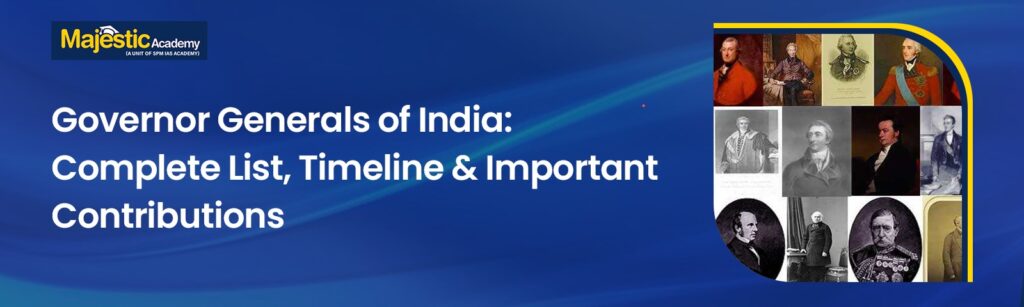
The Governor Generals of India played an important role in shaping the administrative, political, and constitutional framework of British India. Specifically, they were appointed by the British Crown or the East India Company. These officials governed India during the colonial period. Moreover, they introduced several reforms that deeply influenced India’s history.
In this article, we will look into the Governors General of India and their contributions. It benefits those engaged in academic studies of modern Indian history.
Who Was the Governor-General of India?
The Governor-General of India was the highest authority in British India from 1773 to 1947.
Initially, the post was known as the Governor-General of Bengal, but after 1833, the office was formally designated as Governor-General of India, with control over all British territory in India.
British rule over India began as a trading enterprise when the East India Company received a Royal Charter from Queen Elizabeth I on December 31, 1600. Over nearly three centuries, the British transformed from a trading power into one of the most influential countries in the world. Despite being a small island nation, Britain established one of the largest empires in history, famously described as “the empire on which the sun never sets.”
This remarkable achievement was supported by a strong and efficient bureaucracy established in its colonies. In India, the British maintained control through the roles of the Governor-General and Viceroy.
1. Governor Generals of Bengal (1773-1833)
When the East India Company arrived in India, it established control over Bengal through a position known as the “Governor of Bengal,” with Robert Clive being the first to hold this title. Each of the other presidencies—Bombay and Madras—had its own governor.
However, the Regulating Act of 1773 transformed the position of Governor of Bengal into the “Governor-General of Bengal,” with Warren Hastings as the first to occupy this role. Following this Act, the Governors of Bombay and Madras were required to operate under the authority of the Governor-General of Bengal.
2. Governor General of India (1833-58)
Under the Charter Act of 1833, the title of Governor-General of Bengal was changed to “Governor-General of India.” The first Governor-General of India was William Bentinck.
This post was mainly for administrative purposes and reported to the Court of Directors of the East India Company.
List of Governor Generals of India (1773-1947)
The nomenclature has been changed from Governor Generals of Bengal to Governor-General of India. This change reflects the centralising nature of British power in India.
Additionally, after the Battle of Plassey, the title of Governor was altered to Governor General. This alteration was made to emphasise the authority that Bengal held over other presidencies.
| List of Governor Generals of India: | ||
| Governor-General | Tenure | Key Contributions |
| Warren Hastings | 1773–1785 | First Governor-General of Bengal, judicial reforms, Regulating Act of 1773 |
| Lord Cornwallis | 1786–1793 | Permanent Settlement, civil service reforms |
| Lord Wellesley | 1798–1805 | Subsidiary Alliance system |
| Lord Hastings | 1813–1823 | Suppression of Pindaris, expansion of British rule |
| Lord William Bentinck | 1828–1835 | Abolition of Sati, social reforms |
| Lord Auckland | 1836–1842 | First Anglo-Afghan War |
| Lord Ellenborough | 1842–1844 | Annexation of Sindh |
| Lord Hardinge I | 1844–1848 | First Anglo-Sikh War |
| Lord Dalhousie | 1848–1856 | Doctrine of Lapse, railway and telegraph introduction |
| Lord Canning | 1856–1862 | Last Governor-General of Company rule, Revolt of 1857 |
| Lord Lawrence | 1864–1869 | Policy of masterly inactivity |
| Lord Lytton | 1876–1880 | Vernacular Press Act, Delhi Durbar |
| Lord Ripon | 1880–1884 | Local Self-Government Act |
| Lord Curzon | 1899–1905 | Partition of Bengal, administrative reforms |
| Lord Minto II | 1905–1910 | Morley–Minto Reforms |
| Lord Hardinge II | 1910–1916 | Capital shift from Calcutta to Delhi |
| Lord Chelmsford | 1916–1921 | Montagu–Chelmsford Reforms |
| Lord Reading | 1921–1926 | Non-Cooperation Movement |
| Lord Irwin | 1926–1931 | Gandhi–Irwin Pact |
| Lord Willingdon | 1931–1936 | Civil Disobedience suppression |
| Lord Linlithgow | 1936–1943 | WWII period, August Offer |
| Lord Wavell | 1943–1947 | Wavell Plan, Simla Conference |
| Lord Mountbatten | 1947 | First and last Governor-General of Independent India |
Most Important Governor Generals of India
1. Warren Hastings (1773-1785)
The British administration was founded on solid principles. Firstly, various judicial reforms were introduced to enhance the legal system. Additionally, key players emerged during this period, particularly in relation to the Regulating Act of 1773. This act played a significant role in shaping governance and ensuring better management of British territories. Together, these efforts laid the groundwork for a more structured administrative framework.
2. Lord William Bentinck (1828-1835)
Lord William Bentinck served as the Governor-General of India from 1828 to 1835. During his tenure, he made significant strides in social reform. One of his most notable actions was the abolition of Sati in 1829. This practice, which involved the self-immolation of widows, was ended under his leadership.
Additionally, Bentinck promoted various education reforms. These initiatives aimed to improve the literacy and educational opportunities for the people of India. As a result, he is often regarded as the Father of Social Reforms in India. His contributions had a lasting impact on Indian society.
3. Lord Dalhousie (1848-1856)
Lord Dalhousie served as the Governor-General of India from 1848 to 1856. During his administration, he introduced the Doctrine of Lapse, which allowed the British to annex states without a male heir. This policy significantly expanded British control in India.
Additionally, he focused on improving infrastructure. Specifically, he expanded the railways, which facilitated better transportation. He also enhanced the postal system, making communication more efficient. Furthermore, he introduced telegraphs to modernise communication across the country. As a result, his tenure marked a period of significant change and expansion in British India.
4. Lord Curzon (1899-1905)
Lord Curzon served as the Viceroy of India from 1899 to 1905. During his tenure, he implemented significant changes, one of the most notable being the Partition of Bengal in 1905. This partition aimed to improve administrative efficiency.
However, it also sparked controversy and opposition among the Indian populace. In addition to this, Curzon introduced various reforms in education. These reforms sought to enhance the quality of learning institutions. Furthermore, he made changes in the police system to improve law enforcement. Lastly, his contributions to archaeology helped in the preservation and understanding of India’s rich historical heritage. Overall, Curzon’s time in office was marked by both reform and unrest.
5. Lord Mounbatten (1947)
Lord Mountbatten served as the last British Viceroy of India in 1947. He played an important role in overseeing India’s independence. Additionally, he managed the complex process of partitioning the country. This was a significant moment in history, marking the end of British rule in India. His leadership was pivotal during this transitional period, as the nation moved toward self-governance. The events that unfolded had lasting impacts on the subcontinent and the world.
Difference Between Governor-General and Viceroy
Below are the differences between the Governor General and the Viceroy:
| Governor-General | Viceroy |
| Represented the British government | Represented the British Crown |
| Term used mainly before 1858 | Title used after 1858 |
| Power under the East India Company | Power under the British monarchy |
Conclusion
In conclusion, the Governor Generals of India played an important role in establishing and expanding British rule. Their policies in administration, economics, and social issues had a lasting impact on India’s political landscape. Studying the Governors-General and their reforms helps us understand the foundations of modern Indian governance and colonial history.
Frequently Asked Questions
1. Who was the first Governor-General of India?
Warren Hastings was the first Governor-General of Bengal (1773–1785).
The post later evolved into the Governor-General of India under the Charter Act of 1833.
2. Who was the last Governor-General of British India?
Lord Mountbatten was the last Governor-General of British India and the first Governor-General of Independent India in 1947.
3. Which Governor-General abolished Sati?
Lord William Bentinck abolished the practice of Sati in 1829 through a legal regulation.
4. Who introduced the Doctrine of Lapse?
The Doctrine of Lapse was introduced by Lord Dalhousie to annex princely states without a natural heir.
5. Which Governor-General introduced the Subsidiary Alliance?
Lord Wellesley introduced the Subsidiary Alliance system to expand British control over Indian kingdoms.
6. Who partitioned Bengal in 1905?
Lord Curzon ordered the Partition of Bengal in 1905, which led to widespread protests and the Swadeshi Movement.
7. Which Governor-General introduced Local Self-Government in India?
Lord Ripon introduced Local Self-Government through the Resolution of 1882.
8. Who was the Governor-General during the Revolt of 1857?
Lord Canning was the Governor-General at the time of the Revolt of 1857.
9. Under which Governor-General was the Capital shifted from Calcutta to Delhi?
The capital of British India was shifted from Calcutta to Delhi in 1911 during the tenure of Lord Hardinge II.
10. Which Governor-General introduced railways in India?
Lord Dalhousie introduced the railway system in India, with the first train running in 1853.