

For every competitive exam like SSC, Banking, UPSC, or State PSC, having a strong grip on the states and capitals of India is non-negotiable. It’s one of the fundamental topics that seems simple but often trips up candidates in the exam hall. Suppose you know the list of Indian states and capitals. In that case, it will make a quick way to improve your score, regardless of whether the question is “Match the following” in the SSC, “Arrange states by their capitals” in the banking exam, or “Name the capital of a newly formed state” in the UPSC preliminary exam. India has a total of 28 states and 8 Union Territories as of 2025, each of which has a capital city. Some capitals, like Delhi or Mumbai, are well-known, but less well-known but just as significant are Itanagar and Amaravati.
In this blog, you will find the list of states and capitals of India 2025 with easy-to-read tricks, region-wise breakdowns, historical formation dates, unique trivia, and smart memorisation techniques, which are designed to help you remember them effortlessly.
Why Learn the States and Capitals of India?
Before diving into the tables, it’s worth knowing why this topic is important:
- Exam relevance – First, common in GK sections across SSC CGL, CHSL, RRB NTPC, Banking, CDS, NDA, UPSC Prelims, and State PSCs.
- Static GK foundation – Second, this acts as a base for geography, polity, and current affairs questions.
- Map-based questions – Third, the capitals are often linked to river systems, historical events, or economic hubs.
- General awareness – Lastly, it improves your grasp of India’s diversity and federal structure.
Updated List of States and Capitals of India 2025
| State | Capital | Formation Date |
|---|---|---|
| Andhra Pradesh | Amaravati | 1 Nov 1956 |
| Arunachal Pradesh | Itanagar | 20 Feb 1987 |
| Assam | Dispur | 26 Jan 1972 |
| Bihar | Patna | 22 Mar 1912 |
| Chhattisgarh | Raipur | 1 Nov 2000 |
| Goa | Panaji | 30 May 1987 |
| Gujarat | Gandhinagar | 1 May 1960 |
| Haryana | Chandigarh | 1 Nov 1966 |
| Himachal Pradesh | Shimla | 25 Jan 1971 |
| Jharkhand | Ranchi | 15 Nov 2000 |
| Karnataka | Bengaluru | 1 Nov 1956 |
| Kerala | Thiruvananthapuram | 1 Nov 1956 |
| Madhya Pradesh | Bhopal | 1 Nov 1956 |
| Maharashtra | Mumbai | 1 May 1960 |
| Manipur | Imphal | 21 Jan 1972 |
| Meghalaya | Shillong | 21 Jan 1972 |
| Mizoram | Aizawl | 20 Feb 1987 |
| Nagaland | Kohima | 1 Dec 1963 |
| Odisha | Bhubaneswar | 1 Apr 1936 |
| Punjab | Chandigarh | 1 Nov 1966 |
| Rajasthan | Jaipur | 1 Nov 1956 |
| Sikkim | Gangtok | 16 May 1975 |
| Tamil Nadu | Chennai | 1 Nov 1956 |
| Telangana | Hyderabad | 2 Jun 2014 |
| Tripura | Agartala | 21 Jan 1972 |
| Uttar Pradesh | Lucknow | 24 Jan 1950 |
| Uttarakhand | Dehradun | 9 Nov 2000 |
| West Bengal | Kolkata | 1 Nov 1956 |
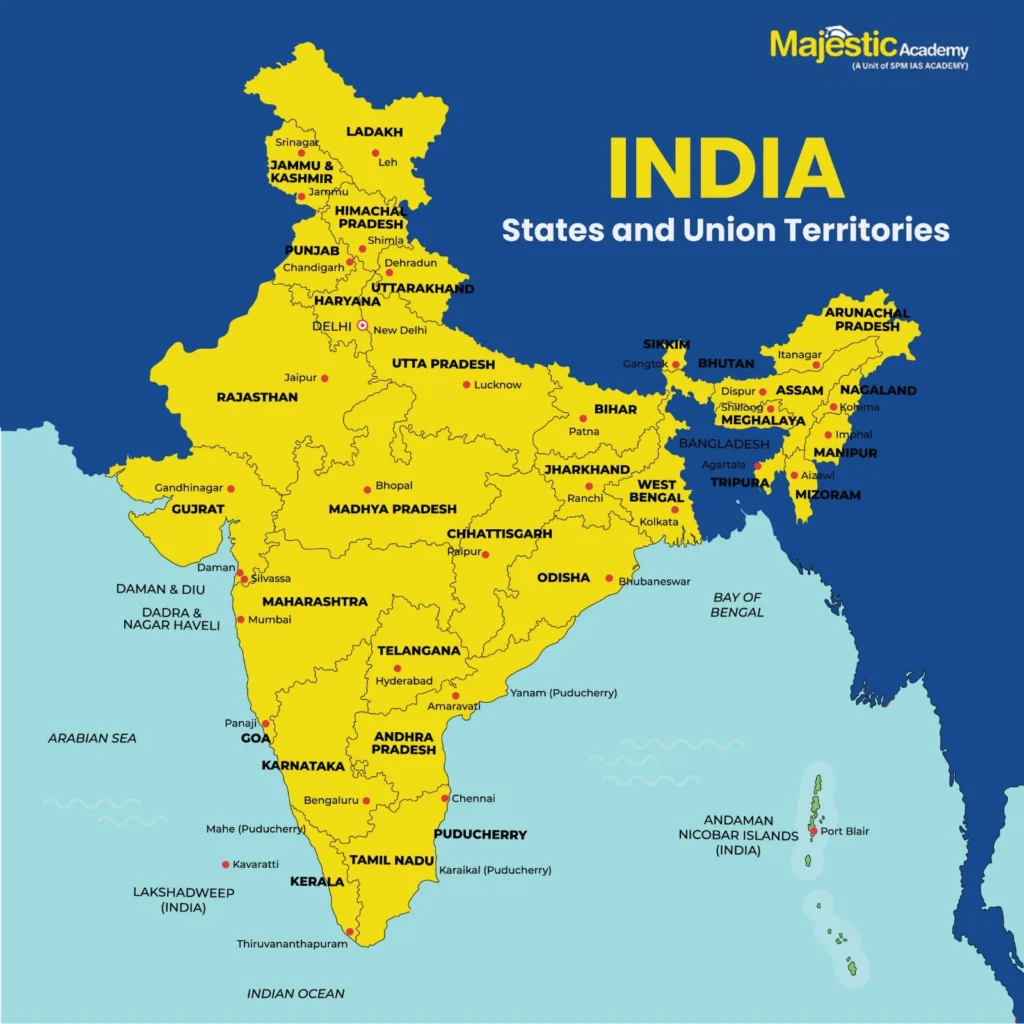
Union Territories and Their Capitals
| Union Territory | Capital |
|---|---|
| Andaman and Nicobar Islands | Port Blair |
| Chandigarh | Chandigarh |
| Dadra and Nagar Haveli and Daman and Diu | Daman |
| Delhi (NCT) | New Delhi |
| Jammu & Kashmir | Srinagar (Summer), Jammu (Winter) |
| Ladakh | Leh |
| Lakshadweep | Kavaratti |
| Puducherry | Puducherry |
Region-wise Grouping of States and Capitals
Breaking the states and capitals of India into regions makes learning faster.
Northern India
- Jammu & Kashmir – Srinagar/Jammu
- Himachal Pradesh – Shimla
- Punjab – Chandigarh
- Haryana – Chandigarh
- Uttarakhand – Dehradun
- Delhi (UT) – New Delhi
Southern India
- Andhra Pradesh – Amaravati
- Telangana – Hyderabad
- Karnataka – Bengaluru
- Tamil Nadu – Chennai
- Kerala – Thiruvananthapuram
- Puducherry (UT) – Puducherry
Eastern India
- Bihar – Patna
- Jharkhand – Ranchi
- Odisha – Bhubaneswar
- West Bengal – Kolkata
Western India
- Rajasthan – Jaipur
- Gujarat – Gandhinagar
- Maharashtra – Mumbai
- Goa – Panaji
- Dadra & Nagar Haveli and Daman & Diu (UT) – Daman
Northeastern India
- Assam – Dispur
- Arunachal Pradesh – Itanagar
- Manipur – Imphal
- Meghalaya – Shillong
- Mizoram – Aizawl
- Nagaland – Kohima
- Tripura – Agartala
- Sikkim – Gangtok
Historical Changes in States and Capitals
The list of states and capitals of India hasn’t always been the same. However, over the years, India has seen:
- 1956 – One this year, states reorganised based on language.
- 1960 – Maharashtra and Gujarat split from Bombay State.
- 1972 – Meghalaya, Manipur, and Tripura gained statehood.
- 2000 – Jharkhand, Chhattisgarh, and Uttarakhand were created.
- 2014 – Telangana was carved from Andhra Pradesh.
- 2019–2020 – Jammu & Kashmir split into two Union Territories; Dadra & Nagar Haveli merged with Daman & Diu.
Interesting Facts About States and Capitals
- Chandigarh serves as the capital for two states, i.e Punjab & Haryana.
- Leh is known as one of the highest capitals in the world (height-wise).
- Hyderabad is a shared capital between Telangana & Andhra Pradesh (under a temporary arrangement).
- Panaji is said to be India’s smallest state capital by population.
Memorization Tips for Aspirants
- Group by Region – First, try to learn 5–6 states at a time.
- Use Mnemonics – For example: “All Amazing Kids Try Making Good Toys” for Andhra, Arunachal, Kerala, Tamil Nadu, Maharashtra, Gujarat, Telangana.
- Practice with Maps – Try to label blank maps daily.
- Daily Revision – Repeat the list morning & evening.
- Flashcards – Digital or handwritten for quick recall and revision .
Conclusion
If you are serious about cracking SSC, UPSC, Banking, or any State PSC, you should never underestimate the importance of the states and capitals of India. This topic may seem static, but questions can come in direct, indirect, or map-based forms. So , try to keep revising the list of states and capitals of India 2025, practise regularly, and test yourself through quizzes and mock papers.
FAQs
A: There are 28 states in India and 8 Union Territories.
A: New Delhi.
A: Chandigarh – Punjab & Haryana.
A: You can copy the updated table from above or create your own flashcards for revision.