If you have a strong command of both Hindi and English and have been looking for a central government job that puts that skill to real use, this is the notification you have been waiting for. The Staff Selection Commission has officially released the Combined Hindi Translators Examination, 2026, notification, and with it comes a genuine opportunity to secure a Group B position in a central government ministry or department. SSC Translator Recruitment 2026 covers 84 posts across five different designations, and the application window is already open. The last date to apply online is May 14, 2026, so there is no time to sit on the fence.
Let us walk through every important detail you need, post names, pay scales, eligibility, exam patterns, and how to apply, so you can move forward with full clarity. For candidates planning multiple exams, don’t miss the detailed MAT 2026 Exam Schedule covering all four modes to plan your preparation effectively.
Overview of SSC Translator Recruitment 2026

The Staff Selection Commission conducts the Combined Hindi Translators Examination every year to fill translation-related roles across central government offices. Through SSC Translator Recruitment 2026, SSC aims to fill a total of 84 Group “B” non-gazetted posts. These positions fall under various ministries, departments, and organizations of the Government of India.
The five posts covered under this recruitment are Junior Hindi Translator (JHT), Junior Translation Officer (JTO), Junior Translator (JT), Senior Hindi Translator (SHT), and Senior Translation Officer (STO). The online application process started on April 23, 2026, and closes on May 14, 2026. The computer-based examination is tentatively scheduled for August to September 2026. For candidates preparing for multiple SSC exams, it is also helpful to review the SSC CGL Syllabus 2026 to understand the overall exam pattern and subjects.
Post-Wise Details and Pay Scale
SSC Translator Recruitment covers four broad categories of posts, each with specific pay levels. Here is a clear breakdown of what is on offer:
Post 1 — Junior Translation Officer (JTO) in Central Secretariat Official Language Service (CSOLS) The exact number of vacancies for this post has not been specified in the notification. The pay falls under Level-6 of the 7th Pay Commission, which translates to a pay range of Rs. 35,400 to Rs. 1,12,400 per month.
Post 2 — Junior Translation Officer (JTO) in Armed Forces Headquarters (AFHQ). Similar to Post 1, the vacancy count for this post has not been mentioned. The pay structure is identical, Level-6, with a salary range of Rs. 35,400 to Rs. 112,400.
Post 3 — Junior Hindi Translator (JHT) / Junior Translation Officer (JTO) / Junior Translator (JT) in various Central Government Ministries, Departments, and Organisations The number of posts under this category is also not specified individually. The pay level remains Level-6, covering Rs. 35,400 to Rs. 112,400 per month.
Post 4 — Senior Hindi Translator (SHT) / Senior Translator (ST) / Senior Translation Officer (STO) in various Central Government Ministries, Departments, and Organisations This is the senior-level post in SSC Translator Recruitment 2026, and it comes with a higher pay band. The pay falls under Level-7 of the 7th Pay Commission, with a salary range of Rs. 44,900 to Rs. 142,400 per month. The experience requirement for this post is also higher, as detailed in the eligibility section below. For candidates preparing for similar government exams, you can also explore SSC CGL Coaching to strengthen your overall preparation strategy.
Educational Qualification for SSC Translator Recruitment 2026
The educational qualification requirements for SSC Translator Recruitment are specific and must be read carefully before applying.
For Posts 1, 2, and 3 (Junior Level Posts):
Candidates need a master’s degree from a recognized university. The degree can be in Hindi with English as a compulsory or elective subject or as the medium of examination at the degree level. Alternatively, the master’s degree can be in English with Hindi as a compulsory or elective subject or as the medium at the degree level. Candidates with a Master’s degree in any subject other than Hindi or English are also eligible, provided Hindi was the medium, and English appeared as a compulsory or elective subject at the degree level, or vice versa, where English was the medium and Hindi appeared as a compulsory or elective subject. Another accepted combination is a Master’s degree in any subject other than Hindi or English, where both Hindi and English were compulsory or elective subjects, or one was the medium, and the other was a compulsory or elective subject at the degree level.
Along with the master’s degree, candidates must also hold either a recognized diploma or certificate course in translation from Hindi to English and vice versa or must have two years of translation experience from Hindi to English and vice versa in a central or state government office, including Government of India undertakings.
For Post 4 (Senior Level Posts):
The degree qualification conditions are exactly the same as Posts 1 to 3. The difference lies in the experience requirement, instead of two years, candidates for senior-level posts must have three years of translation experience from Hindi to English and vice versa in a Central or state government office, including Government of India undertakings. The diploma or certificate in translation also remains an accepted alternative.
Age Limit and Age Relaxation
For SSC Translator Recruitment 2026, the age limit is 18 to 30 years as on August 1, 2026. In practical terms, this means candidates must have been born not before August 2, 1996, and not later than August 1, 2008, to be eligible. For better preparation, you can also explore SSC CGL Coaching in Assam to strengthen your exam readiness.
The following category-wise age relaxations apply:
| Category | Age Relaxation |
| SC / ST | 5 Years |
| OBC | 3 Years |
| PwBD (Unreserved) | 10 Years |
| PwBD (OBC) | 13 Years |
| PwBD (SC / ST) | 15 Years |
Application Fee
The application fee structure for recruitment is straightforward. Fee payment happens only through online modes, BHIM UPI, Net Banking, or by using Visa, MasterCard, Maestro, or RuPay Debit cards. Cash payments and demand drafts are not accepted.
| Category | Application Fee |
| UR / EWS / OBC | Rs. 100/- |
| SC / ST / PwBD / ESM | Nil |
| Female (All Categories) | Nil |
Exam Pattern for SSC Translator Recruitment 2026
The Combined Hindi Translators Examination consists of two papers. Understanding the full exam structure is essential for building your preparation strategy from day one. Here is the complete scheme of examination:
| Part | Mode of Paper | Subject | Number of Questions / Maximum Marks | Duration |
| Paper I (Objective Type) | Computer-Based Mode | Part I: General Hindi | 100 / 100 | 2 Hours (with a sectional timer of 1 hour for each part); {2 hours and 40 minutes (with a sectional timer of 1 hr 20 minutes for each part) for candidates eligible for scribe as per Para. 6} |
| Part II: General English | 100 / 100 | |||
| Paper II | Descriptive | Translation & Essay | 200 Marks | 2 Hours (2 hours and 40 minutes for candidates eligible for scribe as per Para 6) |
Key Points About the Exam Pattern:
Paper I is an objective-type, computer-based examination. Questions come in the form of multiple-choice options only. The exam carries a total of 200 marks, 100 each for General Hindi and General English, with a strict sectional timer that gives you 1 hour per section. Candidates eligible for a scribe get 2 hours and 40 minutes, with 1 hour and 20 minutes per section.
There is a negative marking of 0.25 marks for each wrong answer in Paper I. This means careless guessing will actively damage your score, so accuracy matters just as much as speed. Keep this in mind during all your mock test practice.
If SSC conducts the computer-based examination in multiple shifts, marks get normalised using the procedure published by the commission vide notice dated June 2, 2025. The normalised scores then determine the final merit and cutoff marks.
Paper II is a descriptive exam carrying 200 marks. It covers translation and Essay. Candidates must translate one passage from Hindi to English and another from English to Hindi. On top of that, they must write an essay in both Hindi and English. The entire purpose of Paper II is to test genuine translation skill, language comprehension, and the ability to write precisely and effectively in both languages. The duration is 2 hours, or 2 hours and 40 minutes for candidates with scribe eligibility.
Based on the marks scored in Paper I, candidates get shortlisted category-wise to appear in Paper II. So, clearing Paper I is the first gateway, and Paper II determines the final rank.
Mode of Selection
The selection process for SSC Translator Recruitment runs across two stages, and the final merit list combines performance from both papers.
To qualify in Paper I, candidates need to meet the minimum qualifying marks. The minimum is 30% for unreserved category candidates, 25% for OBC and EWS candidates, and 20% for all other categories.
After shortlisting based on Paper I scores, candidates appear for Paper II. The final merit gets calculated using a weighted formula Paper I contributes 50% of its scores and Paper II contributes 100% of its marks. There may be separate category-wise cutoffs in both Paper I and Paper II.
The final rank and allotment of ministry, department, or organization happens based on the combined performance in both papers and the preference of posts and departments submitted by the candidate during application.
Indicative Syllabus
For Paper I, the questions test candidates on their understanding of Hindi and English language and literature, correct use of words, phrases, and idioms, and the ability to write both languages correctly, precisely, and effectively. The questions align with degree-level knowledge.
For Paper II, the focus shifts entirely to translation ability and essay writing. One passage goes from Hindi to English, and another from English to Hindi. The essay section tests how well candidates express ideas coherently and precisely in both languages. The difficulty of this paper matches the prescribed educational qualifications for the post applied for.
Important Dates for SSC Translator Recruitment 2026
Below are the important dates regarding the recruitment. So have a look
| Event | Date |
| Starting Date of Online Application | April 23, 2026 |
| Last Date of Online Application | May 14, 2026 |
| Schedule of Computer-Based Examination | August – September 2026 |
Candidates must apply well before the deadline to avoid last-minute technical issues on the SSC portal.
How to Apply for SSC Translator Recruitment 2026
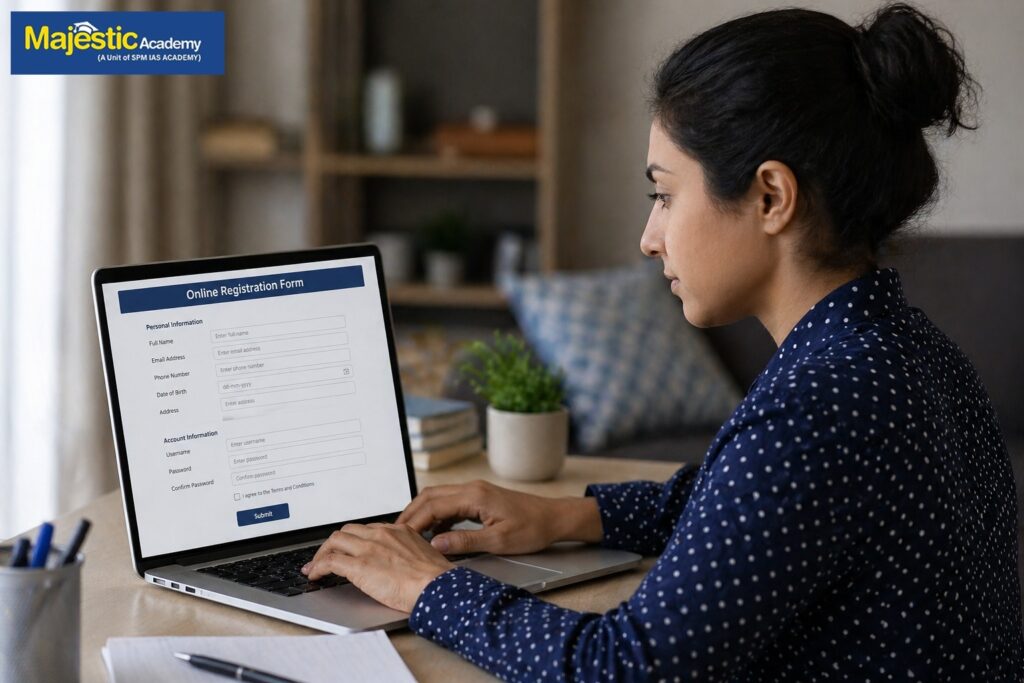
The application process runs entirely online through the official SSC recruitment portal at ssc.gov.in. Here is how to complete your application without any hassle.
Start by visiting ssc.gov.in. Scroll down to the Important Web-Links section on the homepage and click on the Online Application Form link. Complete the one-time registration process if you have not already done so. After registration, log in using your credentials and click on the Online Application Form link again. Fill in all your personal and educational details carefully and upload the required documents, including your photograph and signature. Once the form is complete, pay the application fee as per your category using any of the accepted online payment modes. Finally, submit the form and immediately take a printout of the completed application for your future reference.
Conclusion
SSC Translator Recruitment 2026 is a strong opportunity for language graduates who want a secure, well-paying central government career. With 84 posts on offer across five designations, a clearly structured two-paper selection process, and pay scales ranging from Level-6 to Level-7 under the 7th Pay Commission, this recruitment ticks all the right boxes for candidates with a master’s degree and a solid grip on both Hindi and English.The official notification is out, the portal is live, and the deadline is May 14, 2026. There is no better time to start than today.
Frequently Asked Questions
What is the total number of tentative vacancies for SSC JHT 2026?
SSC has announced a total of 84 vacancies under the Combined Hindi Translators Examination 2026. These 84 posts are spread across five designations, Junior Hindi Translator, Junior Translation Officer, Junior Translator, Senior Hindi Translator, and Senior Translation Officer, in various Central Government ministries, departments, and organizations, including the Central Secretariat Official Language Service and Armed Forces Headquarters. However, the post-wise breakup of the 84 vacancies has not been individually specified in the official notification. The actual distribution of posts across departments gets finalized closer to the time of selection and allotment. Candidates can check the official SSC notification at ssc.gov.in for the most up-to-date vacancy details as and when SSC releases further updates.
What are the application dates for SSC JHT 2026?
The online application process for SSC Translator Recruitment started on April 23, 2026, and the last date to submit the completed application form is May 14, 2026. This gives eligible candidates a window of approximately three weeks to register and fill in all required details. Since the portal typically experiences heavy traffic closer to the deadline, it is always smarter to apply a few days before May 14 rather than waiting until the final day. After the application window closes, the computer-based examination is expected to take place in August to September 2026. Candidates must keep an eye on the official SSC website regularly for updates on the examination schedule and admit card release dates.
What is the age limit for the SSC JHT 2026 recruitment?
The age limit for SSC Translator Recruitment is a minimum of 18 years and a maximum of 30 years, calculated as of August 1, 2026. In practical terms, candidates must be born on or after August 2, 1996, and on or before August 1, 2008, to fall within the eligible age range. Beyond the general limit, the government provides standard age relaxations for reserved and special categories. SC and ST candidates get 5 years of relaxation, OBC candidates get 3 years, PwBD unreserved candidates get 10 years, PwBD OBC candidates get 13 years, and PwBD SC/ST candidates get 15 years of relaxation over the upper age limit. Candidates must verify their exact date of birth eligibility before applying, as age-related ineligibility cannot be corrected after submission.