This is genuinely one of the most common questions every graduate preparing for competitive exams runs into, and most of the advice out there is either too vague or too biased. So let us have an honest, detailed look at SSC CGL vs banking vs State Govt exams, covering syllabus differences, exam patterns, salaries, work profiles, lifestyle, and a clear framework to help you make the right call for your specific situation.
Because the truth is, there is no universally correct answer. The right exam for you depends on your strengths, your lifestyle preferences, your location priorities, and where you want to be five years from now. If you are preparing for SSC CGL and want structured guidance, expert support, and a focused preparation strategy, SSC CGL Coaching in Assam can help you choose the right approach and prepare more effectively.
How Do the Exam Patterns and Syllabi Differ Across All Three?
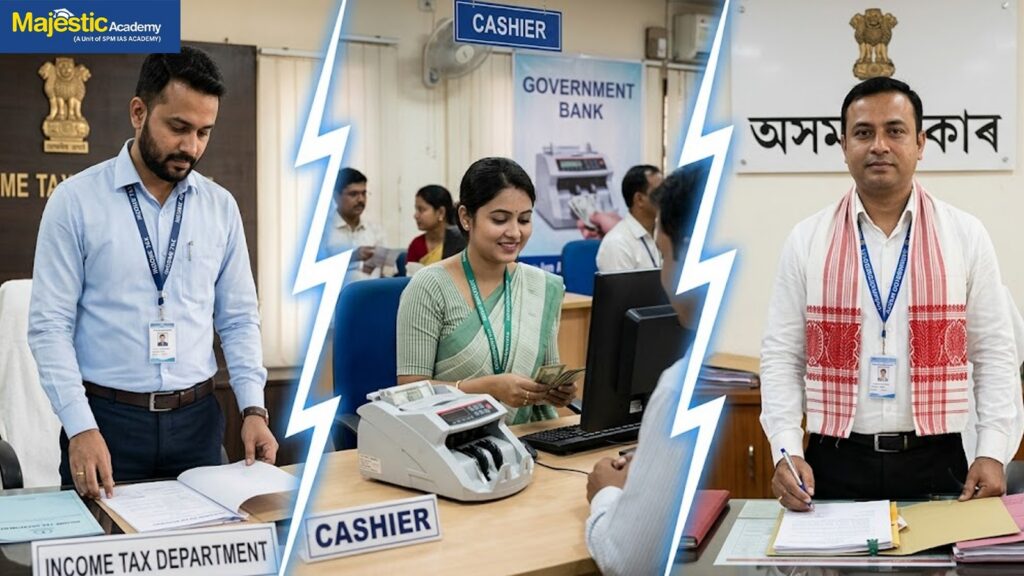
This is the first thing you need to understand before making any decision about SSC CGL vs banking vs State Govt exams. All three test the same broad subjects, Maths, English, Reasoning, and General Awareness, but the style, depth, and emphasis of each are completely different.
Here is a clear subject-wise breakdown:
| Subject | SSC CGL | Banking (IBPS/SBI PO) | Assam State Exams (ADRE & Police) |
| Quantitative Aptitude | Advanced Math — Algebra, Geometry, Trigonometry, Mensuration | Speed Math and Data Interpretation — DI, Simplification, Quadratic Equations | Basic Arithmetic — Percentage, Profit & Loss, Ratio — up to Class 10/12 level |
| Reasoning Ability | Verbal and non-verbal—Matrix, Mirror Images, Coding-Decoding | Complex analytical reasoning—Puzzles, seating arrangements, and Syllogisms | Basic logical puzzles, series completion, and analogy questions |
| English Language | Heavy grammar focus — Error Spotting, Idioms, Active/Passive Voice | Vocabulary and comprehension heavy—RC, Cloze Test, Para-Jumbles | Basic comprehension, grammar, synonyms, and antonyms |
| General Awareness | Static GK — History, Geography, Polity, Science, and National Current Affairs | Banking Awareness, Economy, Financial Trends, and Current Affairs | Assam GK—State History, Geography, Culture, Literature—and basic Current Affairs |
To put this simply, SSC CGL demands conceptual depth in math and broad static GK. For focused preparation, students can consider SSC CGL Coaching in Guwahati to build a structured study plan and strengthen their preparation. Banking demands speed, DI skills, and financial awareness. State exams like ADRE demand local knowledge and basic-level academic skills.
What Is the Recruitment Timeline for Each Exam?
When you are planning your career around a competitive exam, the timeline from notification to joining matters enormously, and this is one area where SSC CGL vs banking vs State Govt exams show a significant gap.
Banking exams through IBPS and SBI follow an extremely efficient cycle. From the notification release to the final joining letter, the entire process typically wraps up in 6 to 8 months. For someone who wants to start working quickly, this is a major practical advantage.
The SSC CGL historically ran a much slower process, often taking 1.5 to 2 years to complete the multi-tier selection, background verification, and posting. However, SSC has noticeably improved its pace in recent years, and the gap between the two has narrowed.
State government exams like ADRE vary by cycle, but they generally fall somewhere between the two, faster than the old SSC timelines but sometimes delayed by administrative processes specific to each state.
How Do the Job Profiles and Work-Life Balance Compare?
This is where SSC CGL vs banking vs State Govt exams diverge the most sharply, and for many candidates, this section alone should make the decision clear.
- Bank PO and clerk roles are customer-facing, high-pressure positions. You will deal with public complaints, sales targets for loans and account openings, frequent transfers across branches, and audit pressures. Promotions happen faster if you clear internal exams, but the day-to-day demands are intense. Work-life balance can be genuinely challenging in banking, especially at the branch level.
- SSC CGL posts — like Income Tax Inspector, Examiner, or Assistant Section Officer, are primarily administrative and desk-based. Working hours are typically fixed (9 to 5), public holidays apply, and the roles carry a level of bureaucratic authority. Promotions are slower and more seniority-linked, but the daily pressure level is considerably lower for most posts. However, not every SSC job is relaxed, some involve inspection duties and fieldwork, so the profile varies by post.
State government roles through ADRE and Assam Police offer guaranteed posting within the state, cultural familiarity, and lower academic difficulty compared to central exams. The trade-off is a lower pay scale compared to SSC CGL and banking at equivalent levels. Police roles additionally require physical fitness tests and carry physical risks associated with law enforcement duty.
What Are the Salary Differences Across All Three?
The salary structure is another critical differentiator when weighing SSC CGL vs banking vs State Govt exams.
- SSC CGL Salaries are governed by the 7th Pay Commission. Entry-level gross monthly pay ranges from around Rs. 40,000 at Pay Level 4 (Tax Assistant posts) to Rs. 80,000 and above at Pay Level 7 (Income Tax Inspector and similar posts). Standard central government allowances, Dearness Allowance (DA), House Rent Allowance (HRA), and Transport Allowance, apply across all SSC posts.
- Banking Salaries (PO/Scale I) are governed by the 12th Bipartite Settlement. The entry basic pay starts at Rs. 48,480, resulting in a gross monthly salary of approximately Rs. 74,000 to Rs. 76,500 or more. Banking also offers additional perks specific to the sector, leased housing arrangements, fuel reimbursements, and medical aid, which push the effective compensation higher than the gross figure alone suggests.
- Assam State Govt. job salaries fall in a lower range compared to both. ADRE Grade 3 posts carry a pay scale of Rs. 14,000 to Rs. 60,500, with an Rs. 8,700 grade pay, resulting in an in-hand monthly salary of approximately Rs. 34,242 after standard deductions. Assam Police Sub-Inspector posts follow a similar scale, Rs. 14,000 to Rs. 60,500 with Rs. 8,700 Grade pay, with an estimated take-home of Rs. 35,000 to Rs. 50,000, along with risk allowances. Assam Police Constable posts carry a monthly gross of approximately Rs. 25,000 to Rs. 30,000.
So in terms of pure salary, banking edges ahead at the entry level; SSC CGL comes close with better long-term perks in senior posts; and state exams trail both but offer the benefit of local posting.
What About Assam State Exams (ADRE and Assam Police) Specifically?
The Assam Direct Recruitment Examination (ADRE) and Assam Police recruitment fall under the SSC CGL vs banking vs State Govt exams conversation specifically for Northeast aspirants. These exams recruit for administrative Grade 3 and Grade 4 office staff as well as state law enforcement roles.
The pros are clear, guaranteed posting within Assam, lower mathematical difficulty compared to SSC CGL and banking, and questions rooted in state history and culture that local candidates naturally have an advantage in. However, ADRE also requires Assam Employment Exchange Registration as a mandatory condition, and police roles carry strict physical fitness standards and additional tests.
It is worth noting that ADRE exams carry negative marking. For standard 1-mark questions, there is a penalty of 0.25 marks per wrong answer. For higher-level 2-mark questions, such as reading comprehension in certain Grade 3 papers, a wrong answer leads to a deduction of 0.50 marks. Blind guessing is a risk not worth taking.
Which Exam Should You Actually Choose?
The decision across SSC CGL vs banking vs State Govt exams comes down to a few honest questions about yourself.
- Choose SSC CGL if you prefer desk-based administrative roles with fixed working hours, you have a genuine comfort with advanced Maths topics like Geometry and Trigonometry, you enjoy static GK covering History and Polity, you want a central government posting with career security, and you are comfortable with being posted outside your home state.
- Choose Banking (IBPS/SBI PO) if you are strong in arithmetic speed and Data Interpretation, you can handle customer pressure and branch targets, you are comfortable with frequent transfers, you want a faster promotion track through internal exams, and you prefer the financial sector environment over administrative bureaucracy.
- Choose State Govt Exams (ADRE/Assam Police) if your priority is staying in Assam, you know Assamese well and have strong familiarity with state history and culture, you prefer questions at a lower mathematical difficulty level, and you value local posting over a higher salary package.
What Is the Preparation Overlap Between All Three Exams?
Across SSC CGL vs banking vs State Govt exams, the common preparation ground covers basic arithmetic, English grammar fundamentals, and foundational reasoning. If you practice these well, the work is not entirely wasted regardless of which exam you eventually prioritize.
Plan your preparation in phases. In the first two months, build the common core, arithmetic, grammar, and basic reasoning. Then, if SSC CGL is your primary target, shift more time to advanced math and static GK. If banking is primary, shift to DI, puzzles, and banking awareness. If state exams are primary, shift to Assam-specific GK and basic comprehension at Class 10 to 12 level.
For official information on SSC CGL, always use the SSC official website for notifications, exam schemes, and results. For banking, use the IBPS website, SBI Careers, and the Reserve Bank of India’s official portal. Making career decisions based on social media hearsay rather than official sources leads to avoidable mistakes. For candidates preparing for banking examinations, choosing the right guidance and preparation strategy can make the process more structured and effective. If you are looking for dedicated guidance, you can explore Bank Coaching in Guwahati at Majestic Academy.
Conclusion
The SSC CGL vs banking vs State Govt exams debate does not have one correct answer, it has the right answer for you based on your strengths, lifestyle expectations, and career goals.
SSC CGL suits candidates who want administrative government roles with fixed hours and can handle advanced math and static GK. Banking suits those who thrive in fast-paced, customer-facing environments and excel at DI and speed arithmetic. State exams like ADRE and Assam Police suit those for whom staying close to home in Assam matters more than the highest possible salary and who have a natural advantage in local GK. Use this guide every time you feel confused about SSC CGL vs banking vs State Govt exams, and then get back to preparing.
Frequently Asked Questions
Can an outside-state candidate apply for ADRE or Assam Police?
No. Both ADRE and Assam Police require candidates to be permanent residents of Assam. A valid Permanent Resident Certificate (PRC) or an active Assam Employment Exchange registration number is mandatory during the application process. Candidates from other states are not eligible for these govt exams state-category positions.
Can I prepare for SSC CGL and banking exams at the same time?
It is genuinely difficult because the exam patterns are contrasting. SSC CGL needs deep knowledge in advanced mathematics and broad static GK, while banking requires extreme calculation speed, complex logic puzzles, and financial awareness. Dual preparation works only if you build a clear phase-based plan and designate one exam as primary from the beginning.
Is there negative marking in ADRE exams?
Yes, ADRE exams carry negative marking. For standard 1-mark questions, 0.25 marks get deducted per wrong answer. For higher-level 2-mark questions, such as reading comprehension in certain Grade 3 papers, the penalty is 0.50 marks per wrong answer. Blind guessing is strongly discouraged in all ADRE papers.
Also read …

Majestic Academy is a trusted coaching institute offering result-oriented SSC Coaching, Banking Coaching, and ADRE Coaching for competitive exam aspirants. Serving students across Guwahati and Assam, we provide structured preparation with expert faculty, updated study materials, and regular mock tests. Our specialized RRB Coaching in Guwahati helps railway exam candidates build strong fundamentals and gain exam confidence. We also offer focused TET Coaching in Guwahati for aspiring teachers with concept-based learning and exam-oriented guidance. At Majestic Academy, we are committed to quality education, clear mentoring, and consistent student success.