
The Dandi March, also known as the Salt March or Salt Satyagraha, was one of the most important events in India’s freedom struggle. Mahatma Gandhi led this march from 12 March 1930 to 6 April 1930. The main aim was to protest against the British salt tax. By breaking the Salt Law at Dandi, Gandhi started a nationwide movement against British rule. The Dandi March became the beginning of the Civil Disobedience Movement.
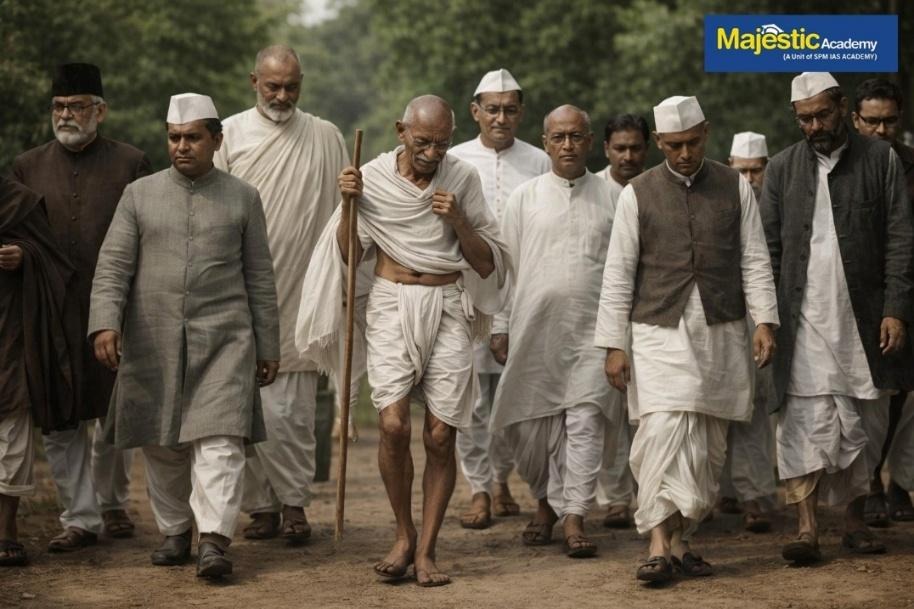
What is Dandi March?
The Dandi March or Salt Satyagraha was a historic nonviolent protest led by Mahatma Gandhi against the British Salt Law in 1930. To begin with, Gandhi started the 241-mile march on 12 March 1930 from Sabarmati Ashram with 78 followers. After walking for 24 days and passing through several villages, he reached the coastal village of Dandi on 6 April 1930. There, he symbolically broke the Salt Law by making salt from seawater. Consequently, this simple yet powerful act directly challenged British economic exploitation. As a result, the movement expanded into the nationwide Civil Disobedience Movement and became a major turning point in India’s freedom struggle.
Background of the Dandi March:
Political Situation Before 1930:
In December 1929, the Indian National Congress passed the Purna Swaraj (Complete Independence) resolution at Lahore. The Congress declared that India wanted full independence from British rule. On 26 January 1930, people across India celebrated Independence Day.
After this, the Congress gave Gandhi the responsibility to start a mass protest. Gandhi decided to protest against the British Salt Act of 1882. This law gave the British government full control over salt production and sale. Indians were not allowed to make their own salt, even near the sea. They had to buy salt from the government and pay tax.
Why Did Gandhi Choose Salt?
At first, some leaders did not support the idea of protesting against salt. However, Gandhi had strong reasons.
Salt was used daily by every Indian, whether rich or poor. The salt tax affected the poorest people the most. Therefore, the issue was simple and easy for common people to understand.
Moreover, salt became a symbol of British economic exploitation. Gandhi believed that this issue would unite the entire nation. As a result, salt became the focus of the movement.
Gandhi’s Idea of Satyagraha:
The Dandi March was based on Gandhi’s principle of Satyagraha, which means “insistence on truth.” Gandhi believed in nonviolence and peaceful protest. He always said that pure methods would lead to pure results.
Earlier movements had faced violence. However, Gandhi wanted strict discipline in this march. Therefore, he trained selected volunteers to follow nonviolence completely.
Preparation for the Dandi March:
Letter to Lord Irwin:
On 2 March 1930, Gandhi wrote a letter to Viceroy Lord Irwin. In the letter, he listed eleven demands. These included:
- Reduction of land revenue
- Abolition of the salt tax
- Reduction of military expenses
Gandhi said he would stop the march if the demands were accepted. However, the Viceroy did not respond positively. Therefore, Gandhi decided to begin the Salt Satyagraha.
Public Awareness and Media:
Gandhi informed newspapers about the march. Many Indian and foreign journalists came to cover the event. Thousands of people gathered at Sabarmati Ashram before the march began.
The Dandi March: Route and Journey:
On 12 March 1930, Gandhi started the march from Sabarmati Ashram with 78 followers. The march covered about 387 kilometres in Gujarat. It passed through 48 villages and lasted for 24 days.
Every day, Gandhi gave speeches in villages. He explained how the salt tax was unfair. Many people joined the march along the way. At Surat, nearly 30,000 people welcomed the marchers. By the time they reached Dandi, more than 50,000 people had gathered.
The marchers wore white khadi clothes. This symbolized unity and self-reliance.
Breaking the Salt Law at Dandi:
On 6 April 1930, Gandhi reached Dandi. After morning prayers, he picked up salty mud from the seashore. He boiled it and made salt illegally. By doing this, he broke the British Salt Law.
This simple act started a nationwide protest. People across India began making salt. They sold illegal salt openly. Many also burned foreign cloth and boycotted British goods.
Civil Disobedience Movement Spreads:
The Salt Satyagraha soon became a large-scale Civil Disobedience Movement. More than 60,000 people were arrested. Farmers refused to pay land taxes in many areas. In Bengal, people refused to pay certain local taxes.
The British government responded with strict laws and censorship. However, the movement continued peacefully in many parts of India.
Role of Women:
For the first time, women participated in large numbers. Women supported the movement in many ways. They made and sold salt. Moreover, they also picketed liquor shops and foreign cloth stores. Leaders like Sarojini Naidu played important roles. Women’s participation became a major feature of the Civil Disobedience Movement.
Dharasana Satyagraha:
After Dandi, Gandhi planned to protest at the Dharasana Salt Works. However, he was arrested on the night of 4-5 May 1930.
Even after his arrest, volunteers continued the protest. British police brutally beat peaceful protesters. American journalist Webb Miller reported this incident. His report was published worldwide and created sympathy for India.
Other Protests Across India:
The Salt Satyagraha inspired similar movements in other regions. C. Rajagopalachari led a Salt March in Tamil Nadu. In Peshawar, Khan Abdul Ghaffar Khan led peaceful protests.
In the Qissa Khwani Bazaar incident, British troops fired on peaceful protesters. Some Indian soldiers refused to fire at civilians. These events showed the strength of nonviolent resistance.
Impact of the Dandi March:
Immediate Impact:
The Dandi March received worldwide attention. Time magazine declared Gandhi “Man of the Year” in 1930. The British government felt pressure due to global criticism.
In 1931, Gandhi signed the Gandhi-Irwin Pact. After that, he attended the Second Round Table Conference in London.
Long-Term Impact:
Although India did not gain independence immediately, the movement strengthened the freedom struggle. It united people from different religions and regions. It also proved that nonviolent protest could challenge a powerful empire.
Moreover, the Dandi March later inspired global leaders like Martin Luther King Jr.
Important Dates of the Dandi March:
| Date | Event |
| 12 March 1930 | Gandhi started the Dandi March from Sabarmati Ashram with 78 followers. |
| 19 March 1930 | Thousands joined the march as it progressed through Gujarat. |
| 5 April 1930 | The march reached the village of Dandi. |
| 6 April 1930 | Gandhi broke the Salt Law by making salt from seawater. |
Assam’s Contribution in Dandi March 1930:
- Firstly, Leeladhar Barua of North Guwahati joined Mahatma Gandhi as one of the marchers at Sabarmati.
- Secondly, since Assam had no sea to violate the Salt Law, leaders chose to defy the British Forest Laws as an alternative form of civil disobedience.
- Moreover, the Assam Provincial Congress Committee (APCC) adopted the all-India programme of 1930-32. It included a boycott of foreign goods, opium, and liquor, along with defiance of repressive laws.
- On 22 March 1930, Ambikagiri Raychoudhury publicly urged people to begin Civil Disobedience by violating forest regulations.
- Meanwhile, Jyotiprasad Agarwala, Amiya Kumar Das, and other leaders held solidarity meetings at Judge’s Field in Guwahati.
- Furthermore, Bishnuram Medhi and other Congress leaders actively organized the movement across Assam.
- Importantly, women like Guneswari Devi, Muktabala Baishnabi, and Chandraprabha Saikiani participated in protests and even courted arrest.
Conclusion:
The Dandi March of 1930 was a major turning point in India’s freedom struggle. It started as a protest against the salt tax. However, it soon became a nationwide Civil Disobedience Movement.
By breaking the Salt Law, Gandhi showed that peaceful resistance could challenge British authority. The Dandi March united Indians and strengthened the demand for complete independence. For ADRE and other government job exams, understanding the Dandi March, Salt Satyagraha, and Civil Disobedience Movement is very important in Modern Indian History.
Source:
https://www.britannica.com/event/Salt-March
The Dandi March, also called the Salt Satyagraha, was a nonviolent protest led by Mahatma Gandhi from 12 March to 6 April 1930 against the British Salt Law. Gandhi broke the Salt Law at Dandi to launch the Civil Disobedience Movement.
Gandhi chose salt because it was a basic necessity used by every Indian. The British salt tax affected poor people the most. Therefore, salt became a powerful symbol of economic exploitation and national unity.
The Dandi March started on 12 March 1930 from Sabarmati Ashram and ended on 6 April 1930 at Dandi village, where Gandhi made salt from seawater.
The main objective of the Salt Satyagraha was to protest against the British Salt Tax and challenge colonial authority through nonviolent civil disobedience.
The Dandi March marked the beginning of the Civil Disobedience Movement. It united Indians across regions and attracted global attention, thereby strengthening the demand for complete independence.

Meet Team Majestic, the dedicated mentors and educators behind Majestic Academy, helping students achieve success in competitive exams with expert guidance and quality learning support.