The RRB NTPC Selection Process 2026 has officially kicked off with the Computer-Based Test (CBT) 1 for Graduate Posts scheduled from March 16 to March 27, 2026. If you are one of the lakhs of aspirants who have applied for Non-Technical Popular Categories (NTPC) posts, understanding the complete RRB NTPC exam process and Railway Recruitment Board (RRB) examinations selection pipeline is the single most important step you can take right now.
What makes this exam unique is its multi-stage selection process. Clearing one stage does not guarantee the job; each stage is a filter, and only the most prepared candidates make it to the final merit list. This guide breaks down every stage of the Railway Recruitment 2026 in clear, actionable detail. Check the latest updates on IBPS RRB Clerk Prelims Result.
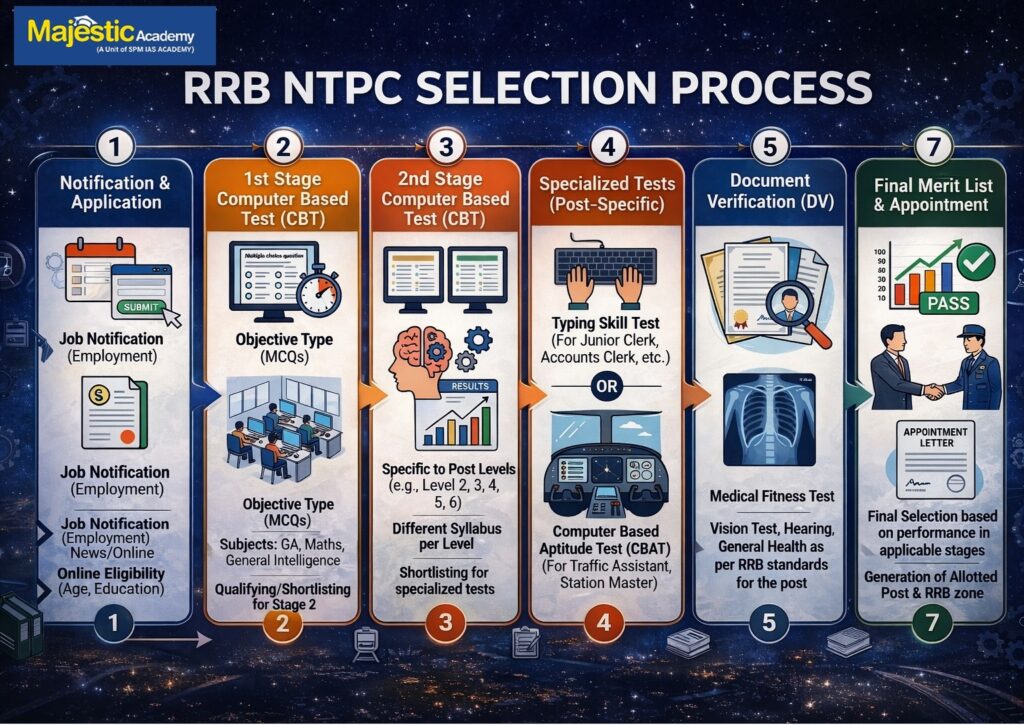
In this article, we will look into the RRB NTPC selection process 2026, including CBT 1, CBT 2, and the skill test. We will also discuss the railway recruitment 2026 stages.
Stage 1: CBT 1-The Screening Test
The First Stage of the RRB NTPC selection process 2026 Computer-Based Test (CBT 1) is a qualifying/screening test. This is a crucial distinction: your CBT 1 marks will NOT be counted in the final merit list. Its sole purpose is to shortlist candidates for CBT 2. For better preparation, you can explore Railway online coaching.
- Duration: 90 minutes (120 minutes for PwBD candidates)
- Total Questions: 100
- Negative Marking: 1/3 mark deducted for every wrong answer
- Normalization: Scores are normalized across shifts using a standard formula to ensure fairness
- Shortlisting Ratio: 20 times the number of vacancies are shortlisted for CBT 2
RRB NTPC Exam Pattern CBT 1 CBT 2 exam pattern is given below:
CBT 1 Exam Pattern: 100 Questions – 90 Minutes
Below is the RRB NTPC exam pattern CBT1:
| Subject | Number of Questions | Maximum Marks |
|---|---|---|
| General Awareness (GA) | 40 | 40 |
| Mathematics | 30 | 30 |
| General Intelligence & Reasoning | 30 | 30 |
| Total | 100 | 100 |
Strategy Tip: Since CBT 1 is only a gateway, focus on speed and accuracy. A score high enough to clear the cutoff is sufficient to aim for the top 20x bracket to advance comfortably to CBT 2.
Stage 2: CBT 2-The Merit-Determining Test
The Second Stage of the RRB NTPC selection process 2026, i.e., CBT 2, is where the real competition begins. This is the stage that determines your final merit rank. Your normalized CBT 2 score is what ultimately decides whether you proceed to the skill test and, eventually, get a job offer. For better preparation, you can opt for Railway coaching.
- Duration: 90 minutes (120 minutes for PwBD candidates)
- Total Questions: 120
- Negative Marking: 1/3 mark deducted for every wrong answer
- Difficulty Level: Higher than CBT 1, and post-specific (Graduate vs. Undergraduate level)
- Normalization: Scores are normalized across shifts
- Shortlisting Ratio: 8 times the number of vacancies are shortlisted for the Skill Test / CBAT
CBT 2 Exam Pattern: 120 Questions – 90 Minutes
| Subject | Number of Questions | Maximum Marks |
|---|---|---|
| General Awareness (GA) | 50 | 50 |
| Mathematics | 35 | 35 |
| General Intelligence & Reasoning | 35 | 35 |
| Total | 120 | 120 |
Note: The RRB NTPC Exam Pattern CBT 1 and CBT 2 follow the same three-subject structure, but CBT 2 has more questions, higher difficulty, and counts towards your final merit. Do not underestimate the jump in difficulty between the two stages.
Stage 3: Post-Specific Skill Tests
After CBT 2, depending on the post you applied for, you will be required to appear for one of two skill tests. These tests are qualifying in nature; you must pass them to be eligible for the post, but they do not add marks to your merit score.
1. RRB NTPC Typing Skill Test (TST)
The RRB NTPC Typing Skill Test is applicable for posts that require clerical and typing work, including:
- Senior Clerk cum Typist
- Junior Accounts Assistant cum Typist
- Senior Time Keeper
- Accounts Clerk cum Typist (UG level)
- Junior Clerk cum Typist (UG level)
Minimum Speed Requirements:
| Language | Minimum Speed | Tools Allowed |
|---|---|---|
| English | 30 Words Per Minute (WPM) | None (no editing tools) |
| Hindi | 25 Words Per Minute (WPM) | None (no editing tools) |
Candidates must type on a computer without using spell-check, autocorrect, or any other editing assistance. The test is designed to assess genuine typing proficiency under exam conditions.
2. Computer-Based Aptitude Test (CBAT) For Station Master & Traffic Assistant
The RRB NTPC CBAT Station Master test of the RRB NTPC selection process 2026 is exclusively for candidates who apply for the posts of Station Master and Traffic Assistant. This is a psychometric and aptitude-based test designed to evaluate cognitive abilities critical for railway operations and passenger safety.
- T-Score Requirement: Candidates must achieve a minimum T-Score of 42 to qualify
- Negative Marking: There is NO negative marking in the CBAT
- Purpose: Tests spatial reasoning, memory, attention to detail, and problem-solving
- Attempts: Candidates may appear for the CBAT a maximum of 3 times across their lifetime
The CBAT is a critical differentiator for operational posts. Even if you score exceptionally well in CBT 2, failing to achieve the T-Score of 42 in CBAT will disqualify you from these specific posts.
Final Stages: Document Verification & Medical Examination
1. Document Verification (DV)
Candidates who qualify the skill test (or CBAT) are called for Document Verification. You must present original and self-attested copies of all required documents, including your educational certificates, caste certificate (if applicable), identity proof, and other relevant documents. Any discrepancy found during DV can lead to immediate disqualification.
2. Medical Examination
The final hurdle is the Medical Examination conducted by Railway Medical Officers. Different posts have different medical standards (A1, A2, A3, B1, B2). For operational posts like Station Master, vision standards are particularly strict. Candidates must be medically fit as per the prescribed standards for their applied post.
Conclusion
In conclusion, the RRB NTPC Selection Process 2026 involves several crucial stages. Firstly, there is CBT 1, which serves as a screening tool. Following CBT 1, candidates must excel in CBT 2, as this is important for the final merit ranking. Additionally, passing the skill tests is also required.
This is important for the subsequent document verification and the medical exam. Therefore, with focused preparation and a solid understanding of the exam structure, candidates can navigate the process confidently. Lastly, best of luck to all aspirants!
Frequently Asked Questions
1. Are the marks scored in CBT 1 used for the final merit list?
No. CBT 1 is purely a screening/qualifying test. Your CBT 1 score is used only to shortlist candidates for CBT 2 (at a ratio of 20 times the number of vacancies). Once you advance to CBT 2, your CBT 1 marks become irrelevant. The final merit list is based entirely on your CBT 2 normalized score.
2. Is there negative marking in all stages of RRB NTPC?
Negative marking of 1/3rd applies to both CBT 1 and CBT 2. However, there is no negative marking in the CBAT (Computer-Based Aptitude Test) for Station Master and Traffic Assistant posts. The Typing Skill Test is a speed and accuracy test with no marks-based negative marking in the traditional sense.
3. What is the minimum qualifying speed for the Typing Skill Test?
Candidates must achieve a minimum typing speed of 30 Words Per Minute (WPM) in English or 25 Words Per Minute (WPM) in Hindi. Critically, this must be achieved without the use of any editing tools such as spell-check, autocorrect, or backspace-based corrections (beyond normal human correction). The test demands genuine, proficient typing ability.
4. Can I choose the language for the RRB NTPC exam?
Yes! The RRB NTPC examination is available in 15 regional languages in addition to English. This includes languages such as Assamese, Bengali, Gujarati, Hindi, Kannada, Konkani, Malayalam, Manipuri, Marathi, Odia, Punjabi, Tamil, Telugu, and Urdu. Candidates can select their preferred language at the time of application. This ensures linguistic inclusivity for aspirants from all corners of India.
Majestic Academy is a trusted coaching institute offering result-oriented SSC Coaching, Banking Coaching, and ADRE Coaching for competitive exam aspirants. Serving students across Guwahati and Assam, we provide structured preparation with expert faculty, updated study materials, and regular mock tests. Our specialized RRB Coaching in Guwahati helps railway exam candidates build strong fundamentals and gain exam confidence. We also offer focused TET Coaching in Guwahati for aspiring teachers with concept-based learning and exam-oriented guidance. At Majestic Academy, we are committed to quality education, clear mentoring, and consistent student success.