
If you are looking for a career that goes far beyond just a job, the Reserve Bank of India’s Grade B Officer recruitment is exactly the kind of opportunity worth putting your full effort into. The RBI Grade B 2026 notification is officially out, and the online registration window opens on April 29, 2026. Life at RBI is a commitment to serving the nation, the decisions you make as an officer directly influence the way the economy and the financial sector of the country evolve. That is not something every job can offer.
So whether you are targeting the General cadre, the DEPR stream, or the DSIM stream, understanding the complete picture of RBI Grade B eligibility, exam pattern, syllabus, and preparation strategy puts you firmly ahead of most other aspirants. Let us walk through everything in detail. If you are also exploring other government job options, you can compare different railway exams like RRB NTPC vs RRB Group D to understand which path suits your career goals better.
RBI Grade B 2026 — Important Dates
Before diving into eligibility and preparation, mark these dates clearly in your calendar. Missing a registration deadline for an exam like this is not an option.
| Event | Date |
| Opening Date for Online Registration & Fee Payment | April 29, 2026 |
| Closing Date for Online Registration & Fee Payment | May 20, 2026 (till 6:00 PM) |
| Grade B (DR) General — Phase I Online Exam | June 13, 2026 |
| Grade B (DR) General — Phase II (Papers I, II & III) Online Exam | July 25, 2026 |
| Grade B (DR) DEPR — Phase I (Papers I & II) Online Exam | June 14, 2026 |
| Grade B (DR) DEPR — Phase II (Papers I & II) Written Exam | July 26, 2026 |
| Grade B (DR) DSIM — Phase I (Paper I) Online Exam | June 14, 2026 |
| Grade B (DR) DSIM — Phase II (Papers II & III) Online/Written Exam | July 26, 2026 |
RBI Grade B Eligibility 2026
Understanding RBI Grade B eligibility in full is the first step every aspirant must take. The eligibility criteria cover nationality, age, and educational qualifications, and each one matters.
Nationality
A candidate must be either a citizen of India; a subject of Nepal; a subject of Bhutan; a Tibetan refugee who came to India before January 1, 1962 to permanently settle here, or a person of Indian origin who migrated from Pakistan, Burma, Sri Lanka, or East African countries such as Kenya, Uganda, the United Republic of Tanzania, Zambia, Malawi, Zaire, Ethiopia, or Vietnam with the intention of permanently settling in India. Candidates from the last category need a certificate of eligibility from the Government of India. Such candidates can appear for the exam, but the appointment offer is issued only after the government issues the eligibility certificate. For a complete understanding of the exam pattern and subject-wise topics, check the detailed guide on RRB NTPC Syllabus 2026.
RBI Grade B Age Limit 2026
The age requirement is calculated as of September 1, 2026. The minimum age is 21 years, and the maximum is 30 years. This means a candidate must have been born not earlier than September 2, 1995, and not later than September 1, 2004.
However, the upper age limit comes with several relaxations depending on category and background:
| Category | Age Relaxation |
| SC / ST | 5 Years |
| OBC | 3 Years |
| Ex-employees of banking institutions (services terminated for economy or bank liquidation) / retrenched Govt. employees registered with the Employment Exchange with at least 1 year service | 5 Years |
| Ex-Servicemen (including ECOs/SSCOs with min. 5 years Military Service as on September 1, 2026) | 5 Years |
| ECOs/SSCOs (initial assignment of 5 years extended beyond 5 years, with MOD certificate for civil employment) | 5 Years |
| Gen / EWS PwBD | 10 Years |
| OBC PwBD | 13 Years |
| SC / ST PwBD | 15 Years |
| Candidates with an M.Phil. qualification | Upper age of 32 Years |
| Candidates with a Ph.D. qualification | Upper age of 34 Years |
| Candidates with experience as officers in Scheduled Commercial Banks, Public Sector Insurance Companies, or AIFIs, including the RBI | Relaxation equal to years of experience (max 3 years); final upper age must not exceed 33 years |
| Grade B (DR) DEPR/DSIM — Master’s Degree with Research/Teaching experience | Relaxation equal to years of experience (max 3 years) |
Important Note: SC/ST and OBC candidates who also fall under the ex-servicemen or PwBD categories can claim cumulative age relaxation under both categories. For all other combinations, cumulative relaxation is not available.
The scheduled commercial banks referred to include those in the Second Schedule of the RBI Act, 1934. Public sector insurance companies include LIC, GIC, New India Assurance, United India Insurance, The Oriental Insurance, National Insurance, and Agriculture Insurance Company of India. AIFIs include EXIM Bank, NABARD, NHB, SIDBI, and NaBFID. For candidates preparing for banking and railway exams, it is also important to go through the RRB NTPC Exam Day Guidelines to avoid last-minute confusion.
RBI Grade B Educational Qualification 2026
RBI Grade B eligibility also sets specific academic requirements, and they differ across the three cadres, General, DEPR, and DSIM.
1. Officers in Grade B (DR) — General
Candidates need a graduation in any discipline or an equivalent technical or professional qualification with a minimum of 60% marks (50% for SC/ST/PwBD applicants) in aggregate across all semesters or years. Alternatively, post-graduation in any discipline or an equivalent technical or professional qualification with a minimum of 55% marks (pass marks for SC/ST/PwBD applicants) in aggregate also qualifies.
For graduation, any course taken after Class XII of at least 3 years’ duration from a recognised university qualifies. For post-graduation, any course taken after graduation of at least 2 years’ duration from a recognized university counts.
2. Officers in Grade B (DR) — DEPR
For the DEPR cadre, candidates need an MA or MSc in economics or in subjects where economics is the principal constituent, such as quantitative economics, mathematical economics, applied economics, econometrics, financial economics, business economics, agricultural economics, industrial economics, development economics, and international economics. Alternatively, an MA or MSc in Finance or in courses where Finance is the principal constituent — such as Quantitative Finance, Mathematical Finance, Quantitative Techniques, International Finance, Business Finance, Banking and Trade Finance, Corporate Finance, Project Finance, or Agribusiness Finance, also qualifies.
The minimum marks required are 55% in aggregate across all semesters or years from a recognised Indian or foreign university or institute. For SC, ST, and PwBD candidates, the minimum is 50%.
“Principal constituent” means that half or more of the total courses, including electives, must be in economics or finance.
A Doctorate in Economics, or research or teaching experience in economics, or publication in standard journals in the economics field, are desirable qualifications that carry additional weight.
3. Officers in Grade B (DR) — DSIM
For DSIM, candidates need a master’s degree with at least 55% marks in Statistics, Mathematics, Mathematical Statistics, Applied Statistics, Quantitative Economics, Econometrics, Informatics, or any related branches from a recognized Indian or foreign university approved by the Government, UGC, or AICTE. Alternatively, a master’s degree in Data Science, Artificial Intelligence, machine learning, or big data analytics or related branches with the same marks requirement also qualifies. A four-year bachelor’s Degree with a minimum 60% marks in the above-mentioned fields is the third accepted qualification path. For SC, ST, and PwBD candidates, the minimum marks threshold drops to 50% across all three qualification options.
Desirable qualifications for DSIM include a Doctorate in related subjects, research or teaching experience, and publications in standard journals. For a detailed understanding of exam stages and preparation strategy, check the complete RRB NTPC Selection Process 2026 Full Guide.
RBI Grade B Salary 2026
The salary structure is one of the most attractive aspects of RBI Grade B recruitment. Selected candidates start with a basic pay of Rs. 78,450 per month in the pay scale of Rs. 78,450 – 4,050(9) – 114,900 – EB – 4,050(2) – 123,000 – 4,650(4) – 141,600 over 16 years.
| Component | Details |
| Basic Pay | Rs. 78,450/- per month |
| Pay Scale | Rs. 78,450 – 4,050(9) – 1,14,900 – EB – 4,050(2) – 1,23,000 – 4,650(4) – 1,41,600 |
| Gross Monthly Emoluments (without HRA) | Approximately Rs. 1,50,374/- |
| House Rent Allowance | 15% of Pay (if accommodation not provided by the Bank) |
In addition to basic pay, officers receive Special Allowance, Grade Allowance, Dearness Allowance, Local Compensatory Allowance, Special Grade Allowance, Learning Allowance, House Rent Allowance, Family Allowance, and Medical Allowance as per applicable rules.
For candidates with exceptionally high academic or professional qualifications or experience of significant value to the bank, RBI may, at its sole discretion, consider up to four advance increments. Such requests can only be raised at the interview stage.
RBI Grade B Exam Pattern 2026
General Cadre — Phase I (Objective Type, Online)
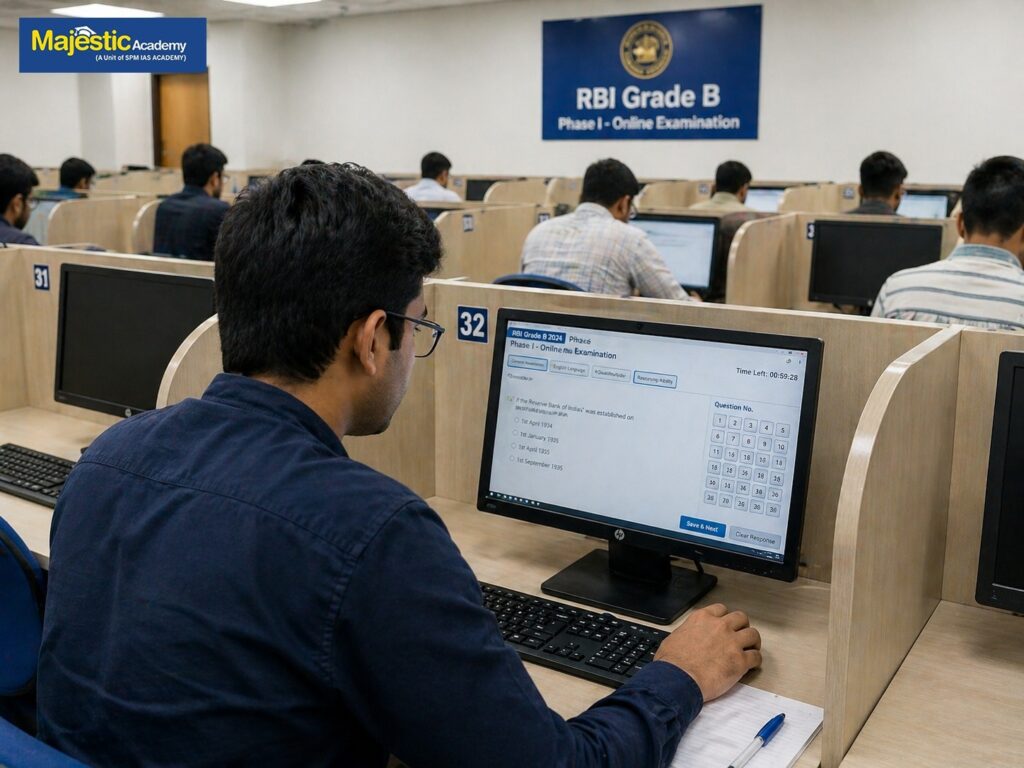
The Phase I exam is a single paper of 200 marks with a composite time of 120 minutes. Based on last year’s pattern, the expected structure is:
| Subject | Number of Questions | Maximum Marks | Duration |
| General Awareness | 80 | 80 | Composite 120 minutes |
| Quantitative Aptitude | 30 | 30 | |
| English Language | 30 | 30 | |
| Reasoning | 60 | 60 | |
| Total | 200 | 200 | 120 Minutes |
Candidates must secure minimum marks separately in each section as well as in aggregate. If conducted in multiple shifts, scores get normalized using the equipercentile method following IBPS’ standard practice. Candidates shortlisted for Phase II based on aggregate Phase I performance get their roll numbers published on the RBI website.
General Cadre — Phase II (Online Examination)
Phase II covers three papers totalling 300 marks:
| Paper | Type | Duration | Questions | Marks |
| Paper I: Economic and Social Issues (ESI) | 50% Objective + 50% Descriptive | 30 min (objective) + 90 min (descriptive) = 120 min | 50 (obj) + 6 attempted as 4 (desc) | 100 |
| Paper II: English Writing Skills | Descriptive (typed on keyboard) | 90 Minutes | 3 | 100 |
| Paper III: General Finance and Management | 50% Objective + 50% Descriptive | 30 min (objective) + 90 min (descriptive) = 120 min | 50 (obj) + 6 attempted as 4 (desc) | 100 |
| Grand Total | 300 |
For the descriptive sections of Papers I and III, 6 questions are asked, and candidates must attempt any 4 of the 2 questions of 15 marks each and 2 of 10 marks each. If a candidate answers more than 4, only the first 4 get evaluated.
Phase II — Interview
Candidates shortlisted from Phase II appear for an Interview worth 75 marks. The final merit list combines Phase II marks plus Interview marks plus applicable grace marks. Before the Interview, candidates must undergo a Personality Assessment conducted by the Bank, this carries no marks and does not form part of the final selection criteria.
DEPR Cadre — Exam Pattern
For candidates whose RBI Grade B Eligibility route runs through the DEPR stream, the exam pattern is as follows:
| Phase | Paper | Duration | Maximum Marks |
| Phase I | Paper I: Objective Type (Economics) | 120 Minutes | 100 |
| Phase I | Paper II: English Descriptive (typed on keyboard) | 120 Minutes | 100 |
| Phase II | Paper I: Descriptive (Economics) — written on paper | 120 Minutes | 100 |
| Phase II | Paper II: Descriptive (Economics) — written on paper | 120 Minutes | 100 |
| Total | 400 |
Final selection is based on combined performance in Phase I, Phase II, and the interview (75 marks). A personality assessment is mandatory before the interview but carries no marks.
DSIM Cadre — Exam Pattern
Similarly, candidates who qualify through the DSIM stream of RBI Grade B Eligibility face this exam structure:
| Paper | Duration | Maximum Marks |
| Paper I: Objective Type (Statistics) | 120 Minutes | 100 |
| Paper II: Descriptive (Statistics) — written on paper | 180 Minutes | 100 |
| Paper III: English Descriptive (typed on keyboard) | 90 Minutes | 100 |
| Total | 300 |
Candidates who clear Paper I get shortlisted for Papers II and III. Final selection combines all three papers and the interview (75 marks).
RBI Grade B 2026 Syllabus
Phase I (General Cadre) — Topic-Wise Syllabus
| Section | Topics |
| Data Interpretation & Analysis | Tabular Graph, Line Graph, Pie Chart, Bar Graph, Radar Graph, Caselet, Missing Case DI, Let it Case DI, Data Sufficiency, Probability, Permutation & Combination, Averages, Ratio, Percentages, Mixture & Allegation, Speed, Distance & Time |
| Reasoning | Verbal Reasoning, Syllogism, Circular Seating Arrangement, Linear Seating Arrangement, Double Lineup, Scheduling, Input-Output, Blood Relations, Directions & Distances, Ordering & Ranking, Coding & Decoding, Code Inequalities, Course of Action, Critical Reasoning, Analytical and Decision Making |
| English Language | Reading Comprehension, Grammar, Vocabulary, Verbal Ability, Sentence Improvement, Para Jumbles, Word Association, Cloze Test, Error Spotting, Fill in the Blanks |
| General/Economy/Banking Awareness | Financial Awareness, Current Affairs, General Knowledge, Static Awareness, Government Schemes, Agreements & Deals, Banking Terms, Banking Rates & Processes |
Phase II — Paper I: Economic and Social Issues (ESI)
This paper covers Growth and Development, National Income and per capita income, Poverty Alleviation and Employment Generation, Sustainable Development, and Environmental issues. The Indian Economy section covers economic history, changes in industrial and labour policy, monetary and fiscal policy since 1991, Economic Survey and Union Budget priorities, Indian Money and Financial Markets, Role of Indian banks and RBI in development, Public Finance, Industrial Developments, Indian Agriculture, and the Services sector. The Globalization section covers Balance of Payments, Export-Import Policy, International Economic Institutions (IMF, World Bank, WTO), and Regional Economic Cooperation. The Social Structure section covers Multiculturalism, Demographic Trends, Urbanisation and Migration, Gender Issues, Social Justice, Social Movements, the Indian Political System, Human Development, and Social Sectors in India including Health and Education.
Phase II — Paper II: English Writing Skills
This paper tests writing skills, expression, and understanding of the topic through descriptive answers typed on a keyboard.
Phase II — Paper III: General Finance and Management
This paper covers the Financial System (structure and functions of financial institutions, RBI functions, Banking System in India, GFS impact, IT in banking, non-banking systems, digital payments), Financial Markets (primary and secondary markets across Forex, Money, Bond, and Equity), and General Topics (Risk Management, Derivatives basics, Global financial markets, Financial Inclusion, Alternate finance, Corporate Governance, Union Budget, Basics of Accounting and Financial Statements, Ratio Analysis, and Inflation).
The Management section covers Fundamentals of Management and Organisational Behaviour (including management functions, evolution of management thought, motivation theories like Maslow, Alderfer, McClelland, Herzberg, Adams, and Vroom, Leadership theories, Emotional Intelligence, Transactional Analysis, Johari Window, Conflict Management, and Organisational Change and Development), Ethics at the Workplace and Corporate Governance, and Communication.
RBI Grade B 2026 Preparation Strategy

Getting your preparation right for the RBI Grade B exam itself requires a structured, long-term approach. Here is how to go about it smartly.
Start with Phase II subjects first.
Most successful candidates recommend starting Phase II preparation, covering economic and social issues, finance, and management, well before shifting to Phase I subjects like quantitative aptitude, reasoning, and English. Phase II requires conceptual depth that builds over months, not weeks. However, if you feel weak in quantitative or reasoning areas, starting with Phase I is equally valid, there is no rigid rule.
The best approach follows a funnel structure. Start broad, read or watch lessons to get a general idea of each topic without worrying about memorizing every detail. Then identify the key concepts behind each topic and understand their meaning. After that, move gradually into deeper details and analyse topics more thoroughly. Finally, connect every fact to its underlying concept, because this linkage is what helps you recall under exam pressure. Revise the conceptual layer first in early revisions, then focus on specific details and tricky areas in later passes.
Use Trusted Sources and Stick to Them
One of the most common mistakes aspirants make is constantly hunting for new books and resources instead of going deep into a few trusted ones. For current affairs, sources like PIB 247 and RBI 247 work well for an 8 to 12-month coverage, and Spotlight Magazine for 6 to 8 months of focused reading. Avoid switching between too many sources, it fragments your preparation and wastes time you cannot afford.
Practice Mock Tests and Answer Writing Simultaneously
Do not wait until the syllabus is complete before you start mock tests or answer writing. Practice aptitude mock tests weekly to build mental speed, comprehension, and logical reasoning. For descriptive papers, start writing topic-wise answers while you study each chapter. Waiting to write only after finishing everything means you never build the writing habit in time.
Do’s and Don’ts for RBI Grade B Preparation
Act on your study plan immediately rather than overthinking it. Understand concepts deeply instead of memorising answers. Stay with a limited number of trusted study materials and do not keep searching for new books when the ones you have are enough. Manage your time by keeping distractions minimal, social media platforms and entertainment content are the biggest time sinks during serious preparation.
Dedicate about one hour daily to solving current affairs questions and quizzes. Set aside one week per month exclusively for current affairs revision without touching new syllabus topics. During the exam, trust your instincts, overthinking questions mid-exam leads to avoidable errors.
On the other hand, do not skip subject syllabus topics in favour of only current affairs, both need dedicated time. Do not use your phone while studying; if you do not have a laptop, use a desktop and keep the phone in another room entirely.
Conclusion
RBI Grade B Eligibility covers nationality, age, and educational qualifications across three distinct cadres, General, DEPR, and DSIM, each with its own academic requirements and exam structure. The registration window opens on April 29, 2026, and closes on May 20, 2026, so the first and most immediate priority for every eligible candidate is to complete the online application before the deadline.Start early, follow a structured plan, stick to trusted resources, and practice both mock tests and answer writing from day one. The RBI Grade B Eligibility bar is set to filter the best, and with the right preparation, clearing it is absolutely within reach.
Frequently Asked Questions
Does the RBI Grade B exam have negative marking?
Yes, the RBI Grade B Phase I examination carries negative marking. For every wrong answer in the objective section of Phase I, a penalty applies, and marks are deducted from your total score. This means that blind guessing or attempting questions where you have no idea is a strategy that can actively bring your score down rather than improve it. Candidates must approach uncertain questions with caution, skip them rather than attempt them just to fill in an answer. This is especially important in Phase I where the score determines your shortlisting for Phase II, so every mark matters. Building the habit of smart attempting versus skipping during mock tests is one of the most practical preparation steps you can take early on.
How long does it take to prepare for RBI Grade B?
The ideal preparation window for RBI Grade B Eligibility and examination is between 8 and 12 months for most candidates, particularly for the General cadre. The Phase II syllabus, covering Economic and Social Issues, General Finance, and Management, is conceptually heavy and takes months of consistent reading and revision to master. Phase I subjects like Quantitative Aptitude and Reasoning, can be built in parallel over a similar period through regular practice. For DEPR and DSIM candidates, the preparation demands deep subject expertise in Economics or Statistics, respectively, which typically requires an even longer runway if the candidate’s academic background is not already very strong in those areas. That said, candidates with strong backgrounds and full-time study hours can sometimes crack the exam in 6 to 8 months with a very disciplined plan.
I have scored just above the cutoff. What are my chances for final selection?
Scoring just above the cutoff for Phase I means you have cleared the first hurdle, but the real competition begins at Phase II. Since the final merit list for the General cadre combines Phase II marks (300 marks across three papers) and Interview marks (75 marks), a Phase I score that barely makes the cutoff does not significantly harm your final selection chances. What matters far more at that stage is your performance in the descriptive papers, Economic and Social Issues, English Writing Skills, and General Finance and Management, and how well you present yourself in the Interview. Candidates who prepare Phase II thoroughly and score strongly there can overturn a below-average Phase I start. So rather than worrying about where you stood in Phase I, shift all your energy into Phase II preparation as soon as Phase I is done.