

Every year, crores of candidates register for RRB NTPC, but only a small fraction of them actually clear CBT 1 on their very first try. The numbers tell an honest story, only 8 to 12 percent of RRB NTPC applicants crack it on their first attempt. And the surprising part is that the exam itself does not test anything beyond basic concepts. The real gap between candidates who clear it and those who do not is not about intelligence, it is about strategy, consistency, and knowing exactly where to put your time and effort.
If you are serious about clearing this exam without a second attempt, this blog gives you everything you need, a 90-day preparation plan broken into three phases, section-wise strategies, exam day tactics, category-wise score targets, and the most common mistakes that have cost other candidates their first attempt. To understand the complete role in detail, check this RRB NTPC Station Master Job.
What the Exam Looks Like — A Quick Overview
Before jumping into the strategy, it helps to know the structure of the exam you are preparing for. RRB NTPC CBT 1 has 100 questions worth 100 marks. The paper covers four sections: mathematics with 35 questions, general intelligence and reasoning with 30 questions, general science with 25 questions, and general awareness with 10 questions. The total time allowed is 90 minutes. There is a penalty of 0.25 marks for every wrong answer, so attempting randomly without confidence can actually bring your score down.
To crack RRB NTPC in First Attempt, here is what you need to target based on your category:
- UR (Unreserved): 75 marks and above for a comfortable, clear
- EWS: 65 marks and above
- OBC-NCL: 63 marks and above
- SC: 55 marks and above
- ST: 50 marks and above
These targets include a buffer of 10 to 15 marks above historical cut-offs, which protects you even if the exam turns out to be slightly tougher than expected.
The 90-Day Plan to Crack RRB NTPC in First Attempt

The 90-day timeline divides your preparation into three clear phases, each with specific goals. Following all three phases in order is what gives you the best shot to crack RRB NTPC in First Attempt without wasting time or repeating mistakes. For exam preparation, you can also check the RRB NTPC Syllabus 2026.
Phase 1 — Foundation Building (Days 1 to 40)
This phase is all about learning the basics properly. Do not rush, and do not skip anything here. The target for Phase 1 is to cover at least 60 percent of the syllabus with 70 percent accuracy on practice questions.
Mathematics — 2 hours daily. Start with number systems, HCF and LCM, percentage, Ratio and proportion, simple and compound interest, profit and loss, averages, time-speed-distance, and time and work. Focus heavily on formula memorization during this phase. The faster you can recall formulas, the more time you save on exam day.
General Intelligence — 1.5 hours daily. Cover Analogy, Classification, Series Completion, Coding-Decoding, direction sense, and Blood Relations. The most important habit to build here is solving at least 30 questions daily to develop pattern recognition. This section rewards consistent practice more than theory reading.
General Science — 45 minutes daily Go through Physics basics including Motion, Force, Energy, and Electricity. For Chemistry, cover Elements, Compounds, Acids and Bases, and basic reactions. For Biology, focus on the Cell, Human Body Systems, and common diseases. The best source for all of this is NCERT textbooks from Class 6 to Class 10, read them thoroughly and do not skip chapters.
General Awareness — 45 minutes daily Start following current affairs from reliable monthly magazines and dedicate 20 minutes daily to reading a newspaper. Also cover Static GK including Geography, History, and Polity basics. Starting this early gives you the 6-month coverage that this section genuinely needs.
Phase 2 — Concept Strengthening (Days 41 to 70)
By Phase 2, you have your basics in place. Now the goal is to sharpen your weaker areas and push your accuracy higher. The week-wise target for this phase is 80 percent syllabus coverage with 80 percent accuracy on mixed topic tests.
Mathematics — 2 hours daily Go back to the topics where you scored lowest in Phase 1 and work through harder problems. Also add Geometry, Mensuration, and Data Interpretation in this phase. Start working on speed, aim to bring your per-question solving time down from 90 seconds to around 60 seconds.
General Intelligence — 1.5 hours daily. Move into nonverbal reasoning topics like Figure Analysis and paper folding. Practice complex patterns, including alternating series and mixed coding. Your daily target should be 50 questions with 85 percent accuracy.
General Science — 1 hour daily. Revisit everything you covered in Phase 1 using previous year questions. Memorize important formulas, scientific laws, and historical discoveries. Give extra attention to high-weightage topics, the human body and Physics laws come up repeatedly in RRB NTPC.
General Awareness — 1 hour daily. Add railway and banking awareness to your reading since these are specific to NTPC. Cover important dates, awards, summits, and government policies. Also, go through state-wise capitals, major rivers, and key industries.
Phase 3 — Mock Test Marathon (Days 71 to 90)
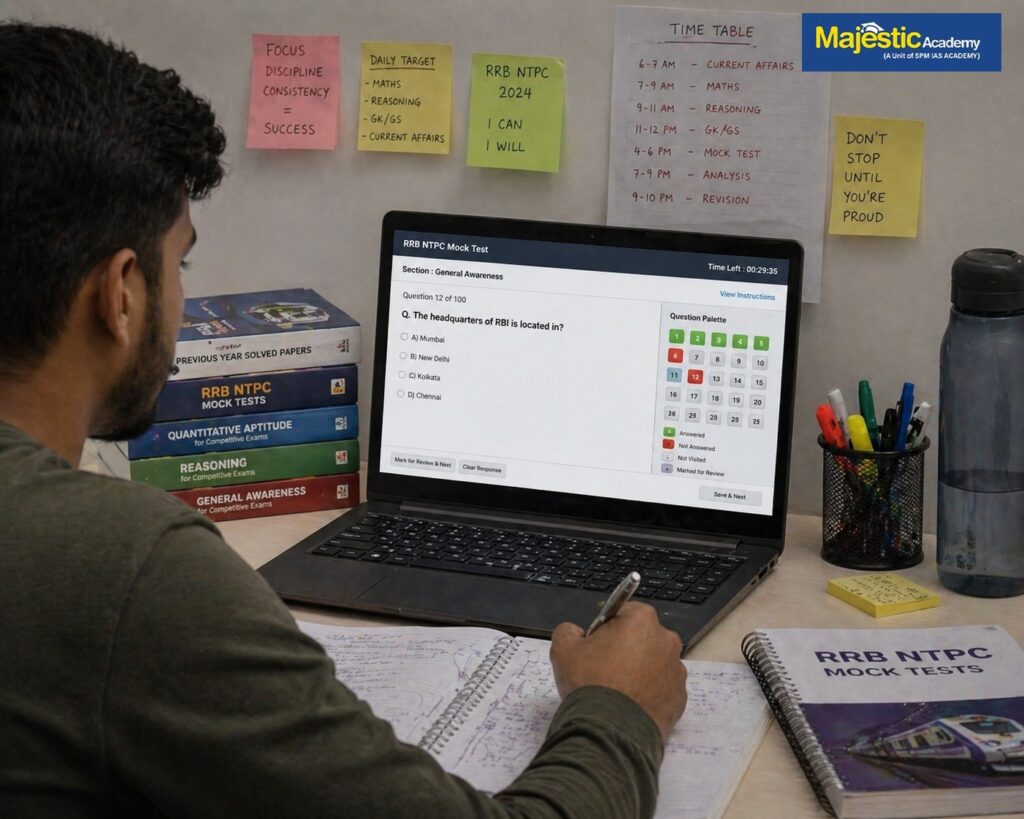
This is the phase that actually determines whether you crack RRB NTPC in First Attempt or not. These 20 days are entirely about mock tests and deep analysis.
The target is 40 or more full-length mocks in 20 days—that is, 2 mocks every single day.
The schedule for each day works like this: take a fresh mock test in the morning under strict 90-minute conditions, then spend 2 hours in the evening analyzing every single mistake. Also solve previous year papers from 2016 to 2024, at minimum 8 full papers. Past papers give you the closest real sense of actual exam difficulty and question patterns.
Analysis of first-attempt qualifiers shows that candidates who followed this exact mock marathon improved their scores by 12 to 18 marks compared to their Phase 2 performance. The learning does not happen while taking the mock, it happens in the analysis session afterward. Never skip it. Before the exam, understanding the RRB NTPC Exam Day Guidelines 2026 can help you stay fully prepared and avoid last-minute confusion.
Section-Wise Strategy to Maximize Your Score
Knowing the syllabus is one thing. Knowing exactly how to approach each section on exam day is another. Here is what the numbers tell you about where to focus.
Mathematics — 35 Questions, 35 Marks
Mathematics deserves 35 to 38 minutes of your 90-minute paper. The high-priority topics to attempt first are Simplification, Percentage, and Ratio-Proportion (around 10 to 12 questions), followed by Average, Profit-Loss, and SI-CI (8 to 10 questions); and then Time-Speed-Distance and Time-Work (6 to 8 questions).
The smart strategy here is to attempt 28 to 30 questions with 90 percent accuracy rather than all 35 with lower confidence. That gives you 25 to 27 marks from this section alone. If Geometry and complex Data Interpretation are weak areas for you, skip them entirely and stay focused on Arithmetic — you will score better that way.
General Intelligence — 30 Questions, 30 Marks
Allocate 28 to 30 minutes to this section. The highest-yield topics are Series Completion, Analogy, and Classification (12 to 15 questions combined), followed by Coding-Decoding and Direction Sense (8 to 10 questions) and then Logical Venn Diagrams and Syllogism (4 to 6 questions).
Attempt 25 to 27 questions with 88 percent accuracy, which should give you 22 to 24 marks. For questions that feel tricky, use elimination, knock out clearly wrong answers first and you improve your odds significantly even on uncertain questions.
General Science — 25 Questions, 25 Marks
Give this section 18 to 20 minutes. Biology questions focusing on the human body, diseases, and nutrition typically make up 10 to 12 questions. Physics laws, units, and electricity basics account for 8 to 10 questions. Chemistry covering everyday chemistry and basic reactions fills the remaining 5 to 7 questions.
Attempt only the 18 to 20 questions you are genuinely confident about. This gives you 16 to 18 marks from the section. Do not waste time on topics you have never seen before, make a quick guess and move on. Sitting on an unfamiliar question for 2 minutes costs you far more than the 0.25 negative mark.
General Awareness — 10 Questions, 10 Marks
This section only gets 8 to 10 minutes. Attempt 7 to 8 questions based on real confidence, which translates to 6 to 7 marks. Current Affairs from the last 4 to 6 months typically produce 4 to 5 questions. Static GK covering Geography, Polity, and Economy gives another 3 to 4 questions. Railway and banking awareness accounts for 2 to 3 questions.
This section has the highest unpredictability of all four. Do not over-invest preparation time here beyond daily current affairs reading and solid static GK coverage. Candidates who spent too much time on this section during the exam consistently scored worse overall because they sacrificed time from mathematics and reasoning, where the marks are more reliable.
Exam Day Attempt Strategy — Three Rounds

Your question selection order on exam day matters just as much as your preparation. This three-round approach is what helps candidates crack RRB NTPC in First Attempt with maximum efficiency. For a complete overview of different job roles under NTPC, you can also explore the RRB NTPC Posts List.
Round 1 — First 45 Minutes: Go through all four sections and attempt every question that feels easy or moderately easy. Mark anything that requires more thought and move on. Target 60 to 65 questions attempted with 95 percent accuracy.
Round 2 — Next 30 Minutes: Come back to the marked questions. Attempt any question where you feel 70 percent or more confident. Skip anything where you genuinely cannot narrow it down. Use the elimination technique on 50-50 guesses, cross out the obviously wrong options and pick from what remains. Target 20 to 25 additional questions with 85 percent accuracy.
Round 3 — Final 15 Minutes: Review any answers you felt unsure about. Pick up any remaining easy questions you may have missed. If you have already reached your safe zone score, do strategic guessing on 2 to 3 questions maximum. Keep 5 minutes to verify your answers before submission.
The critical rule: Never attempt more than 92 questions. With 0.25 negative marking, one wrong answer wipes out four correct ones. Attempting 85 questions at 90 percent accuracy gives you a better score than attempting all 100 at 75 percent accuracy. Quality always beats quantity in this exam.
Category-Wise Score Targets
Setting the right target before you start is important for planning your preparation correctly. Here is what you should aim for based on your category to crack RRB NTPC in First Attempt with a comfortable buffer:
UR Category: A safe score is 75 to 78 marks, a competitive score is 80 and above. Attempt 85 to 88 questions with 90 percent accuracy.
EWS Category: A safe score is 65 to 68 marks; a competitive score is 70 and above. Attempt 80 to 85 questions with 88 percent accuracy.
OBC-NCL Category: A safe score is 63 to 66 marks; a competitive score is 68 and above. Attempt 78 to 82 questions with 87 percent accuracy.
SC Category: A safe score is 55 to 58 marks, a competitive score is 60 and above. Attempt 70 to 75 questions with 85 percent accuracy.
ST Category: A safe score is 50 to 53 marks; a competitive score is 55 and above. Attempt 65 to 70 questions with 83 percent accuracy.
All targets here include a 10 to 15 mark buffer above 2024 cut-offs. This buffer protects you from year-to-year variation in difficulty. Aiming above the cut-off, not just at it, is what gives you the confidence to walk out of the exam hall knowing you have cleared it.
Common Mistakes That Ruin First Attempts
Understanding what goes wrong for other candidates helps you avoid the same traps. These mistakes come up again and again among candidates who narrowly miss clearing CBT 1.
Giving equal time to all sections: Mathematics and General Intelligence together carry 65 marks. They deserve 60 to 70 percent of your daily study time, not 25 percent. Treating all sections equally is a serious strategic mistake.
Not taking enough mock tests: Analysis of first-attempt qualifiers shows that candidates who took 40 or more full-length mocks had a 78 percent first-attempt success rate. Those who took fewer than 30 mocks had only a 42 percent success rate. Mocks are not optional extras, they are the core of Phase 3 preparation.
Ignoring negative marking: Attempting 95 to 100 questions at 75 percent accuracy gives you a lower net score than attempting 85 questions at 90 percent accuracy. Many candidates discover this too late.
Starting current affairs too late: General awareness needs 6 months of daily reading to build adequate coverage. Starting 30 days before the exam is simply not enough. Begin from Day 1.
Taking mocks without analyzing them: A mock test without a 2-hour analysis session afterward is just wasted time. The improvement comes from understanding your mistakes and fixing them, not from the act of taking the mock itself.
Weak formula memorization: At least 50 percent of mathematics questions require instant formula recall. Spending 30 seconds trying to remember a formula during the exam costs you 10 to 15 questions’ worth of time over the full paper. Memorize your formulas until they are automatic.
Conclusion
The path to crack RRB NTPC in First Attempt is not about studying harder than everyone else, it is about studying smarter. The 90-day plan gives you a structured framework: 40 days of foundation building, 30 days of concept strengthening, and 20 days of intensive mock practice with deep analysis after every test. Set your score target 10 to 15 marks above your category’s historical cut-off, follow the 90-day plan without skipping phases, and stay consistent every single day. The candidates who crack RRB NTPC in First Attempt are not the most gifted, they are the most disciplined. With the right strategy and genuine commitment, that candidate can absolutely be you.
Start today. Ninety days from now, you want to be reviewing your score, not restarting your preparation.
Frequently Asked Questions
Q1. What should my attempt strategy be to crack RRB NTPC in First Attempt?
The right approach is to attempt 85 to 90 questions with 90 percent or higher accuracy rather than trying to attempt all 100 questions at 75 to 80 percent accuracy. Because of the 0.25 negative marking system, one wrong answer cancels out four correct ones, so attempting beyond your confidence level actively hurts your score. The three-round strategy works well here, in the first 45 minutes, go through all four sections and solve every question that feels easy or comfortable, skipping the harder ones. In the next 30 minutes, come back to the marked questions and attempt only those where you feel at least 70 percent confident. In the final 15 minutes, review your answers and make any remaining strategic decisions. Sticking to this structure keeps you disciplined and protects your score from unnecessary negative marking throughout the paper.
Q2. How many mock tests should I take to crack RRB NTPC in First Attempt?
You should target at least 40 full-length mocks in the final 30 days of your preparation, which works out to 2 mocks every day during Phase 3. Analysis of first-attempt qualifiers consistently shows that candidates who completed 40 or more mocks had a 78 percent first-attempt success rate, while those who took fewer than 30 mocks only managed a 42 percent success rate. But here is the part most candidates miss, taking the mock is only half the work. The other half, and arguably the more important half, is spending 2 hours after each mock going through every single mistake and understanding exactly why you got it wrong. Whether it was a concept gap, a formula you could not recall, or a time-pressure decision, each mistake teaches you something. Candidates who skip the analysis step do not improve between mocks, and their scores plateau no matter how many tests they take.
Q3. Which section should I focus on most to crack RRB NTPC in First Attempt?
Put 60 percent of your total daily preparation time into mathematics and general intelligence together, since these two sections carry 65 marks out of 100. Both sections follow predictable question patterns and reward consistent practice with guaranteed marks, they are not unpredictable the way general awareness can be. Mathematics is almost entirely formula and concept-based, so strong preparation directly translates to strong scores. General intelligence improves steadily with daily pattern practice. General Science carries 25 marks and needs solid NCERT Class 6 to 10 coverage, with special attention to the human body, physics laws, and basic chemistry. General Awareness carries only 10 marks and has the highest unpredictability of all sections, beyond 6 months of current affairs reading and basic Static GK, do not over-invest time here at the cost of your mathematics and reasoning practice.