The SSC JE syllabus 2026 covers two papers: Paper 1 and Paper 2. Paper 1 tests general intelligence & reasoning, general awareness, and the relevant technical subject. Paper 2 focuses entirely on the engineering subject selected by the candidate during the application process. Therefore, candidates should understand the complete syllabus before starting their preparation. Knowing the topics in advance also helps them divide their study time between technical subjects and the common sections. Candidates preparing for other SSC examinations can also benefit from understanding the different subjects, exam patterns, and preparation strategies used in competitive exams. For students looking to build a strong foundation for the Combined Graduate Level examination, SSC CGL Coaching in Assam can provide structured guidance, regular practice, and exam-focused preparation.
What does the SSC JE Syllabus 2026 include?
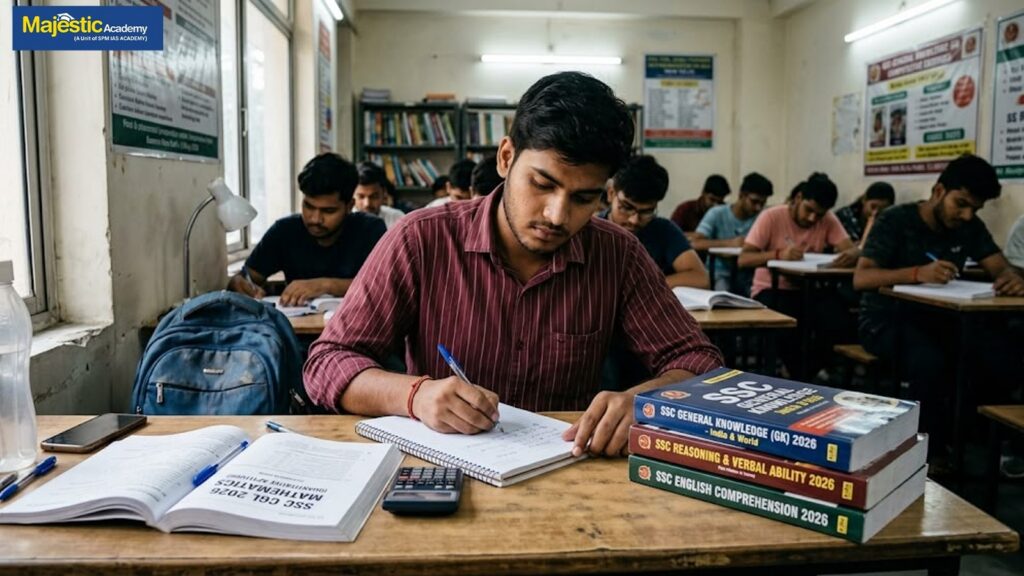
The SSC JE syllabus is divided into compulsory sections and technical subjects. General Intelligence & Reasoning and General Awareness are common to all candidates in Paper 1. Candidates then attempt the technical subject that matches their post and educational qualification. If you are also preparing for competitive government examinations, choosing the right coaching support can make your preparation more structured and focused. Students preparing for the SSC CGL examination can explore SSC CGL Coaching in Guwahati for guidance, study resources, and exam preparation support.
The same engineering subject selected in the application form applies to Paper 2 as well.
| Particular | Details |
| Conducting Authority | Staff Selection Commission (SSC) |
| Examination Name | SSC Junior Engineer Examination 2026 |
| Papers Covered | Paper 1 and Paper 2 |
| Paper 1 Subjects | General Intelligence & Reasoning, General Awareness, and relevant technical subjects |
| Paper 2 Subject | Relevant engineering subject or stream selected in the application form |
| Engineering Streams | Civil & Structural, Electrical, Mechanical, Computer Science & IT, Electronics & Telecommunication, Physics, and Telecommunication Engineering |
| Mode | Computer-Based Examination (CBE) |
| Question Type | Objective Type Questions |
| Official Website | ssc.gov.in |
Note: The SSC JE 2026 notification provides the indicative syllabus for General Intelligence & Reasoning, General Awareness, and the relevant engineering subjects. Candidates should follow the syllabus applicable to their post and qualifying qualification.
What is the SSC JE Paper 1 Syllabus 2026?
Paper 1 is the first stage of the SSC JE 2026 examination. The SSC JE Paper 1 syllabus includes General Intelligence & Reasoning, General Awareness, and the relevant technical subject. Candidates need to obtain the prescribed minimum qualifying marks in Paper 1. The marks are then used to shortlist candidates for Paper 2.
What are the subjects in SSC JE Paper 1?
| Section | Syllabus |
| General Intelligence & Reasoning | Analogies, similarities and differences, space visualization, problem-solving, analysis, judgment, decision-making, visual memory, discrimination, observation, relationship concepts, arithmetical reasoning, verbal and figure classification, number series, abstract ideas and symbols, arithmetical computations, and other analytical functions |
| General Awareness | Current events and general awareness of the environment and its application to society. Questions may cover India and neighboring countries, history, culture, geography, the economic scene, general polity, scientific research, and everyday scientific observations. |
| General Engineering / Technical Subject | Part A to Part G, according to the candidate’s post and educational qualification |
What is the SSC JE Paper 1 Technical Syllabus?
The technical section of the SSC JE syllabus contains seven parts. Candidates must attempt the part that applies to their post and educational qualification.
| Part | Subject / Major Topics |
| Part A | Civil & Structural Engineering: Engineering Mechanics, Solid Mechanics, Structural Analysis, Construction Materials and Management, Estimating, Costing and Valuation, Concrete Structures, Steel Structures, Surveying, Soil Mechanics, Fluid Mechanics and Hydraulics, Hydrology and Irrigation Engineering, Environmental Engineering, and Transportation Engineering |
| Part B | Electrical Engineering: Fundamentals of Electrical Engineering, Magnetic Circuits, A.C. Fundamentals, Measurement and Measuring Instruments, Electrical Machines, Special Electric Machines and Synchronous Generators, Generation, Transmission and Distribution, Estimation & Costing, Utilization of Electrical Energy, Basic Electronics, and Power Electronics |
| Part C | Mechanical Engineering: Engineering Mechanics, Strength of Materials, Theory of Machines, Machine Design, Materials Science and Engineering, Thermal Engineering, Fluid Mechanics and Hydraulic Machinery, Industrial Engineering, Manufacturing Engineering, Metrology and Measurement, and Advanced Manufacturing Processes |
| Part D | Computer Science & Information Technology: Engineering Mathematics, Digital Logic, Computer Organization and Architecture, Programming and Data Structures, Algorithms, Theory of Computation, Compiler Design, Operating System, Databases, and Computer Networks |
| Part E | Electronics & Telecommunication Engineering: Electronics, Electronic Materials & Components, Diodes, Transistors, Amplifiers & Oscillators, Voltage Regulation, Network Theorems, AC Circuits, Three-Phase Circuits, Resonance, Digital Electronics, Sequential & Combinational Logic, Data Conversion & Codes, Antennas, Radio Wave Propagation, Electromagnetic Spectrum, Modulation, Single Sideband, Frequency Modulation, Pulse Modulation, Multiplexing, Digital Communication, RF Communications, and Wireless Telecommunications |
| Part F | Physics: Mathematical Methods, Mechanics, General Properties of Matter, Oscillations, Waves, Optics, Electricity, Magnetism, Kinetic Theory, Thermodynamics, Modern Physics, Solid State Physics, Semiconductor Devices, and Analog and Digital Electronics |
| Part G | Telecommunication Engineering: Engineering Mathematics, Network Analysis, Signals and Systems, Electronic Devices, Analog Circuits, Digital Circuits, Control Systems, Analog Communications, Digital Communications, and Electromagnetics |
What is the SSC JE Paper 2 Syllabus 2026?
Paper 2 is conducted for candidates who qualify for the next stage after Paper 1. It tests technical knowledge in the engineering subject selected in the application form.
The SSC JE syllabus for Paper 2 includes the same seven technical parts:
- Part A: Civil & Structural Engineering
- Part B: Electrical Engineering
- Part C: Mechanical Engineering
- Part D: Computer Science & Information Technology
- Part E: Electronics & Telecommunication Engineering
- Part F: Physics
- Part G: Telecommunication Engineering
For Scientific Assistants in IMD, candidates need to select Part D, Part E, or Part F according to their qualifying stream. The standard of questions for civil, mechanical, and electrical engineering is approximately at the diploma level. For Computer Science & IT, Electronics & Telecommunication Engineering, Physics, and Telecommunication Engineering, the questions are approximately at the graduation level. Candidates should also review the complete SSC Junior Engineer Recruitment details to understand the available posts, eligibility requirements, application process, and other important examination information. This can help them plan their preparation according to the requirements of the recruitment process.
What topics are covered in SSC JE Paper 2?
| Engineering Stream | Detailed Syllabus |
| Civil Engineering | Engineering Mechanics, Solid Mechanics, Structural Analysis, Construction, Estimation, Concrete and Steel Structures, Surveying, Soil Mechanics, Hydraulics, Hydrology, Environmental Engineering, and Transportation Engineering |
| Electrical Engineering | Electrical Fundamentals, Magnetic Circuits, A.C. Fundamentals, Measurements, Electrical Machines, Generation, Transmission & Distribution, Estimation & Costing, Utilization, Basic Electronics, and Power Electronics |
| Mechanical Engineering | Engineering Mechanics, Strength of Materials, Theory of Machines, Machine Design, Materials Science, Thermal Engineering, Fluid Mechanics, Hydraulic Machinery, Industrial Engineering, Manufacturing, Metrology, and Advanced Manufacturing Processes |
| Computer Science & IT | Engineering Mathematics, Digital Logic, Computer Organization, Programming, Data Structures, Algorithms, Theory of Computation, Compiler Design, Operating Systems, Databases, and Computer Networks |
| Electronics & Telecommunication Engineering | Electronics, Electronic Components, Diodes, Transistors, Amplifiers, Oscillators, Voltage Regulation, Network Theorems, AC and Three-Phase Circuits, Resonance, Digital Electronics, Antennas, Propagation, Modulation, Multiplexing, Digital Communication, RF Communications, and Wireless Telecommunications |
| Physics | Mathematical Methods, Mechanics, Properties of Matter, Oscillations, Waves, Optics, Electricity, Magnetism, Kinetic Theory, Thermodynamics, Modern Physics, Solid State Physics, Semiconductor Devices, and Analog & Digital Electronics |
| Telecommunication Engineering | Engineering Mathematics, Network Analysis, Signals and Systems, Electronic Devices, Analog and Digital Circuits, Control Systems, Analog and Digital Communications, and Electromagnetics |
What is the SSC JE Exam Pattern 2026?
Along with the SSC JE syllabus, candidates should understand the exam pattern because it shows how questions and marks are distributed across both papers. The 2026 examination has two computer-based examination papers. Paper 1 is qualifying in nature, while normalized Paper 2 scores determine the final merit.
What is the SSC JE Paper 1 Exam Pattern?
| Section | Questions | Maximum Marks |
| General Intelligence & Reasoning | 50 | 50 |
| General Awareness | 50 | 50 |
| Relevant Technical Subject | 100 | 100 |
| Total | 200 | 200 |
Paper 1 has a duration of 2 hours. Candidates eligible for a scribe receive 2 hours and 40 minutes.
What is the SSC JE Paper 2 Exam Pattern?
| Paper | Questions | Marks | Duration |
| Relevant Technical Subject | 100 | 300 | 2 Hours |
| Total | 100 | 300 | 2 Hours |
Scribe-eligible candidates receive 2 hours and 40 minutes for Paper 2. Paper 2 focuses completely on the relevant technical subject. The SSC JE 2026 notification states that Paper 1 is qualifying, while normalized Paper 2 marks are used for final merit. Separate merit lists are prepared for JE Civil, JE Electrical & Mechanical, Scientific Assistant in IMD, and JE Telecom. Candidates should also understand the eligibility requirements before planning their preparation and applying for the examination. For complete details about age limit, educational qualification, nationality, and work experience, you can check the SSC JE Eligibility Criteria 2026 guide.
Which topics have high weightage in the SSC JE Syllabus?
Candidates should give additional attention to important technical areas while covering the complete SSC JE syllabus. However, they should not completely skip other topics because questions can come from different parts of the prescribed syllabus.
Civil Engineering
- RCC Design
- Soil Mechanics
- Theory of Structures
- Surveying
- Hydraulics
- Concrete Technology
Electrical Engineering
- Electrical Machines
- AC Fundamentals
- Generation, Transmission & Distribution
- Measurement Instruments
- Basic Concepts & Circuit Law
Mechanical Engineering
- Thermodynamics
- Fluid Mechanics
- Theory of Machines
- Strength of Materials
- Refrigeration Cycles
How should candidates prepare for the SSC JE ?
A planned approach can help candidates cover technical and non-technical sections without leaving major topics for the final weeks.
1. How should you balance Paper 1 and Paper 2 preparation?
Start with strong technical fundamentals because the technical subject appears in both papers. After building the core concepts, regularly practice reasoning and general awareness for Paper 1.
2. Why should you practice previous-year papers?
Previous-year papers help you understand the question style and identify frequently tested concepts. Since both papers use objective questions, regular practice can also improve speed and accuracy.
3. How can weekly formula revision help?
Technical subjects such as civil, electrical, and mechanical engineering contain many formulas and standard values. Therefore, revise them every week instead of waiting until the final stage.
4. Why should you take sectional mock tests?
Sectional tests help identify weak areas. For example, candidates can separately practice soil mechanics, electrical machines, or thermal engineering before moving to full-length tests.
5. How should you prepare general awareness?
Follow current affairs regularly instead of trying to cover everything at the last moment. Along with current events, revise history, geography, polity, economy, culture, and scientific research.
Conclusion
Understanding the complete SSC JE syllabus 2026 gives candidates a clear direction for their preparation. Paper 1 combines reasoning, General Awareness, and technical knowledge, whereas Paper 2 focuses entirely on the selected engineering discipline. Candidates should first identify their applicable technical stream and divide the syllabus into manageable sections. Regular revision, previous-year paper practice, sectional tests, and consistent technical preparation can then help them cover the syllabus effectively and perform better in both stages.
Frequently Asked Questions
What is the mode of SSC JE Paper 1 and Paper 2?
Both Paper 1 and Paper 2 of SSC JE 2026 are conducted online as computer-based examinations. Candidates answer objective-type questions through the computer-based system.
What is the difficulty level of SSC JE engineering questions?
The civil, Electrical, and mechanical engineering questions are approximately at the diploma level. The Computer Science & IT, Electronics & Telecommunication, Physics, and Telecommunication sections are approximately at graduation level.
Can I choose my engineering branch separately for Paper 1 and Paper 2?
No. Candidates cannot select different engineering subjects for the two papers. The discipline selected during the application process applies to the relevant technical section of Paper 1 and the complete Paper 2.
Also Read…
Majestic Academy is a trusted coaching institute offering result-oriented SSC Coaching, Banking Coaching, and ADRE Coaching for competitive exam aspirants. Serving students across Guwahati and Assam, we provide structured preparation with expert faculty, updated study materials, and regular mock tests. Our specialized RRB Coaching in Guwahati helps railway exam candidates build strong fundamentals and gain exam confidence. We also offer focused TET Coaching in Guwahati for aspiring teachers with concept-based learning and exam-oriented guidance. At Majestic Academy, we are committed to quality education, clear mentoring, and consistent student success.