Banking mains exams do not test only your objective-question solving ability. They also check how clearly you can present an idea, organize your thoughts, and communicate within a limited time. Therefore, descriptive paper writing for banking needs a different preparation approach. Many candidates practice essays and letters separately but struggle when they have to complete the entire paper within the given time. The solution is simple: first master the format, then build your content, and finally practice under exam conditions. For candidates looking for structured guidance and regular practice, joining Banking Coaching in Guwahati can help you develop the skills needed for both objective and descriptive sections.
This step-by-step approach can help you improve your writing, speed, structure, and confidence.
How Should You Build Your Foundation in the First Two Weeks?
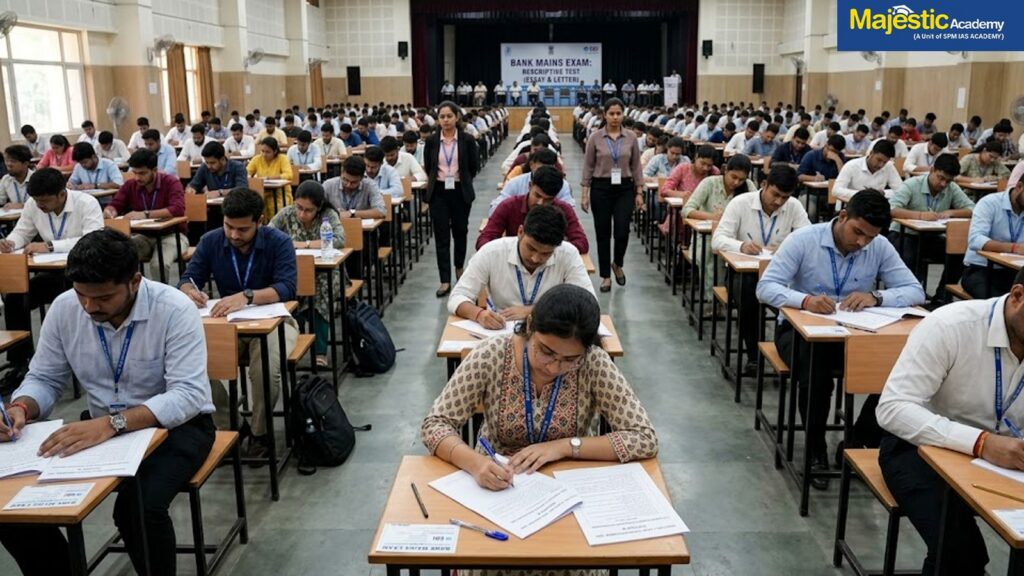
During Weeks 1 and 2, focus mainly on format mastery rather than content. If you still have to think about the structure while writing the exam, you will lose valuable time. Therefore, make the basic formats automatic before moving towards intensive writing practice. For candidates preparing for banking exams, structured guidance and regular practice can make this process easier. You can also explore Bank Online Coaching to access exam-focused learning resources, practice tests, and guidance for your banking exam preparation.
What Should You Cover in Weeks 1–2?
Essay structure:
- Introduction of around 40–50 words
- Body paragraph 1
- Body paragraph 2
- Conclusion
- Use active voice and formal connectors
- Avoid contractions
- Practice three essays every week, covering different topic categories
Letter and email formats:
- Formal letter: Sender’s address, date, receiver’s designation, subject, salutation, body, and closing
- Informal letter: Address, salutation, body, and closing
- Email: To/Subject header, formal salutation, purpose-focused body, and sign-off
By the end of Week 2, you should be able to reproduce the required format without stopping to remember what comes next. That automatic recall forms the first stage of descriptive paper writing for banking.
How Can You Build Topic Knowledge During Weeks 3 and 4?
Once your format becomes comfortable, move towards topic knowledge and writing speed. This stage helps you build a mental collection of ideas that you can use quickly during the examination. One simple daily habit can make a difference. Read one editorial from The Hindu or Business Standard each morning. After reading it, spend five minutes creating a three-point outline:
Problem → Cause → Solution
Do not write a complete essay every day. Instead, train yourself to identify the main issue, understand its causes, and think of practical solutions. This habit gradually makes descriptive paper writing for banking easier because you no longer have to create every argument from scratch during the exam.
How Should You Practice the Full Paper in Weeks 5 and 6?
Timed practice is one of the most important parts of preparation, yet many candidates skip it.
Knowing how to write an essay is different from writing one within 18 minutes while also completing a letter or email. Therefore, you must practice the complete paper under realistic time conditions.
What Is the 30-Minute Simulation Method?
Run this simulation at least twice a week during Weeks 5 and 6.
| Task | Target Time | Target Words |
| Essay planning | 2 minutes | — |
| Essay writing | 16 minutes | 220–245 |
| Letter/email planning | 1 minute | — |
| Letter/email writing | 9 minutes | 160–185 |
| Proofreading | 2 minutes | — |
| Total | 30 minutes | — |
The simulation also helps you identify your personal weaknesses. You may discover that you spend too much time on the essay, struggle to write a strong conclusion, or lose track of letter format when you rush. For a more structured approach to improving your English skills, you can follow these useful strategies for English Preparation for Banking Exams and work on the areas where you need the most improvement.
Finding that problem during practice is far better than discovering it inside the examination hall.
Which Essay Topics Should You Prepare?
Banking descriptive papers generally connect essay topics with current affairs, the economy, banking, and governance.
Therefore, build your preparation around areas such as the following:
- Banking and financial sector reforms
- Digital banking and FinTech
- Indian economy and the Union Budget
- Inflation, GDP, and employment
- Financial inclusion and Jan Dhan Yojana
- Climate change and sustainable finance
- Artificial intelligence in banking
- Cybersecurity and digital fraud
Most importantly, do not prepare these subjects only as isolated facts. Understand the issue, its advantages and disadvantages, its impact, and possible solutions. Current-affairs-based preparation gives you useful examples that can strengthen your arguments.
What Structure Should You Follow for a High-Scoring Essay?
A good essay should have a clear beginning, logical development, and meaningful ending.
1. How Should You Write the Introduction?
Keep the introduction around 20–30% of the essay.
You can:
- Define the topic.
- Mention recent data, reports, or developments.
- Introduce the central issue.
- Create a clear direction for the essay.
Keep it precise. Avoid spending too many words before reaching the main argument.
2. What Should You Include in the Body?
The body should form around 50–60% of the essay.
Depending on the topic, discuss:
- Causes
- Impact
- Advantages
- Challenges
- Relevant facts
- Examples
- Government schemes
Arrange the ideas in separate paragraphs so that the reader can follow your argument easily.
3. How Should You End the Essay?
The conclusion should cover around 15–20% of the essay. Briefly bring together the major points, then suggest a practical way forward. Finally, end with an optimistic or analytical thought. A conclusion should not introduce an entirely new argument. For students and aspirants interested in understanding career opportunities in the banking sector, exploring Banking Compliance Jobs can provide useful insights into the career scope, required skills, and growth opportunities in this field.
This three-part structure is an essential part of descriptive paper writing for banking because it keeps your answer organized and easy to evaluate.
Which Mistakes Should You Avoid in Descriptive Writing?
Even strong candidates can lose marks because of avoidable writing mistakes.
The most common problems include:
- Irrelevant content
- Poor paragraphing
- Repetition of ideas
- Spelling mistakes
- Punctuation errors
- Exceeding the time limit
Therefore, proofreading should become part of your preparation rather than something you remember only on exam day.
Even two minutes of checking can help you identify obvious grammar, spelling, and formatting mistakes.
How Can You Follow a 30–40 Minute Daily Practice Plan?
You do not need to spend several hours every day on descriptive preparation. A focused 30–40-minute routine can provide regular practice.
| Activity | Time |
| Read editorials from The Hindu / Indian Express | 10 minutes |
| Note important banking terms | 5 minutes |
| Write one essay on alternate days | 15 minutes |
| Practice RC answers | 10 minutes |
On days when you do not write an essay, you can use those 15 minutes for letter or email practice. The important thing is to maintain consistency.
Which Resources Can Help With Descriptive Preparation?
Use resources that provide reliable information rather than collecting too many books and PDFs.
Useful sources include:
- RBI Annual Report
- Economic Survey
- Union Budget and Ministry of Finance releases
- Monthly Banking Awareness PDFs
- Editorials from reputed newspapers
- Previous-year IBPS PO descriptive papers
Use these sources to build both your knowledge and your examples. Do not try to memorise entire articles. Instead, note important facts, schemes, terms, and arguments that you can use naturally in your answers.
Conclusion
Descriptive preparation becomes much easier when you stop treating it as an activity that can be mastered through last-minute practice. With regular reading, focused writing, proper evaluation, and repeated timed practice, you can improve both your speed and clarity. The key to descriptive paper writing for banking is simple: understand the topic, organize your ideas, write clearly, and manage your time wisely.
Frequently Asked Questions
Is there a sectional cut-off for the descriptive paper?
Yes. Candidates generally need to score above a minimum qualifying mark to clear the descriptive section. The exact requirement can vary by examination, category, and notification, so always check the official exam notification.
Will my descriptive paper be evaluated if I fail the objective test?
No. The descriptive section is generally evaluated only after the candidate clears the applicable sectional and overall qualifying requirements in the objective examination.
What are the most common topics asked in the essay section?
Topics generally cover banking reforms, digital currency, financial inclusion, artificial intelligence in finance, and major socio-economic government schemes. Current developments in the economy and banking sector are also important.
Sources

Majestic Academy is a trusted coaching institute offering result-oriented SSC Coaching, Banking Coaching, and ADRE Coaching for competitive exam aspirants. Serving students across Guwahati and Assam, we provide structured preparation with expert faculty, updated study materials, and regular mock tests. Our specialized RRB Coaching in Guwahati helps railway exam candidates build strong fundamentals and gain exam confidence. We also offer focused TET Coaching in Guwahati for aspiring teachers with concept-based learning and exam-oriented guidance. At Majestic Academy, we are committed to quality education, clear mentoring, and consistent student success.