
India’s legacy on the global stage is often described through the achievements of its Nobel Prize winners. From literature and physics to peace and economics, Indian laureates have left a remarkable mark on the upliftment of humanity. Their pioneering contributions not only earned them international recognition but also highlighted India’s intellectual, cultural, and humanitarian spirit. In this article, we’ll discuss the complete list of Nobel Prize winners from India, their achievements, and their lasting impact on the world. For students preparing for competitive examinations, knowledge of Nobel Prize winners and other important personalities is an essential part of General Knowledge and Current Affairs. To strengthen your preparation and access educational content on various subjects, visit Majestic Academy at where you can find useful study materials and exam-related resources.
Exam Relevance
The list of Nobel Prize winners from India (1913–2024) is highly relevant for Banking, SSC, Railways, ADRE, Assam TET, DME, and other Assam government exams, as it directly falls under Static GK and Current Affairs. Questions often appear on Nobel laureates, their fields, andtheir achievements in the General Awareness/GK sections. In Assam state-level exams, they are asked to test awareness of India’s contributions in literature, science, peace, and economics. Keeping track of the latest Nobel Prize winners, especially Indians or those of Indian origin, is crucial since such questions are frequently repeated in competitive exams.
India and the Nobel Connection
The Nobel Prize, one of the most prestigious international awards, celebrates excellence in fields such as Physics, Chemistry, Medicine, Literature, Peace, and Economics. Since 1913, India has produced 12 Nobel Prize winners—five Indian citizens and seven of Indian origin or residency. From Rabindranath Tagore, the first Asian laureate, to Abhijit Banerjee, who reshaped the fight against global poverty, these personalities represent India’s diverse intellectual landscape.
Understanding the achievements of Nobel Prize winners requires dedication, discipline, and a strong learning mindset. Similarly, candidates preparing for competitive government examinations must follow a structured preparation strategy and understand the selection process thoroughly. For aspirants looking to join the Assam Police force, it is important to know the complete SLPRB Assam Exam Pattern 2025, including details about the Written Test, PET, PST, and Viva stages. A clear understanding of the exam structure helps candidates prepare more effectively and improve their chances of success.
Rabindranath Tagore – Literature (1913)
The journey of Indian Nobel laureates began with Rabindranath Tagore, fondly called the Bard of Bengal. He became the first non-European and the first Asian Nobel laureate when he won the Nobel Prize in Literature in 1913. His collection Gitanjali was praised for its deeply sensitive and lyrical poetry. Tagore’s contributions were not limited to literature—he also composed India’s national anthem, “Jana Gana Mana.” His work bridged Eastern and Western thought, inspiring generations worldwide.

Sir C.V. Raman – Physics (1930)
Next came Sir Chandrashekhar Venkata Raman, who brought glory to India with his pioneering discovery known as the Raman Effect. He received the Nobel Prize in Physics in 1930 for his scientific discovery of the Raman Effect, which is the phenomenon of scattering of light, where the wavelength of a small fraction of scattered light changes when it passes through a transparent medium. This discovery provided direct evidence of the quantum nature of light and molecular vibrations, and it became a powerful tool for studying molecular structures, today widely used in Raman spectroscopy.

Har Gobind Khorana – Medicine (1968)
Born in Punjab, Har Gobind Khorana shared the 1968 Nobel Prize in Physiology or Medicine with Marshall Nirenberg and Robert Holley for their interpretation of the genetic code. Khorana was the first scientist to successfully synthesize a biologically functional artificial gene in the laboratory in 1970, laying the foundation for modern genetic engineering and biotechnology.

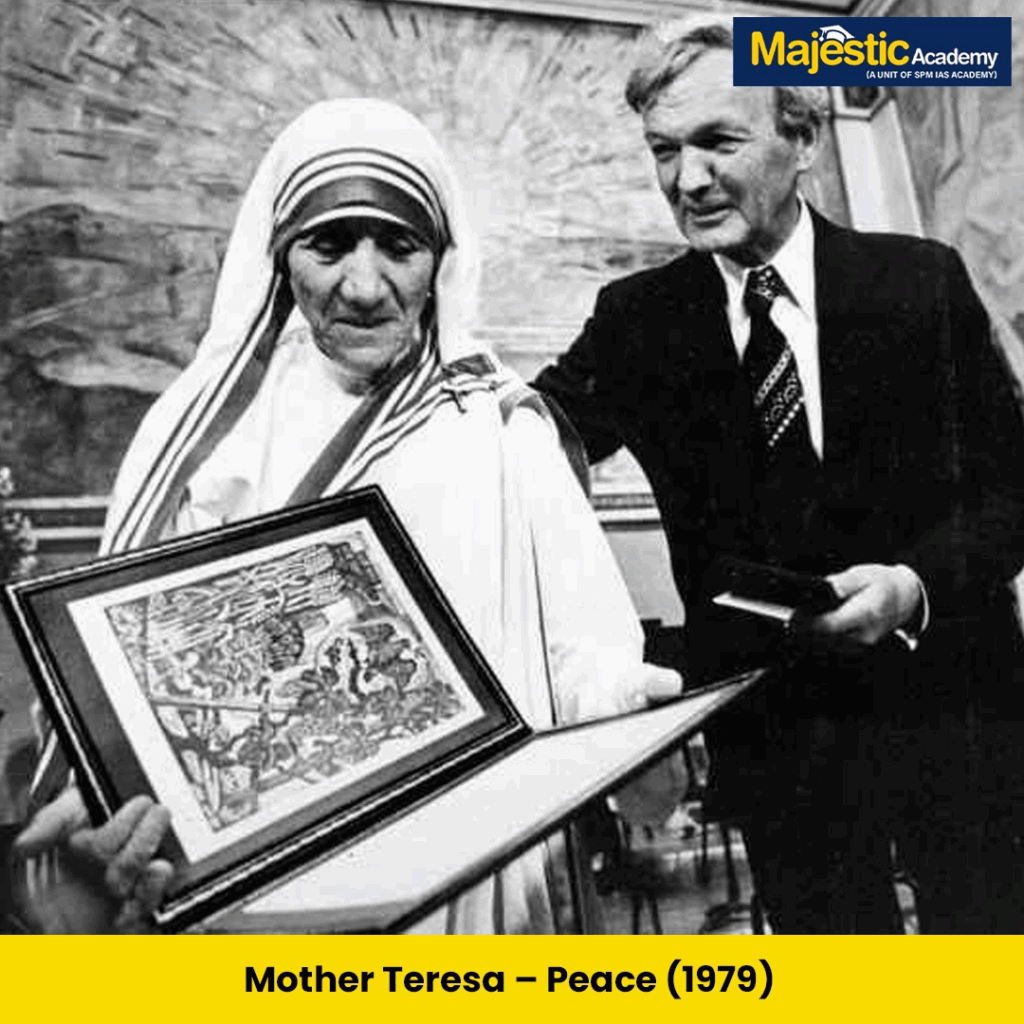
Mother Teresa – Peace (1979)
Known globally as the Saint of Calcutta, Mother Teresa won the Nobel Peace Prize in 1979 for her tireless humanitarian work. She dedicated her life to serving the poor through the Missionaries of Charity. Her legacy continues to inspire compassion and service across the world, making her the only woman Nobel laureate linked to India.
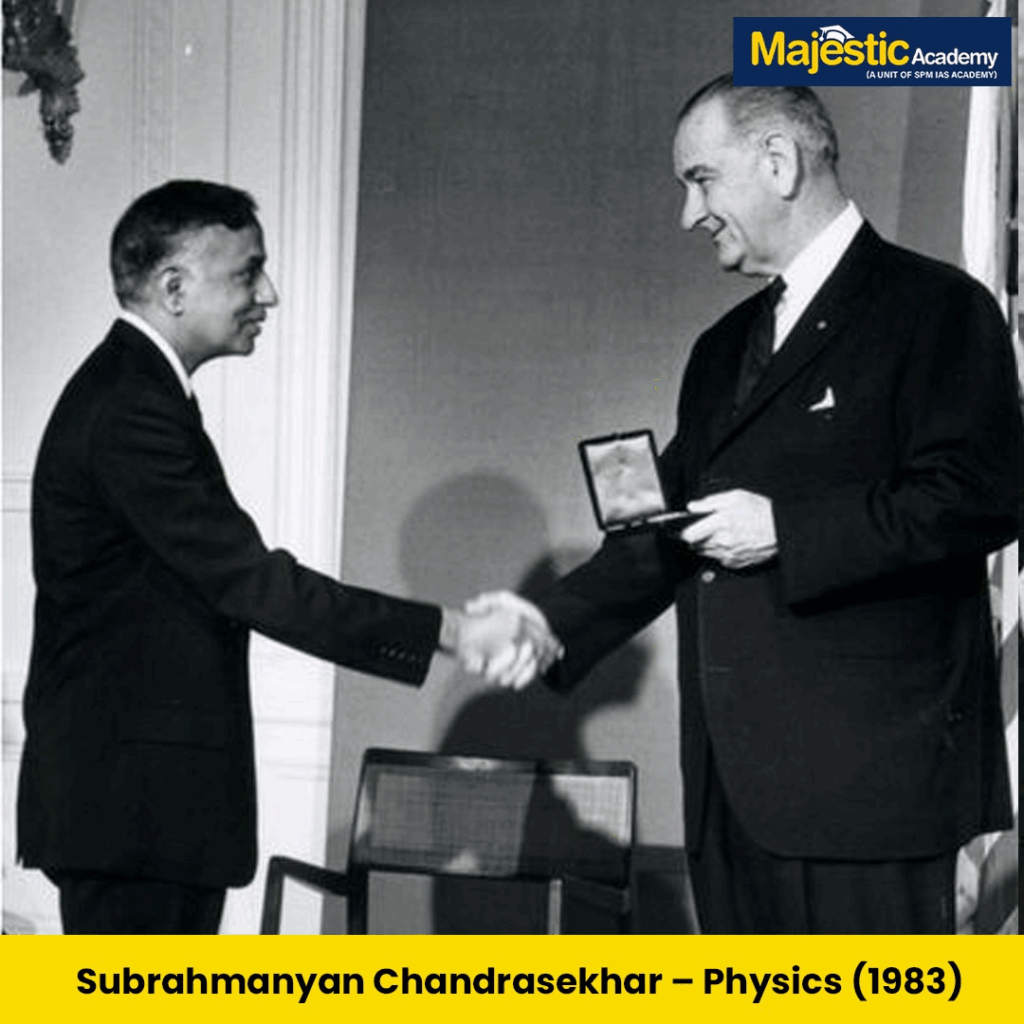
Subrahmanyan Chandrasekhar – Physics (1983)
Subrahmanyan Chandrasekhar, an Indian-American astrophysicist and nephew of C.V. Raman, received the Nobel Prize in Physics in 1983 for his studies on the structure and evolution of stars. His theory on the “Chandrasekhar Limit” explained how stars evolve into white dwarfs or collapse into black holes—an idea that revolutionized astrophysics.
The 14th Dalai Lama – Peace (1989)
Although born in Tibet, the 14th Dalai Lama has lived in exile in Dharamshala, India, since 1959. Awarded the Nobel Peace Prize in 1989, he was recognized for his non-violent struggle for Tibet’s liberation and his message of peace, compassion, and human rights. His teachings continue to inspire people worldwide.

Amartya Sen – Economic Sciences (1998)
The 1998 Nobel Prize in Economics was awarded to Amartya Sen for his pathbreaking work in welfare economics. His “capability approach” provided a new way of understanding poverty, inequality, and human development. Born in Bengal, Sen’s research has influenced global policies on development, justice, and social welfare.

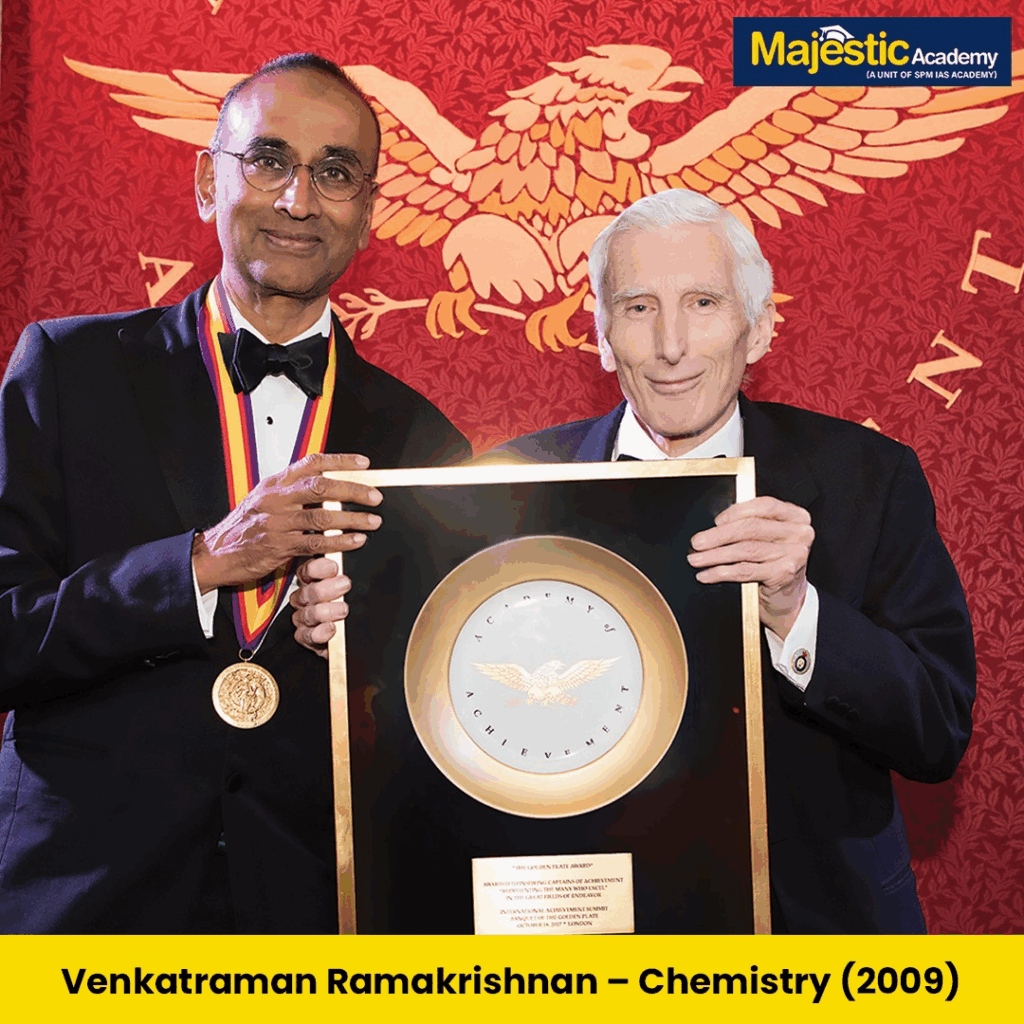
Venkatraman Ramakrishnan – Chemistry (2009)
In 2009, Venkatraman Ramakrishnan, a structural biologist from Tamil Nadu, won the Nobel Prize in Chemistry for his work on ribosomes—the protein factories of cells. His research helped explain how genetic information is translated into proteins, advancing medicine and biology.
Kailash Satyarthi – Peace (2014)
Kailash Satyarthi, an Indian child rights activist, was honored with the 2014 Nobel Peace Prize for his fight against child labor and his advocacy for children’s right to education. He shared the award with Malala Yousafzai, creating a powerful symbol of South Asian commitment to children’s welfare.

Abhijit Banerjee – Economic Sciences (2019)
Economist Abhijit Banerjee, along with Esther Duflo and Michael Kremer, received the 2019 Nobel Prize in Economics for their innovative experiments in uplifting poverty. Their randomized controlled trials transformed the way governments and organizations tackle poverty worldwide. Banerjee, who studied in Kolkata, continues to inspire young economists globally.

Notable Mentions: Gandhi and Aurobindo
It’s worth noting that Mahatma Gandhi, despite being nominated five times for the Nobel Peace Prize, never received it—a fact later described by the Nobel Committee as one of their greatest oversights. Similarly, Sri Aurobindo was nominated for both Literature and Peace but did not win.

Impact and Legacy of Indian Nobel Laureates
The influence of Indian Nobel Prize winners extends beyond their individual achievements:
- Science & Discovery: From Raman’s optics to Ramakrishnan’s ribosome research.
- Peace & Compassion: From Mother Teresa to Kailash Satyarthi and the Dalai Lama.
- Economics & Social Justice: From Amartya Sen’s welfare economics to Abhijit Banerjee’s poverty solutions.
- Culture & Literature: Rabindranath Tagore’s poetry bridged East and West.
These laureates are more than just award winners—they are torchbearers of India’s intellectual and humanitarian values.
Summary
From Tagore’s poetry in 1913 to Banerjee’s fight against poverty in 2019, Indian Nobel Prize winners have showcased brilliance across literature, science, peace, and economics. They remind us that true greatness lies not only in individual achievement but also in uplifting humanity. As India continues to invest in education, research, and innovation, the story of Nobel laureates from India is far from over. The future holds the promise of many more shining stars who will continue this remarkable legacy.